The Video Signal technical video digests

· 31:16

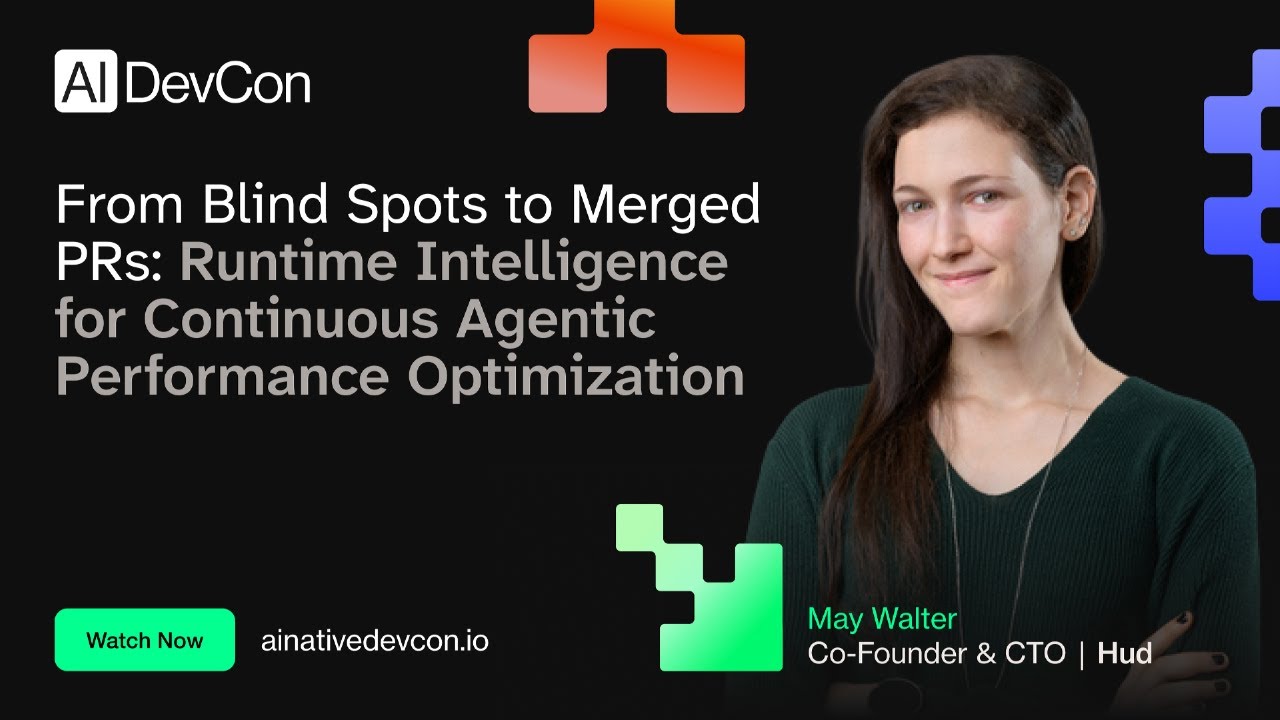
May Walter - From Blind Spots to Merged PRs: Runtime Intelligence for Continuous Agentic Performance

The talk details implementing a runtime intelligence layer for coding agents to enable continuous performance optimization in mature codebases. The approach moves beyond reactive bug fixing by running sensors in production to capture deep forensic context (e.g., function execution frequency, failure modes). This allows agents to proactively surface high-ROI fixes—such as N+1 queries or missing database indexes—scored by complexity and impact, enabling tech leads to prioritize improvements before sprint planning.

Key takeaways

  1. Automating the Investigation Phase 17:52

    Instead of waiting for performance degradation to become a crisis (a 'leaky bucket' problem), the goal is to automate the investigation phase. This allows teams to identify potential optimizations and their estimated impact/cost without dedicating unpredictable engineering time.

  2. Prioritizing Impact over Task Completion 25:30

    The focus shifts from merely generating pull requests (PRs) to identifying the highest impact, lowest risk changes. The system must provide human-readable context that justifies attention, preventing 'PR fatigue' from agents.

  3. Defining Business Context 22:00

    Effective agentic workflows require more than just code analysis; they need business context. The system must map production activity (endpoints, event consumers) to function-level context to understand the true impact of a potential fix.

Watch on YouTube Full article

· 8:51

Get started with the Interactions API

The Interactions API is now generally available and serves as a unified interface for interacting with various Gemini models and agents. It simplifies complex interactions—ranging from synchronous model calls to multi-step agent workflows in remote environments—by providing a single API endpoint. The API supports stateful operations by allowing users to pass the previous interaction ID, enabling iterative refinement of outputs (e.g., image editing) without re-uploading source data.

Key takeaways

  1. Unified Model Access 0:10

    The Interactions API provides easy access to all Gemini models and agents through a single interface, simplifying development across various Google AI capabilities.

  2. Stateful Interactions 4:05

    The API is stateful; developers can pass the previous interaction ID to build upon prior results, which is crucial for iterative processes like image editing or complex data processing.

  3. Advanced Capabilities 0:18

    New features include managed agents, background execution tool improvements, Deep Research, and media generation (e.g., Nano banana for images, Lyriq 3 for music, TTS for speech).

Watch on YouTube Full article

· 34:23

Stanford MS&E435 Economics of the AI Supercycle | Spring 2026 | Economics of Generative AI

This lecture analyzes the economic structure of the Generative AI supercycle, arguing that the industry's value accrual is highly concentrated in the hardware and infrastructure layers (Semis). The speaker introduces a model—an inverted triangle—to contrast the current AI ecosystem with previous tech cycles (Internet, Mobile, Cloud). Key insights focus on the shift from software-driven marginal cost near zero to an inference workload that requires significant GPU burn. The lecture emphasizes understanding hyperscaler CapEx guidance and the competitive dynamics between training and inference workloads.

Key takeaways

  1. AI Value Accrual is Concentrated in Semis 23:49

    The most profitable part of the stack, by a wide margin, is the Semiconductors (Semis) layer. The speaker notes that while Application Layer revenues are estimated between 0% and 30% gross margin, data center revenues from chip providers like NVIDIA can reach around 75% gross margin.

  2. The AI Ecosystem is Modeled as an Inverted Triangle 18:16

    Unlike the Cloud ecosystem, which followed a pyramid shape, the current AI market structure is modeled as an inverted triangle. This suggests that value creation is currently bottlenecked by hardware capacity and compute power.

  3. Inference vs. Training Workloads 26:12

    The economics are shifting toward inference, which involves burst usage (unlike the predictable high utilization of training). The speaker notes that understanding the share of inference in a hyperscaler's fleet is critical for predicting future market dynamics.

  4. Monetization Challenge for Consumer AI 30:42

    The primary economic challenge for consumer AI applications (like ChatGPT and Gemini) is scaling monetization. The current model shows a low revenue per user ($10/user/year for ChatGPT), necessitating a shift toward ad-based models or achieving mandatory utility status to reach the $100/user/year mark.

Watch on YouTube Full article

· 49:13

Stanford MS&E435 Economics of the AI Supercycle | Spring 2026 | Applications, AI in Life Sciences

The discussion details how Artificial Intelligence is poised to fundamentally transform drug discovery and life sciences R&D by creating an end-to-end acceleration platform. Speakers from Anthropic and Chai argue that AI models (like Claude and specialized foundation models) can dramatically compress the current 10–15 year timeline for drug development, addressing bottlenecks in target identification, molecular design, clinical trials, and regulatory processes. The value is shifting from merely selling drugs to building scalable, integrated AI tools and platforms.

Key takeaways

  1. AI Accelerates Drug Development Timelines 23:49

    The current median time for drug development (from idea to market) is 10–15 years. AI has the potential to compress this timeline, with estimates suggesting a reduction to the five-year range or less by optimizing preclinical and clinical phases.

  2. Value Shifts from Drugs to Tools 36:00

    The industry value is expected to shift from traditional drug sales (revenue stream) to the tools, platforms, and foundational models that enable discovery. This makes tool developers highly valuable.

  3. AI's Role in Molecular Design 17:22

    Companies are building Computer-Aided Design (CAD) suites for molecules, aiming for 'zero shot' drug design—the ability to generate patient-ready molecules directly from the computer, bypassing much of the traditional trial-and-error process.

  4. The Platform Approach 20:40

    Anthropic's vision is to train Claude for end-to-end life science R&D acceleration, covering basic research, drug development, clinical trials, and regulatory strategy (e.g., designing clinical protocols).

Watch on YouTube Full article

· 8:53

Antigravity Arcade: From prompt to game in minutes

The video details 'Antigravity Arcade,' a system that leverages AI skills and workflows to allow users to generate functional web games from simple ideas without writing code. The solution covers both the front-end game generation process—which enforces visual consistency using specialized AI skills (e.g., ensuring retro aesthetics, handling physical input)—and a robust back-end deployment pipeline for hosting these user-generated games on physical arcade cabinets.

Key takeaways

  1. AI-Powered Game Generation 3:30

    Antigravity uses modular 'skills' to guide the AI agent, preventing context window bloat and ensuring adherence to organizational best practices (e.g., consistent retro aesthetic, specific key mappings) when generating game code.

  2. Consistent Development Workflow 4:13

    The project enforced consistency by using a starting template built with Phaser JS's game engine, which included skills for visual guidelines (black background, CRT shader) and input handling to ensure cross-platform compatibility.

  3. Secure Deployment Pipeline 6:45

    A custom deployer CLI tool handles the deployment of user code to physical arcade cabinets. This process uses a Unix setuid model API to securely read sensitive API tokens without exposing them to the end-user or agent, followed by Cloud Run validation and GCS storage.

  4. Automated Game Moderation 8:02

    Upon successful upload, an Eventarc trigger spins up a Cloud Run function that validates the game. If approved, Firestore increments a counter, issuing a sequential ID for moderation via a web app.

Watch on YouTube Full article

· 12:08

Codex vs Fable: Which AI Agent Picked the Better Problem?

The video compares two advanced AI agents, Codex and Fable, on an open-ended challenge: identifying and automating a high-leverage problem within a business process. The core finding is that while both agents successfully generated automation ideas, Fable demonstrated superior strategic thinking by identifying a more impactful pain point (pre-pipelining ideas). However, the speaker emphasizes that the true breakthrough is not just the AI's ability to suggest a problem, but the development of an advanced 'auto magic button' skill. This skill allows users to guide the AI to audit complex business processes across multiple data sources and build a complete, secure automation solution.

Key takeaways

  1. AI Agents Must Pick the Problem

    The challenge for modern AI agents is moving beyond simply executing a given prompt or tool. The goal is to have the agent inspect a user's entire workflow (e.g., local files, Slack) and autonomously define the most valuable problem requiring automation.

  2. Codex vs. Fable Performance 7:00

    Codex was noted for being fast, dependable, and completing tasks successfully by picking a bounded, safe problem (e.g., improving handoff packages). Conversely, Fable demonstrated superior strategic sense, identifying a higher-leverage opportunity related to pre-pipelining ideas.

  3. The Need for Strategic Automation Skills 11:20

    To solve the 'open claw problem' (knowing what automation is needed), a specialized skill is required. This skill guides the AI to audit complex business processes, understand multiple levels of causation, and recommend not just a fix, but a complete, secure tool.

Watch on YouTube Full article

· 39:02

Thinking Machines Lab drops Inkling & Meta’s Muse Spark 1.1

The AI landscape is shifting its focus from pure benchmark performance to customizable intelligence and architectural efficiency. This analysis covers three major model releases: Thinking Machines' open-weight Inkling (emphasizing customization via fine-tuning), Meta’s Muse Spark 1.1 (targeting cost-efficient agent workloads for enterprise use), and OpenAI's GPT-5.6 Sol, which showed progress on the challenging ARC-AGI-3 benchmark. Furthermore, Anthropic's J-space paper introduces a novel method to view internal model processing, offering potential new avenues for AI safety and control in agent development.

Key takeaways

  1. Shift from Benchmarks to Customization

    The industry debate is moving away from which closed model is the 'best' toward utilizing open base models combined with robust fine-tuning platforms (e.g., Inkling/Tinker API) for tailored, customizable intelligence.

Watch on YouTube Full article

· 36:51

Daniel Jones & Tomasz Maj - More software, faster - Odevo's AI Native transformation - AI DevCon '26

Odevo details its AI-native transformation journey, moving from a highly heterogeneous tech landscape across multiple acquisitions and time zones. The core message is that adopting generative/agentic coding practices requires more than just providing licenses; it demands fundamental improvements in organizational processes, including robust CI/CD pipelines, standardized coding guidelines, and cultural shifts toward 'boldness' and experimentation. By systematizing training and focusing on failure modes, Odevo achieved significant metrics increases, such as 94% AI adoption among developers.

Key takeaways

  1. AI Adoption Requires Process Maturity 20:03

    Adopting agentic coding is not simple. Success hinges on foundational elements like having a reliable CI/CD platform, standardized coding practices, and comprehensive testing protocols. Without these fundamentals, generating code quickly will only expose bottlenecks elsewhere.

  2. The Importance of Discovery and Workshops 23:50

    Successful AI transformation requires a 'discovery' phase to understand the current state (the 'lay of the land') and using workshops (e.g., employing techniques like TRIZ) to address employee fears, reduce hesitancy, and build consensus on necessary improvements.

  3. Focus on Failure Modes 27:10

    Training should not focus only on the 'happy path.' It is crucial to teach developers about failure modes (e.g., context management, hallucination) and how agents operate in complex environments.

  4. The Biggest Impact is Boldness 32:10

    The most significant outcome of the AI transformation was not just increased efficiency but a cultural shift toward 'boldness'—the willingness to try ambitious, end-to-end agentic workflows and rewrite large systems quickly.

Watch on YouTube Full article

· 1:52

What are the new features in Android Studio Quail 2?

Android Studio Quail 2 introduces significant updates aimed at unifying and accelerating the development and debugging cycle. Key enhancements include parallel multitasking for agentic tasks via Gemini, direct integration of Leak Canary into the Android Studio profiler for faster memory leak detection, and integrating App Quality Insights to analyze production crashes, suggest fixes across multiple files, and deploy those fixes for verification.

Key takeaways

  1. Multitasking with Parallel Agents

    The Gemini app agent mode has been redesigned to allow users to initiate, run, and manage multiple agentic tasks simultaneously across different chats, eliminating the need to wait for one task to complete before starting another.

  2. Built-in Memory Leak Detection

    The Leak Canary library is now built directly into the Android Studio profiler. This streamlines memory leak detection, making it faster and easier to identify issues without slowing down test devices.

  3. App Quality Insights Integration

    Android Studio can now analyze production crashes using App Quality Insights. It has the ability to fix complex, multi-file crashes and deploy those fixes to an emulator for verification.

Watch on YouTube Full article

· 1:41:04

🔬 RL with Verifiable Rewards, but the Verifier is a Lab — Lila Sciences

Lila Sciences proposes that the next frontier of data generation—the 'next internet-scale dataset'—will come from running the scientific method as a closed-loop Reinforcement Learning (RL) process. The wet lab acts as the verifier and data source for training general AI models. This approach aims to create an 'infinite token generator' by synthesizing knowledge across biology, chemistry, and materials science into a single reasoning model, which is then offered via a scalable 'zero-FTE startup' platform.

Key takeaways

  1. The Lab as Data Center 20:30

    The future scientific facility must function like a data center, prioritizing dense packing and energy efficiency. The infrastructure uses planar motor systems and a physical transport layer (analogized to a PCI bus) to connect instruments for seamless, automated operation.

  2. Scientific Superintelligence via RL 40:50

    The core thesis is that science can be an 'infinite token generator.' By using the scientific method and nature as verifiers in a closed-loop system, models generate verifiable reasoning tokens (e.g., 10 trillion tokens across multiple domains) that improve general intelligence, proving that 'breadth gives us depth.'

  3. The Zero-FTE Startup Model 1:18:20

    Lila Sciences commercializes its platform by allowing external partners to run entire scientific programs (e.g., CAR-T development or novel material synthesis) over a short period using the model and automated lab infrastructure, without needing to build their own physical facility.

Watch on YouTube Full article

· 31:32

Peter Wilson & Davide Eynard - cq - Stack Overflow for Agents - AI Native DevCon June 2026

The session introduces CQ (Mozilla.ai's proposal), a system designed as a 'Stack Overflow for agents.' Its core purpose is to standardize and share knowledge units (KUs) across autonomous AI agents—locally, within an organization, or publicly. This prevents agents from repeating mistakes, wasting tokens, and ensures that lessons learned by one agent can benefit all others, thereby improving the reliability of complex automated workflows.

Key takeaways

  1. Knowledge Unit (KU) Standardization 17:09

    A KU is a standardized knowledge artifact (stored in JSON format) capturing solutions to novel problems. It includes domains, insights, actions taken, summaries, and metadata (languages/frameworks).

  2. Agentic Context Management 6:15

    Effective agent performance relies heavily on context injection. The system aims to move beyond simple memory files by allowing agents to query a centralized knowledge base for relevant solutions before starting a task.

  3. Layered Sharing Model 20:40

    CQ supports three levels of knowledge sharing: local (SQLite database, no review), private/team (requires user authentication and human-in-the-loop review), and public commons (CQ Exchange).

Watch on YouTube Full article

· 36:00

New Model: Inkling by Thinking Machine on Hugging Face

Thinking Machines announced Inkling, a massive open model with nearly one trillion parameters. It is designed as a natively multimodal architecture, accepting image, text, and audio inputs simultaneously. Key technical features include a Mixture-of-Experts (MoE) structure (975B total / 41B active params), a 1M token context window, and advanced deployment support across multiple frameworks like `transformers`, SGLang, vLLM, and `llama.cpp`. The model is available in BF16 and NVFP4 formats, facilitating high-performance inference on various hardware setups.

Key takeaways

  1. Multimodal Capability & Scale 3:50

    Inkling is a true multimodal model that natively processes image, text, and audio inputs using a single architecture. It boasts an immense 1M token context window and was trained on 45T tokens.

  2. Architectural Innovations 5:10

    The model utilizes relative attention (replacing RoPE) and a specialized SConv layer to efficiently aggregate hidden states, making it highly efficient for multimodal tasks compared to previous models.

  3. Deployment Flexibility 7:10

    Inkling supports multiple deployment paths: BF16 (requiring ~2TB VRAM) and NVFP4 (600GB VRAM). It provides day-zero support for `transformers`, SGLang, vLLM, and `llama.cpp` (including GGUF quants via Unsloth), enabling diverse inference environments.

Watch on YouTube Full article

· 58:17

Omnigent: Composition, Control, and Collaboration for AI Agents

The AI development landscape is shifting from focusing solely on large language models (LLMs) to building sophisticated meta-harnesses and agent frameworks. The core challenge addressed by tools like Omnigent is managing complexity, ensuring model portability, and controlling escalating costs (tokenomics). This architectural shift requires developers to treat agents as stateful systems that rely heavily on external memory (databases) and advanced orchestration patterns like 'debating' or 'forking' conversations to achieve robust results.

Key takeaways

  1. The Meta-Harness Layer 20:40

    Meta-harnesses, such as Omnigent, sit above individual models (e.g., Claude Code, Codex, Pi) and harnesses, allowing developers to compose different components without rebuilding the entire context or workflow.

  2. Agentic Workflow Patterns 6:05

    Advanced agent techniques include having agents debate each other to surface unknown questions, and 'forking' conversations to explore parallel threads while maintaining shared original context.

  3. Tokenomics as DevOps 1:42

    AI spend is repeating the CapEx-to-OpEx shift. Governance must be pushed down to developers (giving them visibility into token usage) while retaining central policies for cost control and approval.

  4. The Importance of State 39:40

    Agents require cheap, stateful memory. This has led to a resurgence in the use of traditional databases like Postgres, Lakebase, and serverless options for persistent context.

Watch on YouTube Full article

· 32:39

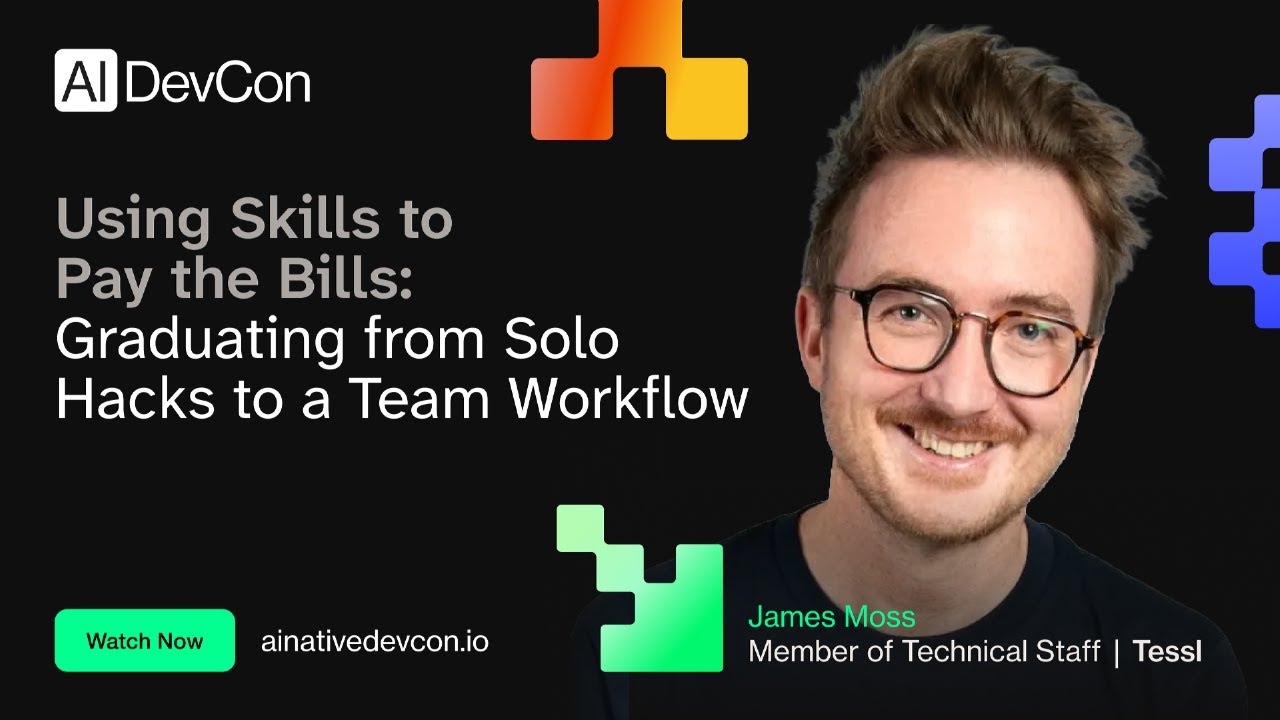
James Moss - Using skills to pay the bills: graduating from solo hacks to a team workflow - DevCon26

The talk addresses the challenge of 'skill sprawl'—the uncontrolled proliferation and management of AI coding agent skills within large organizations. While skills are powerful because they encode domain-specific logic into an agent's context, their current lack of standardized versioning, review, and centralized governance creates significant technical debt. The speaker advocates for treating skills as first-class software assets, requiring dedicated practices like decomposition, mandatory registries, automated reviews, and formal lifecycle management (CDLC) to ensure reliability and scalability.

Key takeaways

  1. Manage Skill Sprawl with a Centralized Registry 17:33

    Due to the low barrier to entry for creating skills, organizations face an 'insane amount' of them (2 million+ on GitHub alone). A centralized registry is crucial for visibility, preventing overlap, and ensuring all teams use approved versions. This also helps mitigate non-technical users needing access without requiring full developer seats.

  2. Adopt the Context Development Life Cycle (CDLC) 27:50

    Just as code requires a Software Development Lifecycle (SDLC), skills and context require their own CDLC. Practices like skill reviews, automated testing, and version control must be applied to maintain quality and prevent 'rot' (skills going out of sync with the codebase).

  3. Decompose Skills for Modularity 20:40

    Instead of creating monolithic skills, break complex functionality into smaller, interconnected plugins. This allows agents to activate specific components and makes the skill set easier to maintain and debug.

  4. Enforce Governance via Registries 22:30

    Using a registry provides a single source of truth, allowing organizations to enforce policies (e.g., 'approved skills only,' minimum release age) and integrate security scanning tools like Snyk.

Watch on YouTube Full article

· 10:52

Reconstructing Pelé’s lost goal

Google DeepMind utilized advanced AI models like Gemini Omni and Veo to reconstruct Pelé's legendary 'Gol da Rua Javari,' a goal scored on August 2, 1959, that was never filmed. The project highlights the use of AI for cultural preservation, combining historical research (period accuracy in uniforms, location, and equipment) with cutting-edge technology. Technical methods included using Gemini Omni to synthesize images from historical fragments and employing a specialized Performance Control Model to transfer motion onto actors, enabling the recreation of the spectacular play as closely as possible.

Key takeaways

  1. The Historical Event

    Pelé scored three consecutive 'sombreros' without the ball touching the ground against Juventus at Rua Javari on August 2, 1959. This goal was never captured on film; only photographs and eyewitness accounts exist.

  2. AI Reconstruction Methodology 4:00

    The project combined historical research with AI to bring the unfilmed moment to life, addressing technical challenges like period accuracy (e.g., heavy leather balls) and motion transfer.

  3. Advanced Motion Modeling 5:20

    To recreate the action, a Performance Control Model was used to transfer motion onto local actors, simulating motion capture without requiring full suits. This allowed for precise reconstruction of the athletic performance.

Watch on YouTube Full article

· 47:39

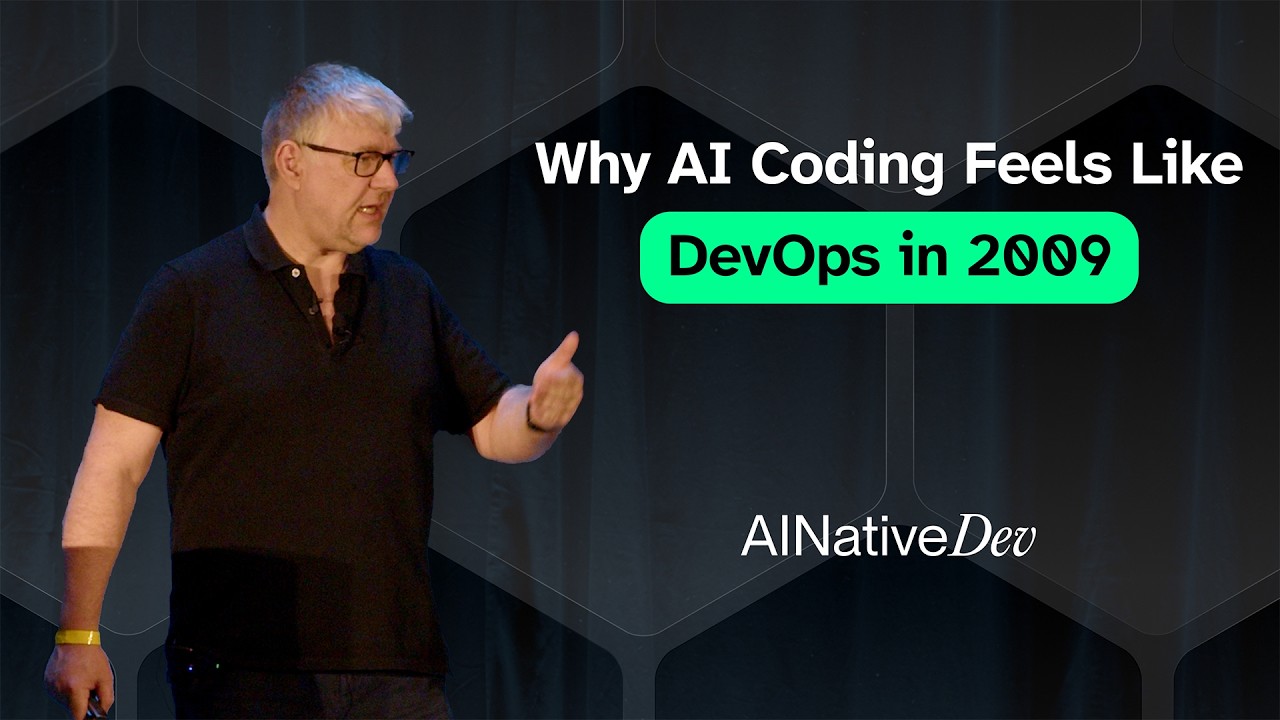
Patrick Debois Maps the Patterns of AI-Native Dev

Drawing parallels between DevOps and AI evolution, Patrick Debois outlines a new socio-technical map for AI-native development. The shift requires organizations to move beyond simple coding capability by mastering structured patterns (Prompting $ ightarrow$ Context $ ightarrow$ Harness $ ightarrow$ Loop Engineering). Success hinges on building shared platforms, optimizing processes through continuous feedback loops, and shifting organizational focus from measuring token usage to improving contributions to shared components.

Key takeaways

  1. AI Maturity is Continuous Exploration 10:36

    Debois argues there is no single 'maturity' point; the field requires constant adaptation across Prompting, Context, Harness, and Loop Engineering. The goal is continuous learning and adapting processes rather than reaching a fixed state.

  2. The Four Layers of AI Enablement 18:39

    AI adoption must be addressed at four levels: Agent enablement (the technology), Team enablement (shared components/libraries), Platform enablement (centralized tools like registries and evals), and Organization enablement (process change).

  3. Shift Measurement from Usage to Contribution

    Effective measurement for AI adoption should focus on how much people are contributing to shared components and fixing the system, rather than solely measuring token usage or license counts. This metric reflects true organizational improvement.

  4. Hiring System Thinkers Over Coders 43:52

    The most valuable skill in the AI era is being a 'system thinker'—someone who cares about architecture and reliability, not just writing elegant code. Adaptability and open-mindedness are paramount.

Watch on YouTube Full article

· 49:44

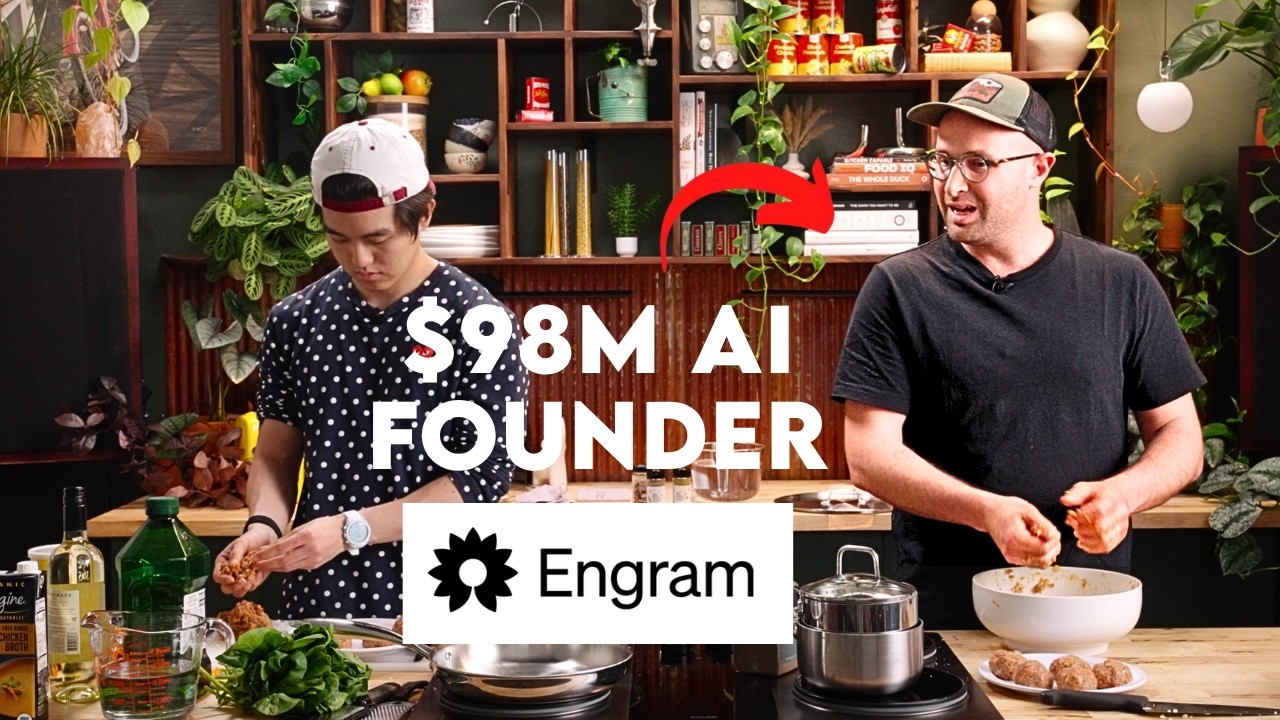
The AI Memory Problem: Why Long Context Isn’t Enough — Dan Biderman, Engram Co-founder & CEO

The talk addresses the limitations of current AI architectures—specifically that simply increasing context window size or relying solely on Retrieval-Augmented Generation (RAG) is insufficient for building truly intelligent, long-horizon agents. Dan Biderman introduces a paradigm shift focusing on 'continual learning' and knowledge compression. Key solutions include using specialized knowledge representations called 'cartridges,' implementing 'test-time training' (or test-time compute), and achieving high token efficiency to enable models to handle the anticipated petabytes of proprietary enterprise data.

Key takeaways

  1. Beyond RAG: The Need for Internalized Knowledge 15:14

    Current methods like RAG are limited because they only provide external, textual context. True intelligence requires embedding knowledge into the model's parameters (weights) to achieve 'intuition,' allowing the model to generalize and extrapolate beyond explicit notes or recipes.

  2. The Problem of Scale: Context Rot and Token Limits 23:30

    As companies accumulate trillions of tokens of proprietary data, simple context management fails due to 'context rot' (the model becoming less accurate the more context it reads) and extreme token consumption. This necessitates methods that are both highly efficient and scalable.

  3. The Solution Stack: Cartridges, Training, and Memory 30:05

    Engram proposes a multi-faceted approach combining knowledge compression via 'cartridges' (compact capsules of knowledge), gradient-based updates during inference ('test-time training'), and advanced memory layers to achieve superior token efficiency and model accuracy.

  4. The Future: Autonomous, Personalized AI

    The ultimate goal is a system where the model autonomously determines what knowledge should be internalized (in weights) versus what should remain external (in text/RAG), creating personalized models that improve continuously with user interaction, similar to nurturing a Tamagotchi.

Watch on YouTube Full article

· 22:25

The DevOps Godfather on AI's "Dark Factory" Problem

Patrick Debois argues that the industry is approaching a 'dark factory' model of autonomous coding agents, mirroring historical skepticism around Continuous Delivery [0:02:51]. He emphasizes that success hinges not on better prompts or larger models, but on fundamentally restructuring teams and platforms. The developer role shifts from solo coder to agent orchestrator, requiring improvements in system-level engineering practices (e.g., building tooling for the agents) rather than just fixing the code produced by the agent [0:09:49]. Scaling this requires platform teams to centralize reusable components like skill registries and guardrails, moving organizations from a 'solo developer' model to a 'multiplayer system' [0:10:53].

Key takeaways

  1. Shift from Coder to Orchestrator 5:21

    The modern developer role evolves into that of an agent conductor or orchestrator, managing and guiding autonomous agents rather than writing all the code themselves. This requires a focus on system improvement over individual code fixes [0:02:51].

  2. Focus on Systemic Improvement 9:49

    The key mentality shift is to stop fixing the agent's output code and instead improve the underlying system, context, and tooling (harnesses/loops) that guide the agents [0:09:49].

  3. Platform Team Centralization 20:53

    To scale autonomous development, platform teams must own centralized components—such as skill registries, guardrails, and reusable harnesses—to prevent organizational sprawl and ensure consistency across teams [0:10:53].

  4. New Productivity Metrics

    Instead of measuring token spend, focus on two metrics: the number of human touches required for the agent to succeed, and the multiplier effect gained when a single system improvement benefits all users/teams [0:14:50].

Watch on YouTube Full article

· 34:18

FORGET Loop Engineering. Agentic Engineering is about THIS

The video argues that 'Loop Engineering' is an insufficient and inaccurate mental model for modern software development with AI agents. The superior approach is **Agentic Engineering**, which focuses on building complex AI developer workflows (ADWs) within a 'software factory.' These ADWs orchestrate three core actors of value creation—Engineers, Agents, and Code—to automate the entire development lifecycle, from planning to deployment, thereby scaling impact and accelerating development far beyond what simple loops can achieve.

Key takeaways

  1. Shift Focus from Loops to Workflows

    Loop engineering is a poor rebrand of the Software Development Life Cycle (SDLC). The focus must be on building comprehensive AI developer workflows that combine code execution with agents, rather than focusing solely on iterative loops.

  2. The Three Actors of Value Creation 2:00

    Successful agentic engineering requires understanding and strategically placing three actors: the human engineer, specialized AI agents, and deterministic code. Code is highlighted as the most reliable actor because it costs zero tokens and runs consistently.

  3. Scaling Developer Workflows 4:00

    Advanced workflows move beyond simple loops by integrating multiple validation steps (e.g., linting, type checking, formatting) and scaling compute through specialized sandboxes for parallel execution. This process is the core of building a 'software factory.'

  4. Meta-Engineering: Building the System 8:00

    The most valuable engineering effort is not working on the application layer, but performing meta-work on the agentic layer—building the system that orchestrates and manages all other components (the 'system that builds the system').

Watch on YouTube Full article

· 35:18

Joseph Katsioloudes - Code Security Reinvented: Navigating the era of AI - AI Native DevCon June 26

AI is revolutionizing code security by helping minimize the gap between developers and dedicated security specialists. While AI tools like GitHub Copilot can significantly improve detection and, more critically, the speed of fixing vulnerabilities (the 'fixing problem'), they are not a replacement for human oversight. Responsible adoption requires utilizing structured protocols like Model Context Protocols (MCPs) and implementing agentic workflows within CI/CD pipelines to ensure deterministic, auditable, and context-aware security checks.

Key takeaways

  1. AI's Role in Security Gap Reduction 18:04

    The primary opportunity is using AI to scale scarce security expertise. While traditional static analysis tools (like CodeQL or Semgrep) are excellent for pattern matching, AI excels at modeling complex behavioral and contextual issues that pass standard checks.

  2. AI Limitations: Hallucinations & Non-Determinism 4:00

    The speaker notes that while AI is powerful, it should not be the sole safety net; good security hygiene remains paramount.

  3. Leveraging MCPs and Skills 22:20

    Model Context Protocols (MCPs) allow AI models to access server-side information from trusted sources (e.g., GitHub Security Lab findings), extending the context beyond narrow training data. Combining MCPs with structured 'skills' ensures that automated fixes are auditable, maintainable, and integrated into development processes.

  4. Agentic Workflows for CI/CD 27:00

    Agentic workflows allow security agents to run on a schedule or trigger automatically. They can perform sophisticated tasks, such as running manual security reviews automated by AI (using quantified knowledge from research) and proposing fixes directly within the Pull Request (PR), accelerating the fix rate.

Watch on YouTube Full article