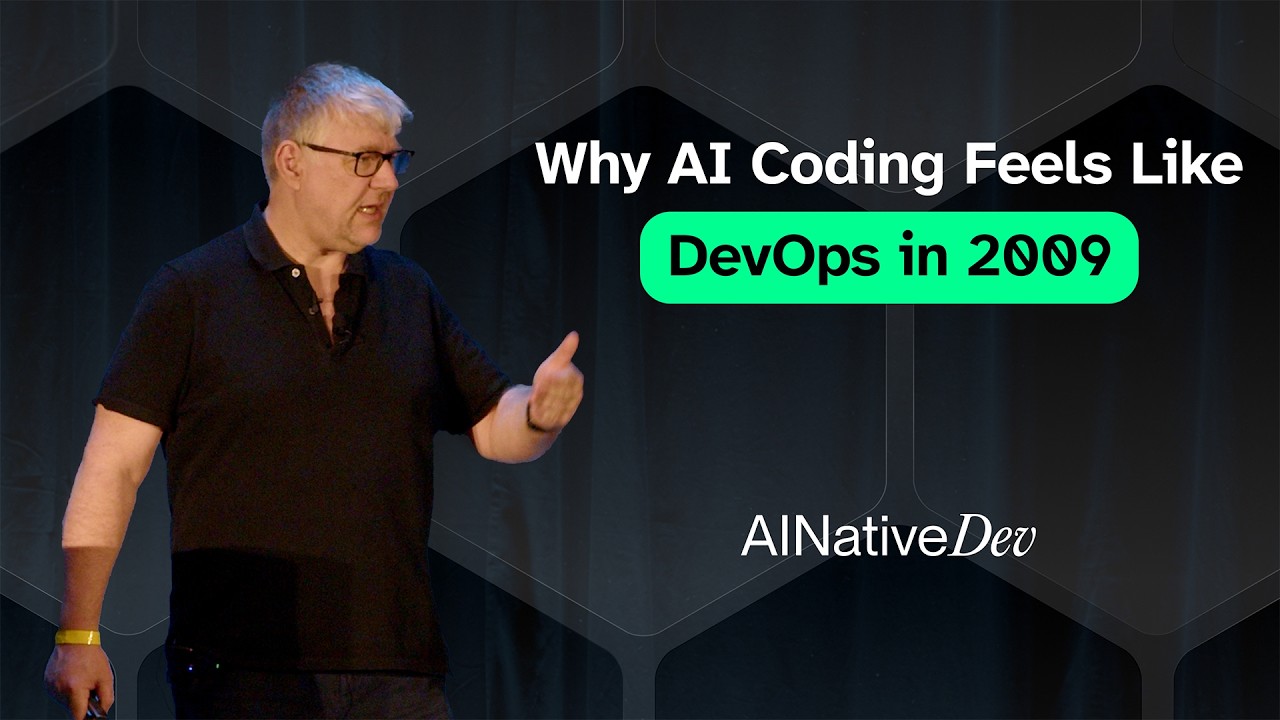
The DevOps Godfather on AI's "Dark Factory" Problem
Patrick Debois argues that the industry is approaching a 'dark factory' model of autonomous coding agents, mirroring historical skepticism around Continuous Delivery [0:02:51]. He emphasizes that success hinges not on better prompts or larger models, but on fundamentally restructuring teams and platforms. The developer role shifts from solo coder to agent orchestrator, requiring improvements in system-level engineering practices (e.g., building tooling for the agents) rather than just fixing the code produced by the agent [0:09:49]. Scaling this requires platform teams to centralize reusable components like skill registries and guardrails, moving organizations from a 'solo developer' model to a 'multiplayer system' [0:10:53].
Key takeaways
-
Shift from Coder to Orchestrator
5:21
The modern developer role evolves into that of an agent conductor or orchestrator, managing and guiding autonomous agents rather than writing all the code themselves. This requires a focus on system improvement over individual code fixes [0:02:51].
-
Focus on Systemic Improvement
9:49
The key mentality shift is to stop fixing the agent's output code and instead improve the underlying system, context, and tooling (harnesses/loops) that guide the agents [0:09:49].
-
Platform Team Centralization
20:53
To scale autonomous development, platform teams must own centralized components—such as skill registries, guardrails, and reusable harnesses—to prevent organizational sprawl and ensure consistency across teams [0:10:53].
-
New Productivity Metrics
Instead of measuring token spend, focus on two metrics: the number of human touches required for the agent to succeed, and the multiplier effect gained when a single system improvement benefits all users/teams [0:14:50].