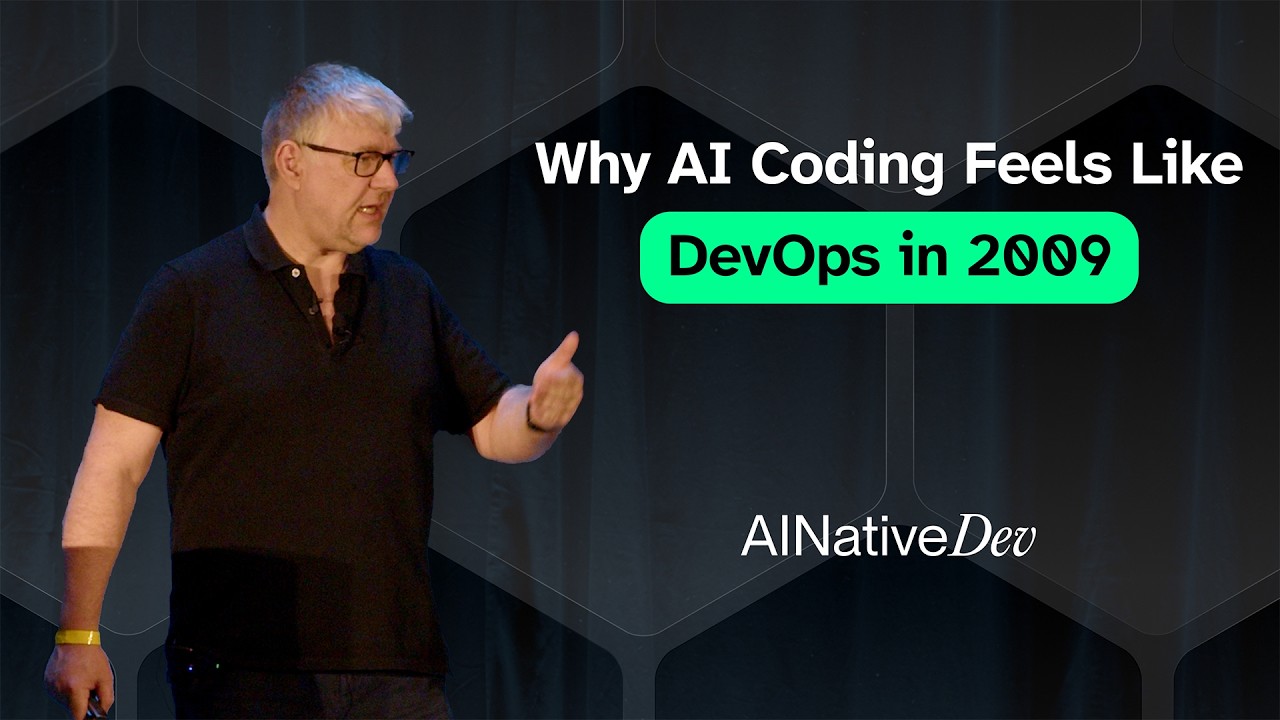
Patrick Debois Maps the Patterns of AI-Native Dev
Summary
Drawing parallels between DevOps and AI evolution, Patrick Debois outlines a new socio-technical map for AI-native development. The shift requires organizations to move beyond simple coding capability by mastering structured patterns (Prompting $ ightarrow$ Context $ ightarrow$ Harness $ ightarrow$ Loop Engineering). Success hinges on building shared platforms, optimizing processes through continuous feedback loops, and shifting organizational focus from measuring token usage to improving contributions to shared components.
Key takeaways
-
AI Maturity is Continuous Exploration
10:36
Debois argues there is no single 'maturity' point; the field requires constant adaptation across Prompting, Context, Harness, and Loop Engineering. The goal is continuous learning and adapting processes rather than reaching a fixed state.
-
The Four Layers of AI Enablement
18:39
AI adoption must be addressed at four levels: Agent enablement (the technology), Team enablement (shared components/libraries), Platform enablement (centralized tools like registries and evals), and Organization enablement (process change).
-
Shift Measurement from Usage to Contribution
Effective measurement for AI adoption should focus on how much people are contributing to shared components and fixing the system, rather than solely measuring token usage or license counts. This metric reflects true organizational improvement.
-
Hiring System Thinkers Over Coders
43:52
The most valuable skill in the AI era is being a 'system thinker'—someone who cares about architecture and reliability, not just writing elegant code. Adaptability and open-mindedness are paramount.

Technical details
-
AI Development Patterns Progression
1119s
The industry narrative for AI coding is progressing through distinct stages: Prompting $ ightarrow$ Context $ ightarrow$ Harness $ ightarrow$ Loop Engineering. This progression requires building technical components to support the increasing complexity of agentic workflows.
-
Platform and Shared Components
1119s
A key enabler for large organizations is the Platform Team, which provides centralized resources such as registries and centralized evaluation (evals) tools, allowing teams to reuse components across the organization.
-
Quality & Security Verification
1814s
As agents automate code generation, the bottleneck shifts to output verification. The IDE is evolving from a coding tool into a review interface, requiring custom tools and processes for robust evaluation (evals) that go beyond simple LLM judging.
-
Cost Management & FinOps
Budget constraints should drive optimization rather than halting usage. Organizations must implement observability for their coding agents to identify inefficient spending patterns, similar to optimizing cloud resources from VMs to instances.
Mentioned resources
Channel & topics
Watch on YouTube · Back to latest
This independent, AI-assisted summary is provided for commentary and informational purposes. It may contain errors or omit important context. Please watch the original video for the creator's complete presentation. Video, thumbnail, and related copyrights belong to their respective owners.