The Video Signal technical video digests

Policy Enforcement and Tamper-Evident Audit Chains | ​Imran Siddique | MCP Release Party - Seattle thumbnail

· 23:32

Policy Enforcement and Tamper-Evident Audit Chains | ​Imran Siddique | MCP Release Party - Seattle

This session introduces cMCP, an open-source gateway designed to enhance Model Communication Platform (MCP) security by enforcing policies and creating tamper-evident audit chains. While existing governance tools like the Agent Governance Toolkit (AGT) manage policy application, cMCP addresses the critical gap of ensuring that the governance mechanism itself—including policies and logs—cannot be tampered with. The solution leverages Confidential AI principles, running core components within hardware enclaves to guarantee verifiability for regulated industries.

Key takeaways

  1. Beyond Governance: Verifiable Trust 17:22

    The focus is shifting from merely having policies (governance) to proving that the governance itself has not been tampered with. This requires bringing critical elements into a confidential enclave, ensuring verifiable audit trails and policy integrity.

  2. cMCP Gateway Functionality 6:30

    cMCP acts as an open-source gateway wrapping any MCP server without requiring changes to the underlying system. It enforces policies (like Cedar) before every tool call and chains all actions into a tamper-evident record.

  3. Standardized Audit Trail (Trace) 12:10

    The concept of 'Trace' is being standardized to provide an absolute, verifiable record of system state, including the model ID, policy hash, machine state, and all actions taken. This verification relies on hardware guarantees.
Watch on YouTube Full article

How To Turn Evals Into A Better Model thumbnail

· 35:46

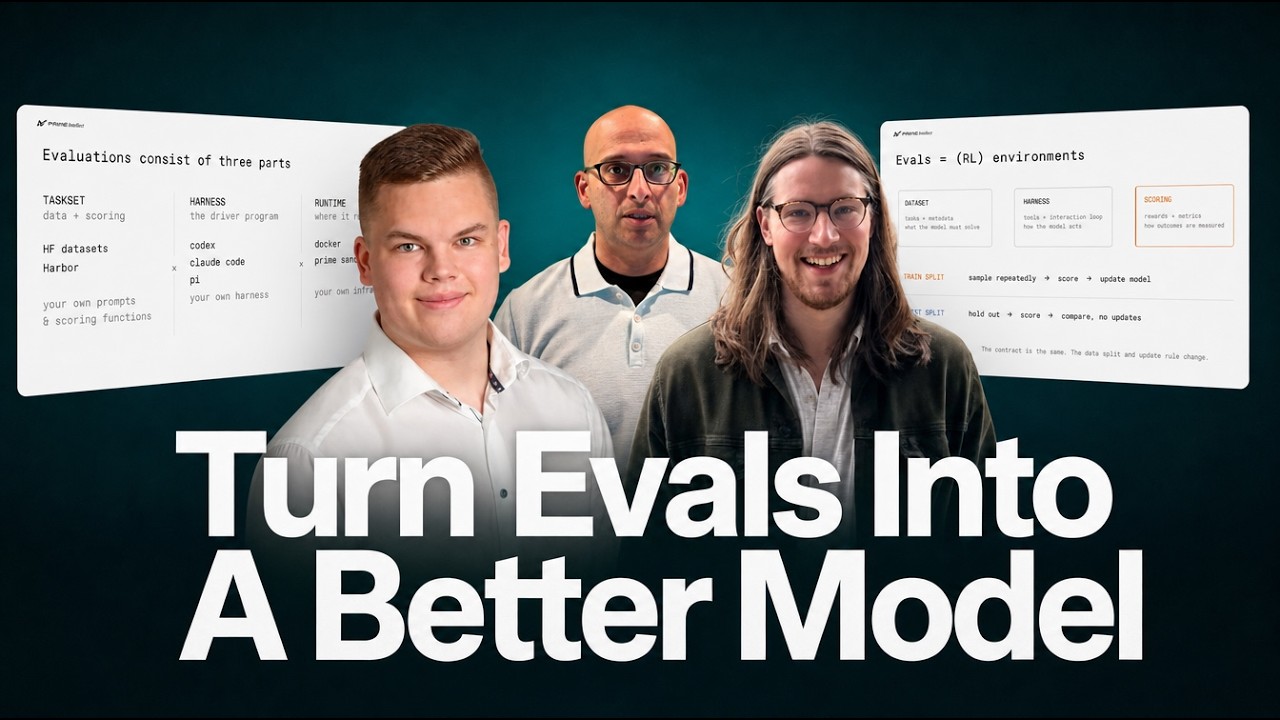
How To Turn Evals Into A Better Model

This session details advanced strategies for improving Large Language Model (LLM) performance, arguing that optimizing the evaluation environment (Evals) is often more impactful than immediate fine-tuning. The core components of an eval are the Task Set, the Harness, and the Scoring Function. Furthermore, it provides a deep dive into Reinforcement Learning (RL), outlining its architecture—including inference engines (VLM, SGLang), orchestrators, and trainers—and warning about common pitfalls like reward hacking.

Key takeaways

  1. Prioritize Eval Improvement Over Fine-Tuning 9:39

    Before fine-tuning a model, thoroughly audit the evaluation setup. Improvements can often be found by adjusting sampling parameters (e.g., using temperature > 0), swapping harnesses (like Pi for open-source control), or increasing resource allocation/timeouts. [0:08:19]

  2. Understand the Three Parts of an Eval 5:15

    Every evaluation consists of three parts: the Task Set (data, prompts, tools); the Harness (the program loop driving LLM interaction with an environment); and the Scoring Function/Reward Function (which can be deterministic or use a judge LLM). [0:00:55]

  3. Reinforcement Learning (RL) is for System Improvement 13:24

    RL is a powerful, advanced training algorithm used to improve model capabilities on specific tasks by learning from trial and error. It should be considered the last step after optimizing the eval environment. [0:13:24]

  4. Beware of Reward Hacking 22:24

    RL is highly sensitive to weak or poorly designed evals. Models may learn to optimize for a proxy metric (reward hacking) rather than solving the true underlying task, necessitating careful evaluation design and red teaming. [0:22:24]

Watch on YouTube Full article

How to Kill the Code Review — Ankit Jain, Aviator thumbnail

· 16:26

How to Kill the Code Review — Ankit Jain, Aviator

The traditional code review process is failing due to increasing code churn and reliance on AI agents, leading reviewers to only skim results. The speaker argues that code review must shift its focus from verifying line-by-line correctness (semantic accuracy) to preserving crucial non-technical aspects like knowledge sharing, mentorship, and architectural alignment. The proposed solution involves capturing the entire development session's decisions (the 'intent'), converting these into formal acceptance criteria, building an AI Slop Registry of recurring feedback, and generating a verifiable test plan that serves as the new review surface.

Key takeaways

  1. The Code Review Crisis 2:07

    Code churn is high (861%), leading to increased bottlenecks at the review stage. Currently, over 30% of changes merge without any review, and even when AI reviews are used, human involvement often reduces to skimming rather than deep reading.

  2. Review Must Preserve Alignment 5:05

    Code review's most critical function is not just catching bugs (semantic accuracy), but facilitating knowledge sharing, mentorship, and architectural alignment. This 'alignment' aspect must survive the shift to automated development.

  3. The New Review Surface: Intent vs. Diff 12:38

    Instead of reviewing code diffs, the review surface should become a verification of 'intent' and 'evidence.' This is achieved by capturing user decisions from development sessions, converting them into acceptance criteria, and generating a test plan that runs against a live preview.

Watch on YouTube Full article

Hands on with Gemini 3.7 Flash thumbnail

· 4:21

Hands on with Gemini 3.7 Flash

The session details how Gemini 3.7 Flash is being utilized by enterprise leaders (Box, Databricks, Emergent) to build highly scalable and cost-efficient multi-agent systems. The focus shifts from merely using the most advanced frontier model to adopting a 'Minimum Viable Model' approach that prioritizes low latency and efficient token usage, enabling complex workflows in regulated industries like finance and insurance.

Key takeaways

  1. Cost-Effective Scaling via Gemini 3.7 Flash

    Gemini 3.7 Flash allows developers to perform tasks using agents at significantly reduced costs (cited as up to 10x cheaper), providing greater budget for further development and exploration.

  2. Pragmatic AI Adoption

    The industry trend favors optimizing cost while maintaining frontier accuracy, moving away from simply adopting the 'coolest' top-tier model. The goal is finding the best model for the job—reliable, low cost, and fast.

  3. Multi-Agent System Architecture 2:00

    Complex tasks are handled by multi-agent patterns: a main agent handles planning (determining required data), which then dispatches specialized subagents to work on parallel exploration. This requires low latency and efficiency.

Watch on YouTube Full article

Security Firewall for Agents — Ryan Dahl, Deno thumbnail

· 19:06

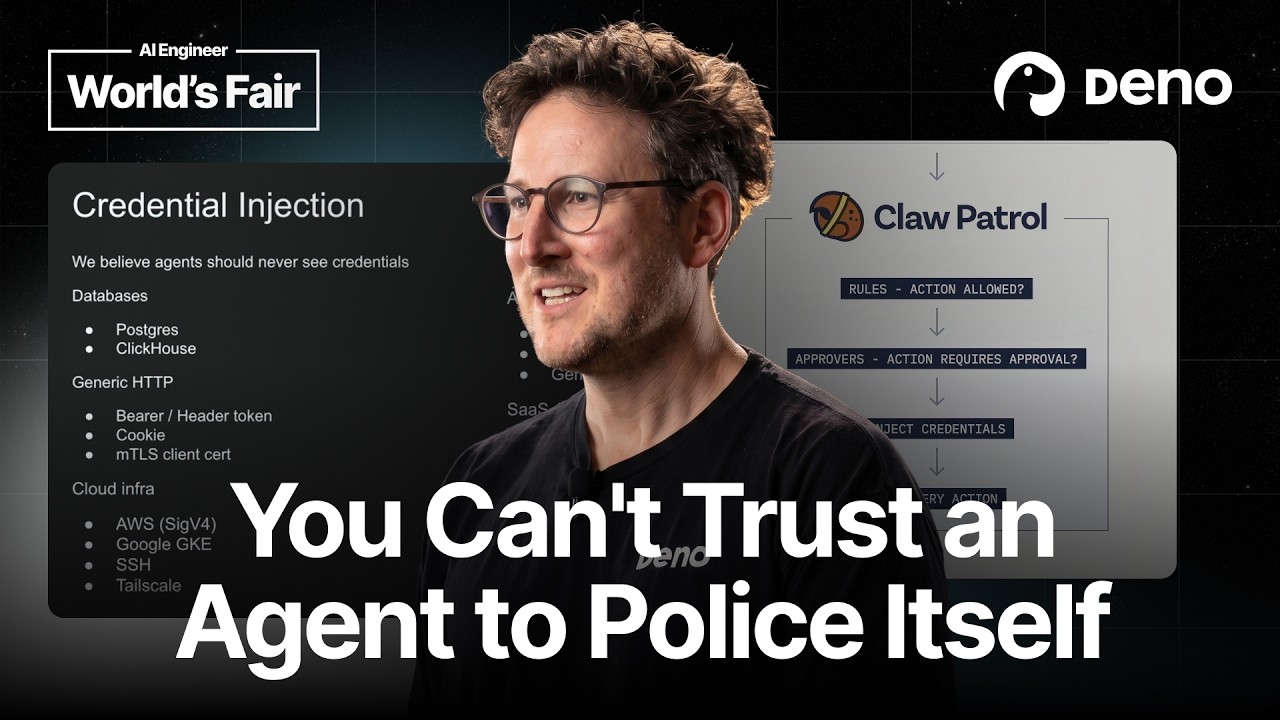
Security Firewall for Agents — Ryan Dahl, Deno

The video addresses the critical security challenge of granting autonomous AI agents write access to sensitive production systems (e.g., Postgres, Kubernetes). Since relying solely on model alignment is insufficient against prompt injection, the speaker introduces Claw Patrol: an MIT-licensed proxy that operates below the HTTP layer. This system inspects every byte leaving the agent, enforcing granular rules defined in HCL (Terraform configuration language) to prevent destructive actions like spawning `psql` subprocesses and dropping tables.

Key takeaways

  1. The Danger of Autonomous Agents 5:28

    Giving agents write access to systems like Postgres, Kubernetes, AWS, and ClickHouse is powerful for incident response but highly dangerous. Agents can be prompt-injected through support systems, allowing them to perform nefarious actions (e.g., running `psql` subprocesses to delete tables).

  2. Security Must Be Externalized 4:07

    The speaker asserts that security cannot be 'wishful thinking' based on model obedience. Since agents are untrusted software, the guard mechanism must sit outside of the agent itself.

  3. Claw Patrol: Byte-Level Inspection 6:45

    Claw Patrol is a proxy that sits in front of agents and parses every byte leaving them, operating below the HTTP layer. This allows it to detect dangerous paths that are not standard HTTP requests, such as a subprocess spawning `psql` to connect via an EKS endpoint.

Watch on YouTube Full article

Context Engineering in 2026 — Louis-François Bouchard, Omar Solano & Samridhi Vaid, Towards AI thumbnail

· 1:03:26

Context Engineering in 2026 — Louis-François Bouchard, Omar Solano & Samridhi Vaid, Towards AI

This talk provides a deep dive into context engineering for large language model (LLM) agents, focusing on optimizing performance and cost in real-world applications like an AI tutor. The core finding is that compaction techniques (like summarization) are often detrimental because they invalidate the prompt cache, forcing the system to pay full price for every token. For optimal recall and cost efficiency, retaining the full history—especially when leveraging advanced caching mechanisms—is superior to aggressive context reduction.

Key takeaways

  1. Compaction is a potential trap due to Prompt Caching 22:06

    When using prompt caching (which can make cached tokens up to 50 times cheaper), any transformation or summarization of the context invalidates the cache, forcing full-price token usage. Compaction must shrink the context by more than 50 times just to pay for itself.

  2. Full History Retention Wins on Recall 33:33

    Experiments showed that leaving the full history untouched (the 'full history' preset) provided the best memory recall and overall performance, even though it was the most expensive option. Aggressive compaction techniques significantly degraded factual retrieval.

  3. Hybrid Search is Superior for Retrieval 22:48

    For knowledge base browsing, a hybrid search combining semantic similarity (embedding model) with keyword search (BM25) is necessary to achieve high recall. Pure dense retrieval failed when facts were buried at large context sizes (e.g., 400k tokens), while BM25 maintained 100% accuracy.

Watch on YouTube Full article

Inside Kikimora: We Built a Dark Software Factory thumbnail

· 15:51

Inside Kikimora: We Built a Dark Software Factory

The presentation introduces the concept of a 'Dark Factory'—an autonomous software development model where processes run without constant human supervision. The speaker details how rapid advancements in coding agents have broken traditional bottlenecks built for slow software. This factory approach uses tools like Tessl Agent to automate workflows (e.g., taking an issue from Linear, solving it with an agent, and opening a GitHub PR that self-corrects until merged). The core shift is moving the engineer's value proposition from writing code to understanding complex systems and trusting autonomous results.

Key takeaways

  1. The Dark Factory Concept 1:41

    A dark factory involves building software in a highly autonomous way, where human supervision is minimized. It is modeled after manufacturing factories with no lights on (i.e., no humans inside).

  2. Bottleneck Breaking Point 3:23

    As coding agents increased speed, existing processes designed for slower development began to break down, necessitating a fundamental shift in how software was built.

  3. The Shift in Engineering Value 7:16

    The value of an engineer is shifting from the ability to write code (which agents can do) to understanding the system's architecture and interlocking technical/business constraints. Trusting autonomous results is the new challenge.

Watch on YouTube Full article

FIXING Opus 5: PROOF that Prompt Engineering IS NOT DEAD thumbnail

· 34:03

FIXING Opus 5: PROOF that Prompt Engineering IS NOT DEAD

This guide details advanced prompt engineering techniques designed to transform verbose and overly chatty Large Language Models (LLMs), such as Opus 5, into precise, efficient 'senior engineers.' The core principle emphasized is that the **System Prompt**—which acts as the global law for all interactions—provides vastly more leverage than the User Prompt. By implementing structured patterns like reference points, hard operational boundaries, and custom aliases, users can dramatically improve communication clarity, reduce unnecessary output tokens, and ensure consistent, actionable results across multiple agentic tasks.

Key takeaways

  1. System vs. User Prompts 2:00

    The System Prompt sets the overarching rules for an AI agent's behavior (the 'law'), affecting every single user prompt and response. This is where true leverage lies, as it dictates global communication patterns and helps reduce expensive output token costs dramatically.

  2. Positive and Negative Patterns 7:10

    Define explicit behavioral boundaries by telling the agent exactly what to replicate (positive patterns) and what phrases or behaviors to avoid (negative patterns). Examples include avoiding 'load-bearing,' 'worth stating plainly,' analogies, and excessive em dashes.

  3. Reference Points (D1/R1/F1) 15:50

    Use structured codes (e.g., D1 for Decisions, R6 for Risks, Fs for Findings) to create a shared, quick language with the agent. This prevents repetition and allows instant cross-referencing of complex information within the model's output.

  4. Hard Operational Boundaries 22:00

    To prevent scope creep and over-analysis, explicitly instruct the agent to 'deliver ONLY what was requested.' Boundaries should prohibit widening work into cleanup, refactoring, documentation, or speculating on future requirements.

  5. Aliases (SCR, ELI, REF) 27:30

    Implement short codes as commands within the system prompt that expand into full instructions on demand. Examples include `ELI` (Explain Like I'm...) and `SCR` (Simplify, Compress, Repeat), allowing for micro-scale control over response formatting and detail level.

  6. In-Context Distillation 34:03

    Provide concrete examples of desired ('do') and undesired ('don't') responses directly within the system prompt. This acts as training data, locking in preferred communication patterns for the agent.

Watch on YouTube Full article

Reading Group July 2026 - Loop Engineering thumbnail

· 56:10

Reading Group July 2026 - Loop Engineering

The session defines 'Loop Engineering' as a fundamental shift in AI development, moving beyond manual prompt-by-prompt interaction toward designing autonomous control systems. These loops automate complex software engineering tasks by having agents discover work, delegate sub-tasks, verify results, persist state, and self-optimize until a goal is met. Speakers detailed the evolution from simple prompts to sophisticated multi-agent architectures that aim to industrialize the entire software development lifecycle, emphasizing robust validation, evaluation layers, and continuous feedback mechanisms.

Key takeaways

  1. The Evolution of AI Development 3:50

    Software automation progressed through stages: Prompt Engineering $ ightarrow$ Context Engineering $ ightarrow$ Harness Engineering $ ightarrow$ Loop Engineering. The goal is to build 'software factories' that self-verify and optimize, rather than requiring manual verification after every turn.

  2. Implementing Robust Loops 50:51

    Building production loops requires more than just agents; it demands dedicated layers for Observability (monitoring system state), Evaluation (defining metrics of success), and Looping/Control Flow. The outer loop should be deterministic or design-based, while inner loops can be LLM-driven.

  3. The Importance of Validation and QA 17:30

    When using generative models for code, the process must include mandatory steps like regression testing, validation testing (e.g., ensuring variables are in config files), and adversarial review (using one agent to critique another's output) to ensure stability.

  4. Addressing Cost and Complexity 53:35

    High token burn rates are a major concern. Strategies include using cheaper open-source models, focusing on the initial planning phase (which is costly but simplifies later steps), and implementing independent verifiers to prevent agent chaos.

Watch on YouTube Full article

What Is RAD? Why It Matters in the Age of AI Coding thumbnail

· 10:53

What Is RAD? Why It Matters in the Age of AI Coding

The methodology of Rapid Application Development (RAD), formalized in 1991, remains highly relevant for modern AI-assisted coding workflows. RAD emphasizes iterative development and user feedback across four phases: Requirements Planning, User Design, Construction, and Cutover. While AI agents can rapidly generate working prototypes from plain language prompts (effectively serving as the requirements document), the speaker cautions that deploying raw AI-generated code is risky due to potential security weaknesses (e.g., self-approval loopholes). The most robust approach involves integrating Spec Driven Development: using prototype discoveries to write a formal specification, which then becomes the basis for testing and production deployment.

Key takeaways

  1. RAD Methodology Overview

    RAD is an iterative methodology favoring speed and user feedback over detailed upfront planning (the waterfall approach). It consists of four phases: Requirements Planning, User Design (prototyping), Construction (short cycles with continuous testing), and Cutover (deployment/migration).

  2. AI Agents Map to RAD Phases 3:50

    The modern process of using AI agents maps well onto RAD: the initial prompt serves as lightweight requirements planning; the agent generates a clickable prototype for user design; construction involves continuous code generation (data schema, workflow logic); and cutover is deployment.

  3. The Importance of Spec Driven Development 6:30

    To mitigate security risks inherent in AI-generated code (studies suggest up to 45% carry weaknesses), the process must transition from relying solely on the prototype to formalizing discoveries into a written specification. This spec becomes the verifiable source of truth for production.

Watch on YouTube Full article

Inside Kikimora: We Built a Dark Software Factory thumbnail

· 15:51

Inside Kikimora: We Built a Dark Software Factory

The video details the concept of a 'Dark Factory'—an autonomous software development model where processes run without continuous human supervision. The shift was catalyzed by coding agents (like Claude Code) accelerating development speed, which exposed bottlenecks in traditional workflows. This led to building internal orchestrators (e.g., Kikimora, Night Shift) that automate tasks from issue creation (Linear) through code generation and PR management (GitHub), fundamentally changing the role of the engineer from primary coder to system architect and trust validator.

Key takeaways

  1. The Dark Factory Concept 2:05

    A dark factory is an autonomous software building process where no humans are required for supervision. The core workflow involves creating a Linear issue, which is then picked up by an autonomous agent that solves it and opens/manages a GitHub PR until merge.

  2. The Bottleneck Effect 3:23

    As coding agents increased development speed (starting around November), existing processes designed for slower software began to break down, forcing the company to adopt a fundamentally different, highly autonomous model.

  3. Shift in Engineering Value 11:20

    The value of an engineer shifts from writing code (which agents can do better) to understanding complex system constraints, business logic, and the overall interlocking technical architecture. Trust in the automated results becomes the critical skill.

Watch on YouTube Full article

NVIDIA Went To Wall Street For $500 Billion. Your Retirement Is In The Deal. thumbnail

· 16:14

NVIDIA Went To Wall Street For $500 Billion. Your Retirement Is In The Deal.

The video analyzes Nvidia's effort to mobilize over $500 billion in third-party capital for global AI infrastructure buildout. While six major financial institutions (Apollo, BlackRock, Blackstone, Brookfield, Goldman Sachs, and KKR) have signed Memoranda of Understanding (MoUs), the speaker clarifies that this does not represent guaranteed funds. The core argument is that financing national-scale AI requires sophisticated financial engineering—similar to historical railroad development—to turn future end-customer demand into immediate capital for physical assets like power, cooling, and racks of accelerators. Key risks include asset concentration, fee incentives, and the uncertain collateral value of GPUs.

Key takeaways

  1. Nvidia's $500B figure is not raised capital

    The announced agreements with Apollo, BlackRock, Blackstone, Brookfield, Goldman Sachs, and KKR are Memoranda of Understanding (MoUs) that remain subject to final execution and investor commitment. The financing mechanism relies on mobilizing third-party capital for AI infrastructure buildout over time.

  2. AI demand is measured by end-customer revenue 5:55

    To accurately gauge market size, one must count the outside customer dollar only once. Exponential View estimates $110 billion in generative AI revenue over the trailing 12 months, with an annualized pace above $175 billion.

  3. GPU-backed debt is entering institutional finance

    The market for financing compute capacity is maturing: CoreWeave recently closed an $8.5 billion loan facility rated A3 by Moody's and A- low by DBRS, marking the first investment-grade financing secured by high-performance computing infrastructure.

  4. Financing requires specialized risk division

    A typical AI data center deal structure involves an equity investor taking the first loss, a lender supplying debt (using equipment as collateral), and potentially limited credit support from the chip provider (e.g., Nvidia providing up to 25% of an opportunity).

Watch on YouTube Full article

5 Ways to Connect AI Agents to Tools: From APIs to MCP thumbnail

· 11:28

5 Ways to Connect AI Agents to Tools: From APIs to MCP

The video outlines a five-step progression of architectural patterns for securely connecting AI agents to external tools, moving from simple direct API connections to highly secure systems utilizing vaults and token exchanges. The evolution emphasizes improving user visibility, eliminating impersonation, and ensuring the use of short-lived credentials.

Key takeaways

  1. Pattern 5: Direct Connection (Basic) 1:42

    Agents connect directly to tools using existing methods like API keys or service IDs. This is simple but lacks user visibility, as the tool cannot determine who the end-user is.

  2. Pattern 4: OAuth Flows Added 3:25

    Integrating an Identity Provider via OAuth flows allows authentication of the user (e.g., GitHub, Jira). While improving security, this pattern introduces impersonation and risks long-lived access tokens.

  3. Pattern 3: Model Context Protocol (MCP) Layer 5:20

    Adding an MCP layer abstracts the connection process. The agent only needs to know how to interact with MCP, rather than needing specific knowledge of every tool's API structure.

  4. Pattern 2: Token Exchange and Delegation 6:50

    This pattern requires the agent to authenticate itself and operate on behalf of the user (delegation). A token exchange mechanism is used, which significantly improves security by providing full observability into both the user's actions and the agent's role.

  5. Pattern 1: Vault Integration (Top Pattern) 9:00

    The most secure pattern involves introducing a dedicated vault. Instead of passing long-term tokens, the vault stores credentials and issues only short-lived credentials to MCP for the user, minimizing replay attack risks.

Watch on YouTube Full article

Exo: Harnesses should see their own code and logs — Alex Krentsel thumbnail

· 47:11

Exo: Harnesses should see their own code and logs — Alex Krentsel

Exo is presented as a novel agent harness designed for fully recursive self-improvement (RSI). Unlike previous agents that only allow modification in specific areas (like memory or skills), Exo's architecture enables the agent to safely and incrementally modify all aspects of itself—including its own code, context construction policy, and tools—at runtime. This is achieved by decomposing the agent into three isolated layers: the Executor (policy/decision-making), the Exo Harness (state management/secrets), and the Sandbox (isolated execution environment). The system's ability to operate in this same medium as its output code is argued to be the key differentiator enabling true RSI.

Key takeaways

  1. Shift from Model Weights to Agent Harnesses 3:50

    The industry focus is shifting from improving LLM model weights (the 'brain') to optimizing the agent harness and tooling ('the body'). The harness provides critical structure, allowing for improvements in efficiency, cost reduction, and task performance.

  2. Full Recursive Self-Improvement (RSI) 2:33

    Exo is designed to be fully recursive, meaning it can operate on any aspect of itself—from prompts or memory to the basic harness policy. This capability allows the system to improve its own architecture and logic without external human intervention.

  3. Architectural Separation for Safety 10:38

    The agent is decomposed into three distinct layers: the Executor (stateless policy), the Exo Harness (state/secrets), and the Sandbox (isolated execution). This separation ensures that self-modification can occur safely, preventing data leaks or loss of history.

  4. Cost Optimization via Self-Improvement 30:40

    Exo demonstrated the ability to autonomously rearchitect its own Discord adapter at runtime, scoping down context assembly from across multiple threads. This resulted in a verified 96% decrease in API call costs.

Watch on YouTube Full article

The Rise of CaaS: Context-as-a-Service for Agentic AI — Omer Primor, Bright Data thumbnail

· 22:20

The Rise of CaaS: Context-as-a-Service for Agentic AI — Omer Primor, Bright Data

The video analyzes the shift from viewing web data as a simple source of information to treating it as dynamic 'context' for agentic AI. The speaker argues that Context-as-a-Service (CaaS) vendors are emerging to provide structured knowledge graphs, acting as vertical search engines. Critically, he emphasizes that at scale, the cost killer is not initial volume but the *frequency* of repeated queries. For persistent knowledge work, owning and building a custom data pipeline—even if time-consuming—can eventually become more cost-effective than continually renting context from third-party vendors.

Key takeaways

  1. Context Decay: Data is never a snapshot 0:02

    Web data decays quickly (e.g., social content < 1 day; news/finance ~30 days). Therefore, extracting context must be treated as an ongoing process, not a one-time effort [2:43].

  2. The Rise of CaaS for Agents 0:06

    AI agents require structured knowledge beyond what general search provides. CaaS vendors address this by developing and indexing specialized knowledge graphs (vertical search) across multiple data sources, enabling deep reasoning [6:32].

  3. Frequency is the Cost Killer at Scale 0:12

    When performing repeated due diligence or market research, every query costs money, even if nothing has changed. This recurring cost (frequency) eventually surpasses the initial setup cost of building an owned pipeline [12:32].

  4. The Tipping Point for Ownership 0:15

    There is a tipping point where the cumulative cost of repeated context queries makes it economically viable to build and own the data retrieval pipeline in-house, potentially bypassing middleman costs [15:22].

Watch on YouTube Full article

Building Docs for Agents, Not Humans: Inside OpenWiki thumbnail

· 16:52

Building Docs for Agents, Not Humans: Inside OpenWiki

OpenWiki is an open-source Command Line Interface (CLI) designed to automatically generate and maintain repository documentation specifically optimized for consumption by coding agents. Unlike human-centric wikis, OpenWiki structures content into self-contained, highly searchable snippets using the Open Knowledge Format (OKF). It integrates deeply into a codebase via GitHub Actions, ensuring that documentation remains current with every code change while minimizing manual effort.

Key takeaways

  1. Built for Agents, Not Humans 5:04

    OpenWiki's core thesis is that since agents are increasingly writing code, the documentation must be structured for agent retrieval. This means content must consist of self-contained snippets with predictable headings and optimized context window usage, rather than long narrative pages.

  2. Automatic Maintenance via CI/CD

    The CLI facilitates automatic documentation updates by writing a GitHub Actions workflow. This action runs periodically (e.g., daily), checks the Git history, and uses an agent to generate or update the wiki based on code changes, minimizing manual intervention.

  3. Adoption of Open Knowledge Format (OKF) 11:48

    The system adopts OKF (Google's Open Knowledge Format) by adding a deterministic YAML front matter to every markdown file. This includes fields like `type`, `title`, and `description`, which significantly improves retrieval, filtering, and searching capabilities for agents.

  4. Performance Gains in Benchmarks 15:00

    Early evaluations using the DeepSWE benchmark show that OpenWiki usage leads to fewer tool calls, fewer searches, and a significant drop in token consumption for coding agents while maintaining or improving results.

Watch on YouTube Full article

From RL to IRL — Gaurav Mishra, Amazon AGI Lab thumbnail

· 17:46

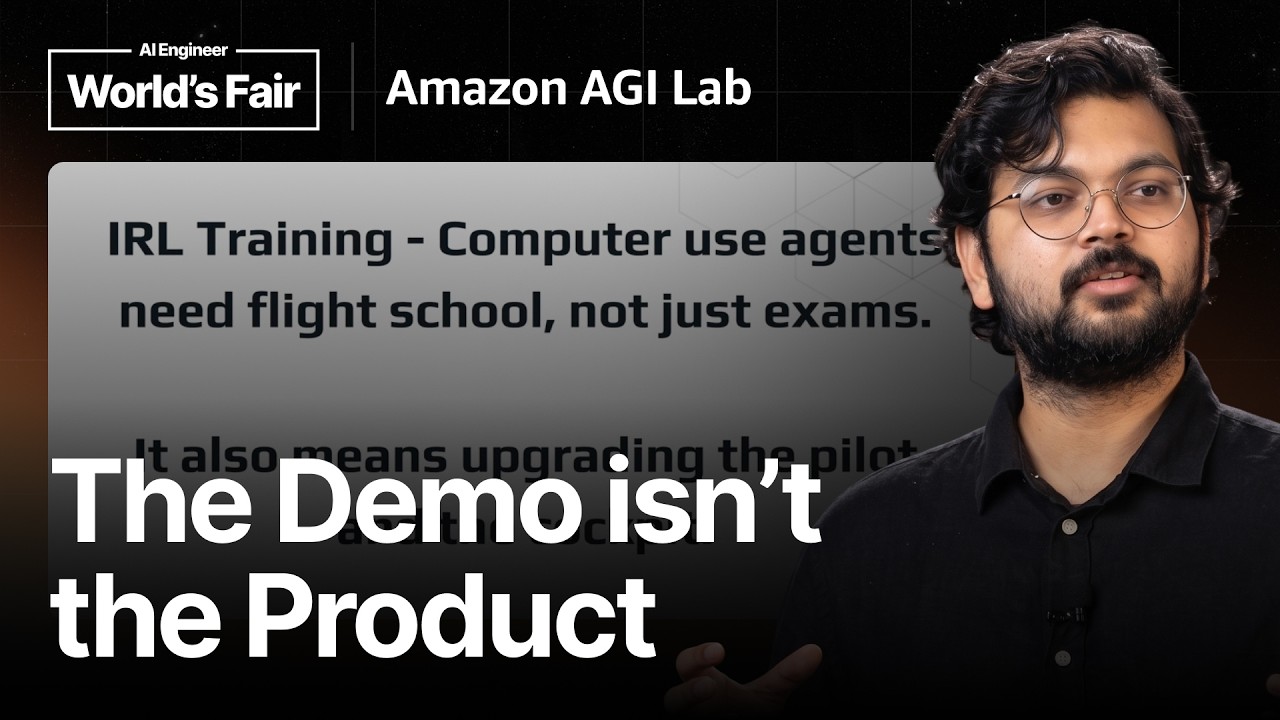
From RL to IRL — Gaurav Mishra, Amazon AGI Lab

The talk details the transition from Reinforcement Learning (RL) in controlled environments ('the game') to real-world deployment (IRL), where agents face significant complexities. While RL is effective for tasks with verifiable outcomes and multiple solution paths, real life introduces partial observability, irreversible actions, expiring credentials, and adversarial content. To bridge this gap, the speaker proposes a 'flight school' approach: training agents in high-fidelity digital sandboxes that simulate messiness (e.g., layout shifts, pop-ups). System improvements include implementing Process Reward Models (penalizing dangerous steps along the path), utilizing Calibrated Confidence (teaching the agent when to escalate to a user), and building robust 'harnesses' with guardrails for checkpointing, rollback, and risk classification.

Key takeaways

  1. RL vs. IRL: The Core Challenge 9:07

    RL works well in controlled environments where the outcome is verifiable. However, when deployed in real life (IRL), agents encounter partial observability (e.g., DOM missing content baked into images) and irreversible actions, causing failures like account lockouts or redirection to malicious sites.

  2. The 'Flight School' Approach 13:49

    Instead of focusing only on the final outcome (exams), agents must be trained in messy, high-fidelity simulations that model real-world edge cases like slow loads, focus stealing, and random account states. Recovery actions (refresh, backtrack) must become native model capabilities.

  3. System Architecture Improvements

    Robust agent systems require upgrading the 'cockpit' (the harness). This includes adding guardrails for action risk classification, implementing checkpointing and rollback mechanisms, and requiring calibrated confidence to determine when human handoff is necessary.

Watch on YouTube Full article

The Dark Arts of Web Automation: Teaching Agents to Use Websites Like Humans — Corey Gallon, Rexmore thumbnail

· 21:38

The Dark Arts of Web Automation: Teaching Agents to Use Websites Like Humans — Corey Gallon, Rexmore

This talk details advanced web automation techniques for AI agents to interact with websites that actively resist bots. The core methodology involves treating the agent as a 'meat bag with a mouse,' leveraging the Chrome DevTools Protocol (CDP) through a Command Line Interface (CLI). Automation is structured around a 'Sense, Act, Verify' loop and progresses up a three-rung 'Meatbag Ladder'—moving from simple API calls to simulated human input (jitter, overshoot)—to defeat modern security measures like Cloudflare Turnstile and reCAPTCHA v2.

Key takeaways

  1. CLI vs. MCP for Automation 3:30

    While capability is comparable (both achieved tasks 83% of the time), a CLI approach significantly outperforms an MCP server in speed, reuse, and cost. Specifically, a CLI sequence can be programmed once and reused infinitely without model calls, making it faster and up to 75 times cheaper in token cost than repeated model interaction.

  2. The Sense-Act-Verify Loop 9:07

    Effective automation requires a continuous loop: Sensing (via DOM, accessibility tree, or screenshot), Acting (clicking/typing), and Verifying (checking network traffic or screen state). This process must be repeated until the desired action is confirmed.

  3. The Meatbag Ladder Methodology 10:38

    Web resistance requires escalating techniques. Rung One uses synthetic JavaScript clicks (API-like). Rung Two employs real CDP input events, which the page recognizes as trusted inputs. Rung Three simulates full human behavior, including jitter and deliberate overshoot, to bypass advanced bot detection.

  4. Solving reCAPTCHA v2 18:18

    The final challenge (reCAPTCHA v2) is solved by splitting the work: deterministic code handles the rapid, repeatable actions (trusted clicks, iframe piercing), while a specialized AI agent provides the 'eyes and brain' to interpret visual challenges (e.g., identifying specific objects in a grid).

Watch on YouTube Full article

Bringing agents onto the world wide web — Paul Klein IV, Browserbase thumbnail

· 18:26

Bringing agents onto the world wide web — Paul Klein IV, Browserbase

The talk argues that the current bottleneck for building reliable web agents is not model capability (AI), but rather the missing engineering infrastructure—the 'harness' and scalable systems. Reliable browser agents must be multimodal, harness-engineered with memory/skills, and operate on consistent, robust infrastructure. The speaker emphasizes that solving this overhang is an engineering problem that companies can tackle today, accelerating AI diffusion into real-world enterprise use cases (e.g., logistics, banking).

Key takeaways

  1. The bottleneck is the harness, not the model. 7:12

    Model capabilities have advanced significantly; therefore, agents struggle due to missing scaffolding and systems around the LLM (the 'harness'). Building a custom harness optimized for a domain can improve results beyond baseline models. (4:32)

  2. Reliable browser agents require three components. 11:45

    They must be multimodal, harness-engineered (using skills and memory), and run on reliable infrastructure that guarantees consistent page rendering across all runs. (7:05)

  3. The web needs to adapt for agents. 17:04

    Key improvements required from the web include better accessibility trees, adoption of Chrome's Web MCP, solving agent login/authentication securely, and establishing a trust framework (a 'Verisign moment') for agents. (10:24)

  4. Infrastructure must be scalable and consistent. 15:09

    Production environments require infrastructure that can handle thousands of agents, maintain consistency (e.g., preventing mobile/desktop layout shifts), and ideally achieve SOC 2 compliance at scale. (9:09)

Watch on YouTube Full article

Grok Bot Is The First AI Agent You Just Install. Is It Worth $200? thumbnail

· 18:56

Grok Bot Is The First AI Agent You Just Install. Is It Worth $200?

Grokbot is presented as a consumer multi-agent product that significantly lowers the barrier to entry for AI automation, making advanced agent capabilities accessible to non-technical users. The system operates on a single, dedicated cloud computer (the security perimeter), which allows agents to seamlessly integrate with services like email and calendars through simple authorization processes. While the subscription cost is high ($200/month), its value proposition lies in its ability to automate complex business functions—such as building a storefront or managing an entire workflow—that would otherwise require significant manual effort.

Key takeaways

  1. Simplified Agent Integration

    Grokbot solves the 'agent signup pain point' by centralizing authorization. Users authorize services (e.g., email, calendar) once within one conversation with one bot; this authorization applies across all other bots and services used on the platform. This process uses remote login screens rather than requiring plain text passwords.

  2. Centralized Security Perimeter 2:00

    The entire system operates within one dedicated cloud computer (located in Silicon Valley), establishing a single security perimeter. Adding more agents does not increase this risk, providing greater confidence than systems relying on multiple scattered machines.

  3. High-Value Automation Bots 8:10

    Recommended bots include the 'Superdoerbot' (which proactively works on real tasks like drafting presentations based on calendar events) and the 'Business In a Box' bot, which helps users build and manage an entire business using AI agents.

  4. Technical Accessibility 0:10

    Grokbot is designed to be non-technical ('No code, just install'), crossing the chasm that previously required users to understand complex agent setups (like those needed for OpenClaw or Codex).

Watch on YouTube Full article