Topic

LLM Agents

All digests tagged LLM Agents

Benchmarking Coding Agents on New vs Legacy Codebases — Denys Linkov, Wisedocs thumbnail

· 18:08

Benchmarking Coding Agents on New vs Legacy Codebases — Denys Linkov, Wisedocs

The talk analyzes the necessity of undertaking a major codebase refactor—specifically collapsing over ten legacy repositories into a monorepo—despite rapid advancements in AI coding agents. The speaker argues that while modern LLMs (like Opus 4.8) significantly accelerate tasks compared to older models (o3), the business value gained from proactively addressing technical debt and establishing robust development patterns outweighs waiting for perfect AI tooling. Key findings include benchmarking model performance on refactoring tasks, noting that Sonnet 4.6 required one iteration while Opus 4.8 achieved near single-pass completion. The speaker also cautions against relying solely on LLMs to complete complex tasks without proper guardrails and validation.

Key takeaways

  1. Refactoring is necessary despite AI progress

    The refactor was worthwhile because it improved business metrics (commit velocity, time-to-market) by establishing clean patterns, even if models continue to improve.

  2. LLM performance benchmarks show rapid improvement 9:30

    Refactoring tasks that took three hours of back and forth with o3 could be accomplished in roughly one-fifth the time using modern models like Sonnet 4.6 (one iteration) or Opus 4.8 (near single pass).

  3. Monorepos simplify development flow

    Consolidating ten separate repositories into a monorepo allowed almost every developer to contribute, even outside their area of expertise, significantly boosting commit velocity and collaboration.

Watch on YouTube Full article

The Agent Development Lifecycle 101 by Harrison Chase thumbnail

· 45:17

The Agent Development Lifecycle 101 by Harrison Chase

The Agent Development Lifecycle outlines a systematic approach for moving AI agents from isolated demos to reliable production systems. The process is broken down into five stages: Build, Test, Deploy, Monitor, and Govern. Key focus areas include ensuring agent reliability at scale by implementing durable execution, managing complex state via virtual file systems, and using advanced observability tools like tracing and online evaluation (evals) to detect failures and drive continuous improvement.

Key takeaways

  1. Systematic Iteration is Key 3:50

    Successful teams treat agents not as one-off projects but as systems requiring systematic iteration across the entire lifecycle: build, test, deploy, monitor, and improve. The primary challenge in shipping agents reliably at scale is ensuring consistent behavior.

  2. Agent Development Components 5:50

    The core components are Build (frameworks/harnesses), Test (data sets, metrics, benchmarks like Terminal Bench 2), Deploy (durable execution, sandboxes), Monitor (tracing, online evals), and Govern (cost control, tool access management).

  3. The Role of Tracing and Observability 17:06

    Tracing is fundamental for debugging agents, allowing developers to see the inputs and outputs at every step (including tool calls) to understand why an LLM or agent failed. Online evals extend this by scoring production traces without needing ground truth.

  4. Self-Improving Agents 31:30

    Advanced platforms, like LangSmith Engine, are beginning to automate the improvement loop. They run in the background over existing traces, clustering issues and suggesting fixes (code or prompt changes), thereby drastically lowering the burden of operating agents at scale.

Watch on YouTube Full article

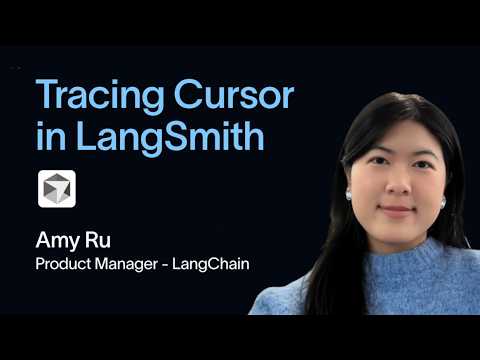
Trace Every Cursor Agent Turn in LangSmith thumbnail

· 3:04

Trace Every Cursor Agent Turn in LangSmith

This walkthrough details how to integrate LangSmith tracing with Cursor agents, ensuring that every agent turn is captured as a full, inspectable trace in LangSmith. The process involves installing the LangSmith plugin in Cursor, setting three specific environment variables (including `LANGCHAIN_TRACING_V2`), and running an end-to-end task to verify the hook's functionality.

Key takeaways

  1. Full Trace Capture

    By implementing this setup, every agent turn executed by Cursor is logged as a distinct trace in LangSmith, providing comprehensive visibility into the agent's execution flow.

  2. Trace Structure Details 1:43

    Each trace captures the model run details (model name, token usage), input/output, tool runs (e.g., file reads, shell commands), and nested tasks if sub-agents are involved.

  3. Cross-Agent Comparison

    LangSmith maintains a common trace structure that allows users to compare traces from multiple agents (Cursor, Claude Code, and Codex) within the same workspace.

Watch on YouTube Full article