What is LangSmith?
Summary
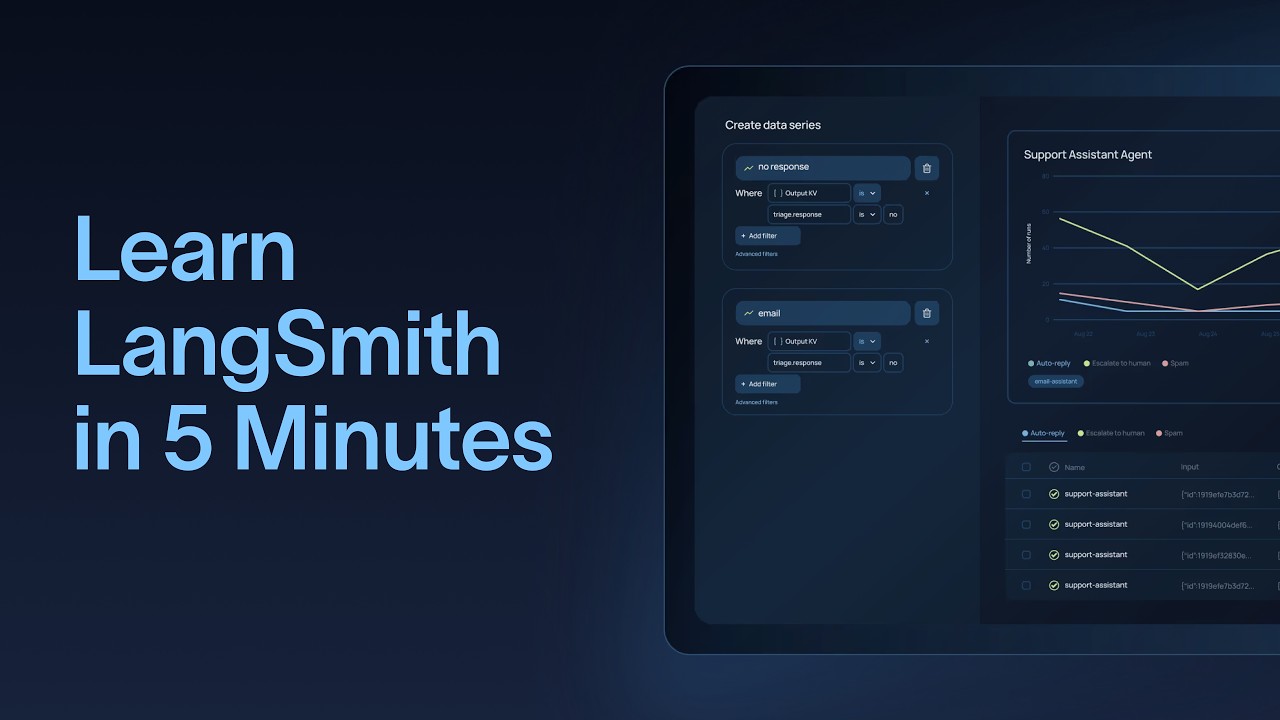
LangSmith is a comprehensive platform designed for the Agent Development Lifecycle (ADLC), enabling build engineers to build, test, deploy, and monitor LLM applications and agents. It functions as a tracing backend, providing crucial observability into complex agent behavior—which can involve dozens of model and tool calls—by tracking every step, diagnosing bugs, and facilitating continuous quality assurance through structured testing and production monitoring.
Key takeaways
-
Agent Observability is Critical
Agents are inherently 'black boxes'; LangSmith solves this by providing visibility into the sequence of model calls and tool decisions, which are not visible in the final output.
-
Tracing Components
0:01
LangSmith defines three components: a 'Run' (a single unit of work, e.g., one model call or tool call), a 'Trace' (a full pass through the agent, composed of multiple runs), and a 'Thread' (a conversation grouping multiple traces from one customer interaction).
-
Testing and Validation Loop
0:02
The platform uses Datasets (sets of examples), Evaluators (which score examples, potentially using an LLM-as-a-judge), and Experiments (running agents over datasets) to verify fixes and compare performance changes (regression testing).
-
Production Monitoring
0:03
In production, LangSmith allows online evaluators to score live traffic, generating dashboards that track scores, volume, latency, errors, and cost, and can trigger alerts or route traces to annotation queues.
Technical details
-
LangSmith Architecture
0s
LangSmith is a tracing backend, not a LangChain feature, meaning it can be used with any agent framework (LangChain, LangGraph, OpenAI/Claude SDKs, or custom loops).
-
Tracing Implementation
1s
Integration is achieved via setting environment variables (for LangChain/LangGraph) or using a one-line integration (for OpenAI/Claude SDKs). Custom loops require adding a decorator to the function.
-
Debugging and Diagnosis
2s
By reading a trace, engineers can pinpoint bugs (e.g., an agent adding a pizza ingredient despite a zero stock unit lookup) and view associated latency and token costs per step.
-
Advanced Features
4s
The platform supports Annotation Queues for human review and scoring, and Insights, which analyzes batches of traces to categorize user questions and identify areas where the agent may lack support.
-
LangSmith Engine
5s
This feature automates the ADLC by clustering traces into issues, opening pull requests against a GitHub repository, and streamlining the creation of evaluation assertions.
Mentioned resources
Channel & topics
Watch on YouTube · Back to latest
This independent, AI-assisted summary is provided for commentary and informational purposes. It may contain errors or omit important context. Please watch the original video for the creator's complete presentation. Video, thumbnail, and related copyrights belong to their respective owners.