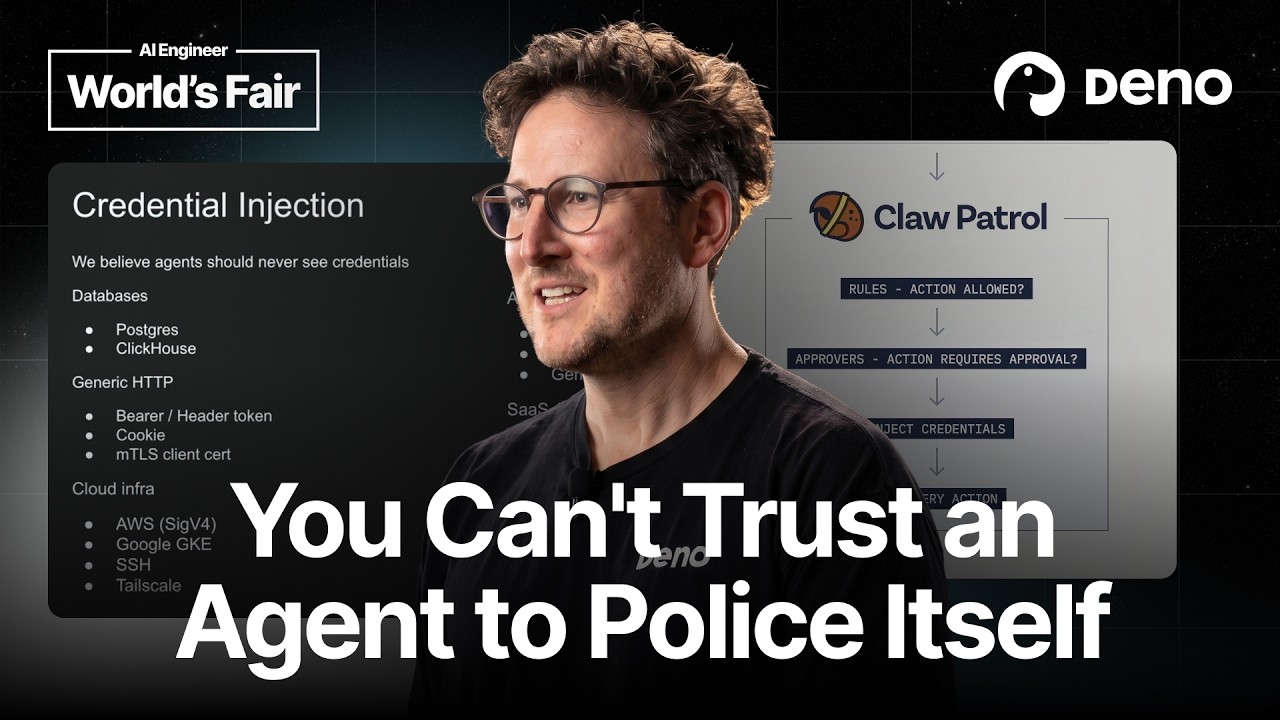
Security Firewall for Agents — Ryan Dahl, Deno
The video addresses the critical security challenge of granting autonomous AI agents write access to sensitive production systems (e.g., Postgres, Kubernetes). Since relying solely on model alignment is insufficient against prompt injection, the speaker introduces Claw Patrol: an MIT-licensed proxy that operates below the HTTP layer. This system inspects every byte leaving the agent, enforcing granular rules defined in HCL (Terraform configuration language) to prevent destructive actions like spawning `psql` subprocesses and dropping tables.
Key takeaways
-
The Danger of Autonomous Agents
5:28
Giving agents write access to systems like Postgres, Kubernetes, AWS, and ClickHouse is powerful for incident response but highly dangerous. Agents can be prompt-injected through support systems, allowing them to perform nefarious actions (e.g., running `psql` subprocesses to delete tables).
-
Security Must Be Externalized
4:07
The speaker asserts that security cannot be 'wishful thinking' based on model obedience. Since agents are untrusted software, the guard mechanism must sit outside of the agent itself.
-
Claw Patrol: Byte-Level Inspection
6:45
Claw Patrol is a proxy that sits in front of agents and parses every byte leaving them, operating below the HTTP layer. This allows it to detect dangerous paths that are not standard HTTP requests, such as a subprocess spawning `psql` to connect via an EKS endpoint.