Topic

Guardrails

All digests tagged Guardrails

Event Recap: Build Smarter Voice Agents - New York Edition thumbnail

· 29:13

Event Recap: Build Smarter Voice Agents - New York Edition

This recap details the complexities of building and deploying production-grade voice AI agents across two distinct sectors: professional networking (Boardy) and regulated healthcare (Flagler Health). Key challenges discussed include maintaining conversational flow, establishing user trust, managing multi-party video meeting interactions, and ensuring subsecond latency for natural conversation. The discussion highlights the difference between highly structured, goal-oriented flows (healthcare) and highly conversational, relationship-driven interactions (networking).

Key takeaways

  1. Design Flow Differences 10:20

    Healthcare voice agents require highly structured, step-by-step flows with strict guardrails (e.g., collecting insurance info) to prevent medical advice or deviation. Conversely, networking agents are designed to handle highly conversational, open-ended interactions to facilitate connections.

  2. The Importance of Trust and Disclosure 21:20

    Building user trust is critical. Speakers emphasized that being upfront and immediately disclosing that the user is speaking to an AI (e.g., 'I'm Sarah and AI') is essential to prevent user frustration and loss of trust.

  3. Technical Challenge: Multi-Party Meetings 24:10

    Handling voice agents in multi-person video meetings (like Google Meet) is technically difficult. The primary challenge is determining when the agent should speak (turn-taking) to avoid false positives (randomly jumping in) or false negatives (failing to reply).

  4. Achieving Low Latency 25:00

    To feel like a natural conversation, the system must achieve subsecond latency. This requires advanced architecture, such as preemptively generating the entire voice pipeline while the user is speaking.
Watch on YouTube Full article

Agentic Engineering Benchmarks: How I RANK Astra, Fable 5.1, and Open-Weights thumbnail

· 39:23

Agentic Engineering Benchmarks: How I RANK Astra, Fable 5.1, and Open-Weights

The video argues that relying on generalized AI benchmarks (like the Artificial Analysis Index) is misleading because model performance is a complex, three-dimensional problem involving performance, cost, and speed. The speaker advocates for selecting a curated set of five specialized benchmarks—Terminal-Bench, APEX Agents, AutomationBench, AA-Omniscience, and DeepSWE—to accurately assess model capabilities for specific, real-world agentic engineering tasks, rather than relying on single aggregate scores.

Key takeaways

  1. Model Selection is a 3D Problem 0:40

    Choosing a model requires balancing performance, cost, and speed simultaneously. A model that performs best may be prohibitively expensive or slow, making the trade-off critical for production systems.

  2. Focus on Variance, Not Indices 1:50

    The most valuable benchmarks show significant variance in model performance, indicating 'alpha' or information gain. Flat-lining benchmarks (like some long context retrieval tests) are considered saturated and uninformative.

  3. The Importance of Guardrails (Alignment) 10:30

    AutomationBench is highlighted for its focus on guardrail adherence. A model must not only complete the objective but also avoid triggering guardrail violations, which is crucial for reliable, production-grade agents.

  4. The Value of Honesty (AA-Omniscience) 17:30

    The AA-Omniscience benchmark measures hallucination rate and the cost of honesty. It is critical that an agent can 'opt to not answer' when lacking information, as this prevents cascading errors in long-running agent pipelines.

  5. Long-Horizon Work is Key 27:30

    DeepSWE v1.1 is emphasized for testing long-horizon software engineering tasks. The goal is to build systems that operate autonomously with minimal human oversight, requiring models that maintain consistency over extended periods.

Watch on YouTube Full article

Every Repo Is a Software Factory Now | Don Syme, GitHub thumbnail

· 1:04:36

Every Repo Is a Software Factory Now | Don Syme, GitHub

This talk explores the concept of 'Continuous AI,' defining it as an evolution that extends traditional Continuous Integration and Continuous Deployment (CI/CD) into subjective, automated activities like documentation updates and bug triage. The core mechanism for this is the use of GitHub Agentic Workflows, which run coding agents with strong guardrails within a bounded repository context. The discussion emphasizes that while AI offers incredible power, maintaining quality gates, controlling costs, and ensuring human oversight remain critical to building reliable 'software factories.'

Key takeaways

  1. Continuous AI vs. CI/CD 5:52

    Continuous AI extends the principles of CI/CD by applying automation to subjective activities (e.g., documentation, bug triage) that are not inherently deterministic like traditional build checks. It requires operationalizing these processes on a permanent basis [00:03:52].

  2. Bounding the Context is Key 10:42

    To prevent automated AI agents from 'going off the rails,' they must operate within a strictly bounded context (e.g., restricted to creating a single pull request or issue) [00:09:42]. This situates the automation, making it manageable and auditable.

  3. The Repo as the Unit of Production 13:59

    GitHub Agentic Workflows are designed around the repository being the primary unit of production and security boundary. This repo-centric approach aligns with established CI/CD principles while enabling advanced AI automation [00:25:19].

  4. Quality Gates and Human Review 5:12

    The focus shifts from human review as a bottleneck to creating automated, high-quality pull requests. The goal is to 'equip the reviewer' with all necessary information (e.g., performance evidence) to make informed decisions [00:52:01].

  5. Complexity Management 3:59

    For maintainers, a single supervisor orchestrator pattern workflow that can perform multiple tasks is preferred over an 'agent zoo' of many individual workflows. This simplifies maintenance and provides better cost control [03:59:00].

Watch on YouTube Full article

From RL to IRL — Gaurav Mishra, Amazon AGI Lab thumbnail

· 17:46

From RL to IRL — Gaurav Mishra, Amazon AGI Lab

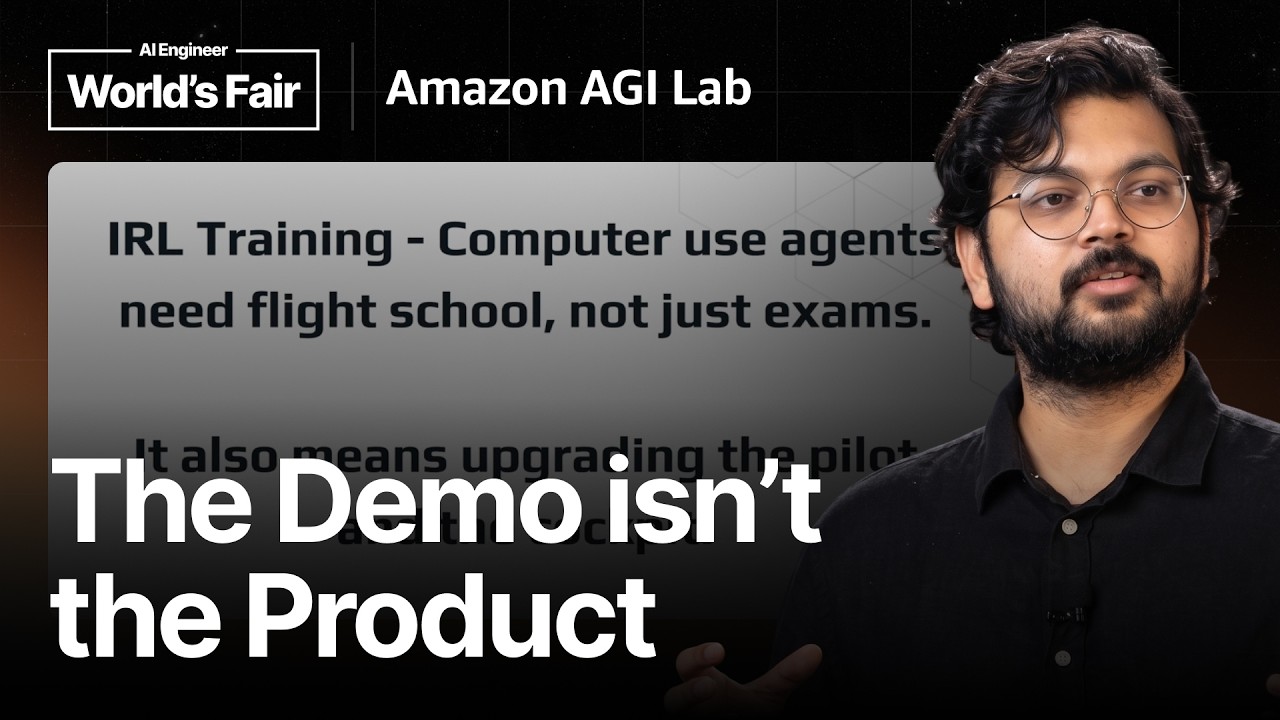
The talk details the transition from Reinforcement Learning (RL) in controlled environments ('the game') to real-world deployment (IRL), where agents face significant complexities. While RL is effective for tasks with verifiable outcomes and multiple solution paths, real life introduces partial observability, irreversible actions, expiring credentials, and adversarial content. To bridge this gap, the speaker proposes a 'flight school' approach: training agents in high-fidelity digital sandboxes that simulate messiness (e.g., layout shifts, pop-ups). System improvements include implementing Process Reward Models (penalizing dangerous steps along the path), utilizing Calibrated Confidence (teaching the agent when to escalate to a user), and building robust 'harnesses' with guardrails for checkpointing, rollback, and risk classification.

Key takeaways

  1. RL vs. IRL: The Core Challenge 9:07

    RL works well in controlled environments where the outcome is verifiable. However, when deployed in real life (IRL), agents encounter partial observability (e.g., DOM missing content baked into images) and irreversible actions, causing failures like account lockouts or redirection to malicious sites.

  2. The 'Flight School' Approach 13:49

    Instead of focusing only on the final outcome (exams), agents must be trained in messy, high-fidelity simulations that model real-world edge cases like slow loads, focus stealing, and random account states. Recovery actions (refresh, backtrack) must become native model capabilities.

  3. System Architecture Improvements

    Robust agent systems require upgrading the 'cockpit' (the harness). This includes adding guardrails for action risk classification, implementing checkpointing and rollback mechanisms, and requiring calibrated confidence to determine when human handoff is necessary.

Watch on YouTube Full article

Evals-Driven Development for a Mental Health AI Coach — Akele Reed & Dave Revere, SonderMind thumbnail

· 21:17

Evals-Driven Development for a Mental Health AI Coach — Akele Reed & Dave Revere, SonderMind

SonderMind details its approach to building Sonder, a clinically grounded AI coach for mental health support. The core focus is on achieving safety and effectiveness through eval-driven development, moving beyond general-purpose LLMs which are unsuitable for high-stakes care. The architecture employs modular guardrails (Input/Output) within a Supervisor/Executor/Evaluator framework. Safety is maintained by integrating clinical judgment into the CI pipeline via annotated traces, ensuring that every model or prompt change is scored against expert-defined 'evals' before deployment.

Key takeaways

  1. Specialized AI for Mental Health 2:00

    General purpose LLMs are insufficient for mental health care due to the high stakes involved. Sonder was designed specifically to act as a front door to human therapy or provide support between sessions, addressing a critical gap in current AI offerings.

  2. Robust Architecture and Guardrails 4:00

    The system uses separate Input and Output guardrails—acting as 'sandwich' layers—to monitor user input and the entire conversation flow for clinical safety risks. This modularity allows iteration without compromising safety.

  3. Clinical Feedback Loop in CI 9:40

    Safety is enforced by capturing edge-case conversations (traces) and having licensed professionals annotate them. These annotations generate typed 'evals' that gate releases, ensuring every model or prompt change is tested against real-world clinical judgment.

  4. Focus on Correct Triggers 6:10

    The guardrails are calibrated not to generate more alerts (false positives), but to correctly identify genuine safety risks. The system must distinguish between a user in an active crisis and one seeking past support.

Watch on YouTube Full article

Why This Company Won't Let AI Agents Touch Bash thumbnail

· 1:06:04

Why This Company Won't Let AI Agents Touch Bash

The presentation details the evolution of an internal AI agent platform at Cyera, transforming a personal assistant project into an enterprise-wide tool for data security and operational efficiency. The core focus is on building robust guardrails to prevent agents from becoming uncontrolled 'black boxes.' Key architectural innovations include whitelisting tools over blacklisting them, implementing a structured citation system for verifiable claims, and replacing traditional RAG with a Knowledge Graph (KG) that allows agents to navigate interconnected data like an LLM wiki. The platform emphasizes controlled deployment, allowing multiple developers to build and own specialized agents while maintaining centralized security and governance.

Key takeaways

  1. Controlled Agent Architecture

    The system prioritizes control by whitelisting specific tools rather than blacklisting forbidden actions. A critical guardrail is the use of structured, validated output, ensuring that an agent cannot execute arbitrary code (like unrestricted Bash) or leak sensitive data outside its designated context.

  2. Citation and Hallucination Mitigation 20:55

    To ensure reliability, every claim generated by the agent must be backed by a citation. This is achieved by forcing the model to output structured blocks containing both the claim and the source reference. A second model then performs clean-context verification against the raw data to drastically reduce hallucinations.

  3. Knowledge Graph over RAG 32:33

    The platform utilizes a Knowledge Graph (KG) instead of standard RAG for context retrieval. This allows agents to 'walk' connections between entities (e.g., an exception, a service, and the related pull request), providing more structured and reliable data exploration than simply dumping retrieved documents.

  4. Adoption through Platform Engineering 50:27

    To drive adoption across engineering teams, the platform was designed to be easily customizable. By allowing users to name and modify their own agents (e.g., 'It's my agent'), the barrier to entry is lowered, promoting organic growth with a strategy of 'carrots, not sticks.'

Watch on YouTube Full article