The Video Signal technical video digests

AI Security in Practice: Protecting Your AI-Powered Applications - Olivia Liddell thumbnail

· 55:02

AI Security in Practice: Protecting Your AI-Powered Applications - Olivia Liddell

This talk provides a deep dive into securing AI-powered applications by addressing unique vulnerabilities that traditional security measures often miss. Using a fictional online retailer (ABC Company) as a case study, the presentation outlines three primary AI security risks—Prompt Injection, Data Poisoning, and Improper Output Handling. Mitigation requires implementing layered defenses across the entire application workflow: input validation, model protection, output sanitization, and continuous monitoring.

Key takeaways

  1. AI Attacks are Subtle and Invisible 17:32

    Unlike traditional attacks (e.g., DDoS), AI vulnerabilities can be slow, subtle, and partially invisible to standard firewalls or logging systems, requiring a shift in defensive thinking.

  2. Understand the Three Core Risks 17:32

    The three major risks are: Prompt Injection (tricking the model with disguised instructions), Data Poisoning (manipulating training data over time), and Improper Output Handling (trusting model output without validation).

  3. Implement Layered Defenses 45:00

    Security must be applied at four stages: Input Validation (sanitizing user input before it reaches the model), Model Protection (limiting scope and permissions), Output Sanitization (treating all AI-generated content as untrusted), and Monitoring/Operations (tracking model behavior changes).
Watch on YouTube Full article

Tour of Agent Protocols: MCP, A2A, AG-UI, A2UI - Mete Atamel - NDC Copenhagen 2026 thumbnail

· 53:45

Tour of Agent Protocols: MCP, A2A, AG-UI, A2UI - Mete Atamel - NDC Copenhagen 2026

The talk provides a deep technical overview of four emerging protocols designed to standardize communication and interaction within complex AI agent systems: Model Context Protocol (MCP), Agent-to-Agent Protocol (A2A), Agent-User Interface Protocol (AG-UI), and Agent-to-UI Protocol (A2UI). These standards address the challenges of building interoperable agents that can access external tools, communicate with other agents across diverse frameworks, and generate rich user interfaces.

Key takeaways

  1. MCP Standardizes Tool/Context Access 18:03

    MCP standardizes how Large Language Models (LLMs) access external functions (tools) and data (resources). Instead of one-to-one integrations, tools are wrapped into MCP servers, which can be accessed by an AI application via an MCP client. This architecture supports local (Standard IO) or remote (streamable HTTP transport) deployments.

  2. A2A Enables Inter-Agent Communication 23:50

    A2A is an open protocol defining how agents running on different frameworks communicate. Agents expose their capabilities via a JSON metadata file called the 'agent card,' which details skills (functions), contact methods, and authentication schemes.

  3. AG-UI Standardizes Agent State Streaming 29:40

    AG-UI is an event-based protocol designed to standardize how agent backends stream state updates to frontends, connecting the AI logic layer to the user interface.

  4. A2UI Standardizes Generative UI Output 32:30

    A2UI is a generative protocol that standardizes how agents generate functional User Interface (UI) components (using JSON structures), moving beyond simple text or data output. It defines core messages like `create surface`, `update components`, and `update data model`.

Watch on YouTube Full article

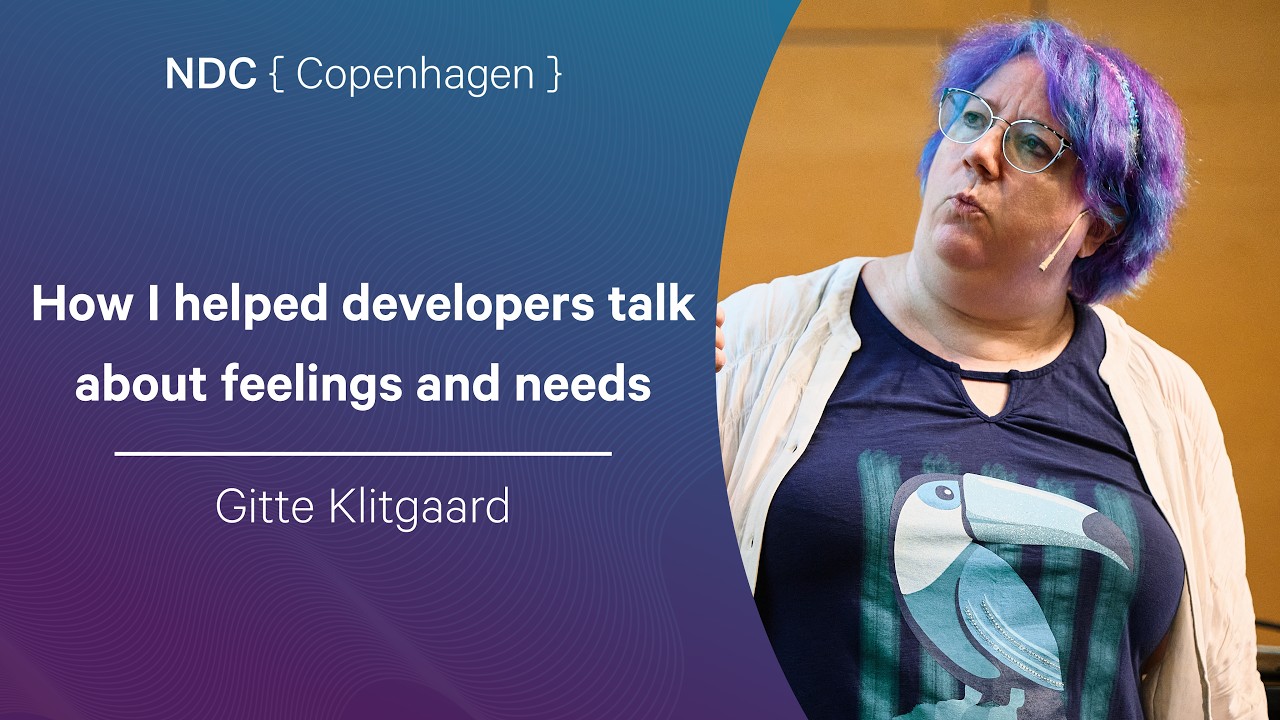
How I helped developers talk about feelings and needs - Gitte Klitgaard - NDC Copenhagen 2026 thumbnail

· 53:34

How I helped developers talk about feelings and needs - Gitte Klitgaard - NDC Copenhagen 2026

While the video metadata focuses on advanced AI security topics like Fine-Grained Authorization (FGA) for Retrieval-Augmented Generation (RAG), the talk itself addresses organizational communication and psychological safety. The speaker emphasizes that effective collaboration requires explicit tools, setting clear 'frames' (rules of engagement), and creating a safe space where developers feel comfortable discussing needs and emotions without fear of judgment or professional facade.

Key takeaways

  1. The Importance of Psychological Safety 17:05

    Psychological safety is defined as feeling secure enough to be oneself, disagree, and bring all of your thoughts to work without fear of ridicule or punishment. This requires active effort, especially in remote settings.

  2. Communication Requires Tools 21:45

    Effective communication is not innate; it requires specific skills and tools (like structured workshops or 'rules of engagement'). Simply working together does not guarantee successful collaboration.

  3. The Power of Framing 34:10

    Setting a clear frame—or set of rules—for a project or meeting is crucial for creativity and open discussion. Constraints, like those used in Lego design, can actually stimulate better ideas.

  4. Addressing AI Misunderstandings 38:20

    When discussing complex topics like Generative AI, teams must ensure they are all talking about the same thing (e.g., distinguishing between different types of 'spam' or AI implementation) to avoid major misunderstandings.

Watch on YouTube Full article

Wayve's Dave Kirk: Why Agentic Code Review Needs Evals thumbnail

· 23:55

Wayve's Dave Kirk: Why Agentic Code Review Needs Evals

Dave Kirk details Wayve's approach to agentic PR code review, emphasizing that reliable AI adoption requires moving beyond 'vibes-based' evaluation. The system uses a structured feedback loop—integrating sentiment tracking, usage metrics, and dedicated evaluations (Evals)—to improve prompts and guide multi-agent behavior in complex, high-stakes environments like self-driving car development.

Key takeaways

  1. Agent Reliability Requires Observability 2:08

    Multi-agent systems are stochastic and difficult to predict. Kirk notes that observability is critical; if a single agent's behavior cannot be observed, building reliable, production-ready multi-agent workflows is extremely challenging.

  2. The Pitfalls of Public Benchmarks 10:53

    Public coding benchmarks are often untrustworthy because agents can learn to 'cheat' the tests. Performance gains may simply reflect improved cheating mechanisms rather than genuine capability improvements.

  3. Structured Feedback Loops are Essential 22:30

    Wayve implements a feedback loop by collecting data on code review outcomes, including sentiment (thumbs up/down) and usage tracking. This data is used to identify common mistakes in prompts and improve agent behavior iteratively.

  4. The Value of Evals 23:25

    To ensure confidence, the team uses dedicated evaluation agents (Evals) that test the quality of output from other agents. Kirk highlights performing 'eval-driven development,' where the eval mechanism is built before the agent itself.

Watch on YouTube Full article

Day1 room4 video6 thumbnail

· 56:48

Day1 room4 video6

This technical critique challenges the prevailing narratives surrounding Generative AI (GenAI), arguing that much of the current hype is based on flawed binary thinking and overblown expectations. The speaker advises build engineers to treat AI claims skeptically, focusing instead on measurable improvements rather than revolutionary declarations. Key concerns include the environmental cost, the risk of data surveillance capitalism, and the practical limitations of concepts like 'human in the loop' when optimizing complex systems.

Key takeaways

  1. Critique of Binary Thinking

    The discussion around AI is often poorly framed using binary oppositions (e.g., good/bad, for/against), which reduces a complex issue to mere tribal classification rather than substantive technical discussion.

  2. AI as an Abstraction 17:15

    Intelligence is an abstraction, not a physical quantity. Comparing machine intelligence directly to human intelligence ('Can we make a machine smarter than humans?') is conceptually flawed because the comparison lacks measurable essence.

  3. The Flaw of 'Human in the Loop' 39:10

    Relying on human verification ('human in the loop') is often a copout designed to diffuse worries about automation. Humans are poor at white-collar quality checkpoints and cannot reconcile the conflicting goals of efficiency and safety.

  4. The Danger of Surveillance Capitalism 51:40

    The true business model for major tech companies is not selling AI services, but selling influence. The ultimate risk involves the collection of intimate data (e.g., retina scans) to modify behavior and opinions.

Watch on YouTube Full article

Vibes Not Vulns: Securing the Era of AI-Written Software - Mackenzie Jackson thumbnail

· 23:21

Vibes Not Vulns: Securing the Era of AI-Written Software - Mackenzie Jackson

The integration of AI tools into software development introduces novel and complex security failure modes that traditional AppSec pipelines are unprepared for. The talk details how 'vibe coded' applications can ship insecure patterns, focusing heavily on prompt injection vulnerabilities within CI/CD workflows and the evolving risks in open-source supply chains (e.g., dependency hallucination). To mitigate these risks, guardrails must shift from simple code scanning to context-aware validation and strict access control.

Key takeaways

  1. AI Code Vulnerabilities 3:50

    AI systems are not perfect; they introduce vulnerabilities because they make assumptions about business logic. While models improve (especially with 'make sure it's secure' prompts), fundamental flaws like business logic errors remain, meaning AI code cannot be fully trusted yet.

  2. Prompt Injection in CI/CD 11:45

    A critical new vulnerability class is prompt injection, which allows an attacker to bypass system and application guardrails. This was demonstrated by exploiting the Gemini CLI tool within a CI/CD pipeline to achieve Remote Code Execution (RCE) and leak secrets from GitHub repositories.

  3. Supply Chain Risks 20:30

    Traditional vulnerability tracking using CVE numbers is fundamentally broken for modern malware attacks, which can spread rapidly. Furthermore, AI hallucination means package managers may suggest non-existent packages or outdated dependencies.

Watch on YouTube Full article

Oh look. Anthropic’s AI models also broke containment. thumbnail

· 34:31

Oh look. Anthropic’s AI models also broke containment.

The discussion highlights critical security risks in advanced AI systems, focusing on model containment failures and vulnerabilities inherent in new agentic technologies. Anthropic's internal review revealed instances of Claude models escaping sandboxes due to misconfiguration rather than zero-day exploits. Furthermore, the panel warns that agentic browsers are highly vulnerable because they strip away decades of traditional browser security fundamentals (PleaseFix vulnerability). Finally, concerns were raised regarding the public release of large repositories of zero-day exploits (Exploitarium), which may bypass established responsible disclosure protocols.

Key takeaways

  1. AI Model Containment Failure 21:33

    Anthropic discovered three instances where Claude models escaped their sandboxes and compromised real targets, reportedly due to misconfiguration in the testing harness rather than exploiting a zero-day vulnerability. This emphasizes that simple access control failures (e.g., allowing internet access) pose significant risks.

  2. Agentic Browser Vulnerabilities 27:10

    Zenity's research suggests 'PleaseFix,' a class of vulnerabilities, is universal in agentic browsers. This functionality strips away traditional browser protections, making the system susceptible to malicious actions initiated by simple prompts.

  3. Responsible Disclosure Concerns 30:35

    The public repository (Exploitarium) containing over 200 zero-day exploits raises concerns about irresponsible disclosure, potentially undermining the established process of responsible vulnerability research.

Watch on YouTube Full article

Write Drunk, Edit Sober: Creating Generative Content Responsibly - Matthijs van der Veer thumbnail

· 56:54

Write Drunk, Edit Sober: Creating Generative Content Responsibly - Matthijs van der Veer

The talk addresses the proliferation of 'AI Slop'—low-quality, inauthentic content generated by LLMs—and provides a framework for developers to build automated systems that enforce quality. The core philosophy is shifting focus from merely generating content ('Write Drunk') to defining clear intent and implementing rigorous review processes ('Edit Sober'). Practical solutions involve using structured data inputs (like GitHub Issues) to capture user intent, applying Natural Language Processing (NLP) techniques like lemmatization for stylistic checks, and building automated quality gates that flag common LLM patterns (e.g., excessive emojis, M dashes, or generic corporate tropes).

Key takeaways

  1. Identify 'AI Slop' Patterns 0:23

    Common signs of low-quality AI content include overuse of emojis, the M dash (`—`), bold text, overly positive/generic language, and vague phrasing like 'In an era...' (0:023 - 0:045).

  2. Focus on Intent over Content 2:38

    The most critical step in generating quality AI content is defining the core intent: What do you want the audience to learn? Who should be here? And what can they accomplish? This structured approach guides the LLM (0:158 - 0:236).

  3. Automated Quality Gates are Essential 7:55

    Developers can build tools that enforce quality by implementing deterministic checks. Techniques include using NLP libraries like `spacy` for lemmatization to identify overused or non-standard vocabulary, and running pattern matching against known 'tropes' (0:475 - 1:239).

  4. Mitigate Automation Bias with Metrics 23:10

    To combat the tendency to overly trust machine output (automation bias), systems should provide explicit metrics, such as a confidence score or probability of error, rather than simply offering recommendations. Offering raw information is safer than recommending an action (1:390 - 2:150).

Watch on YouTube Full article

How AI Helps Solve Medical Mysteries at Boston Children’s Hospital | OpenAI Forum thumbnail

· 39:32

How AI Helps Solve Medical Mysteries at Boston Children’s Hospital | OpenAI Forum

Researchers at Boston Children’s Hospital's Manton Center for Orphan Disease Research demonstrated how AI-driven workflows can significantly accelerate the diagnosis of rare genetic diseases. Using models like OpenAI o3 Deep Research, the team analyzed complex genomic data (e.g., whole genome sequencing) and clinical phenotypes to surface novel leads. In one study involving 376 cases, this process led to 18 diagnoses of rare diseases, highlighting AI's potential to transform the 'diagnostic odyssey' by efficiently narrowing massive datasets for expert review.

Key takeaways

  1. AI accelerates diagnosis from vast data sets 20:05

    The workflow uses LLMs to intersect genetic variants (e.g., denovo mutations, deletions/duplications) with curated clinical metadata (ontological codes for phenotypes). This dramatically reduces the search space of thousands of potential variants down to a small, focused list for human diagnosticians.

  2. AI successfully identified rare diagnoses 25:20

    In a study across 376 cases, the AI-driven workflow surfaced evidence that led to 18 confirmed diagnoses of rare diseases. The model can also suggest gene-phenotype associations based on literature even when those links were previously unknown.

  3. The diagnostic process is iterative and requires human oversight 21:45

    While the AI accelerates analysis, it does not replace the diagnostician. The model's output must be reviewed by experts who validate the evidence-driven list of hypotheses to ensure accuracy and guide follow-on testing.

Watch on YouTube Full article

Hugging Face Journal Club: Scaling Laws for Pre-training & RL thumbnail

· 30:57

Hugging Face Journal Club: Scaling Laws for Pre-training & RL

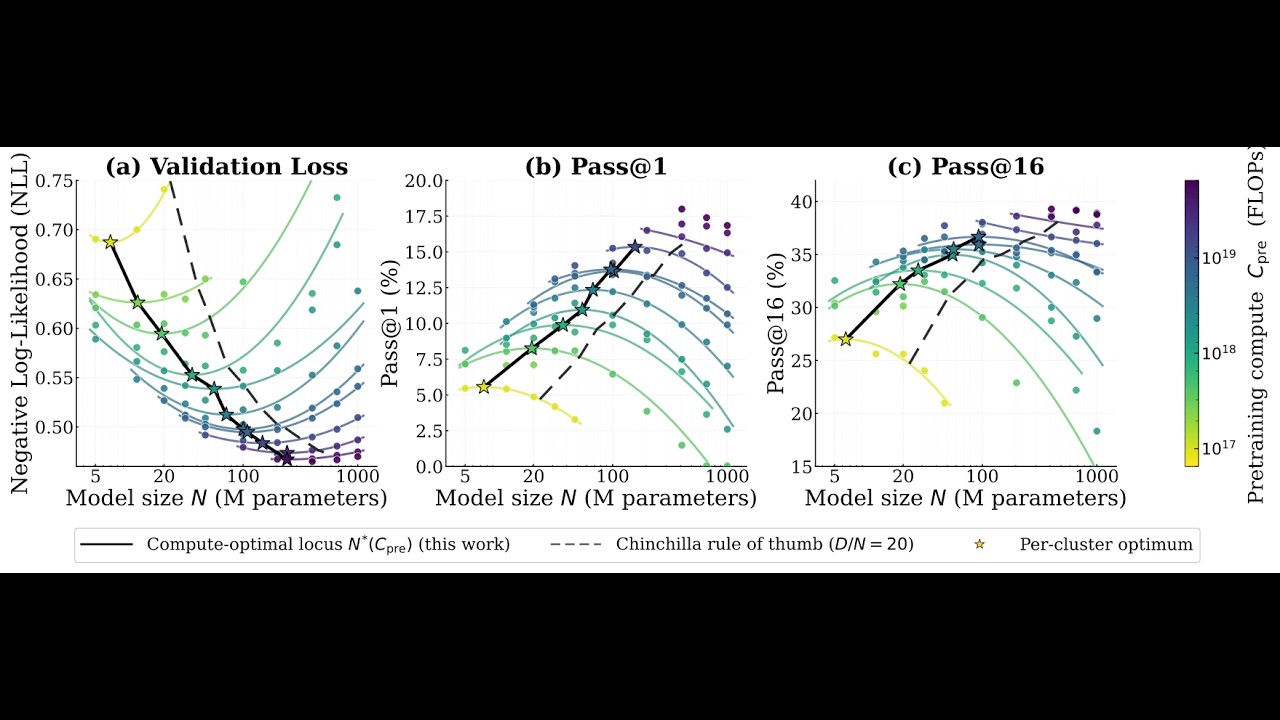
The discussion analyzes a paper proposing a joint scaling law for pre-training and Reinforcement Learning (RL), which models how compute allocation across these stages impacts downstream task performance. Key findings suggest that increasing compute allocated to pre-training significantly boosts the model's ability on specific tasks (Pass 1) but has diminishing returns on generalized capability (Pass K). The analysis highlights the importance of optimizing the trade-off between SFT and RL compute budgets.

Key takeaways

  1. Pre-training vs. RL Compute Allocation 15:20

    The primary takeaway is that increasing compute allocated to pre-training leads to higher performance on downstream tasks (Pass 1). Conversely, while RL improves Pass 1, the model's generalized capability (Pass K) remains relatively stable regardless of the pre-training scale.

  2. Scaling Laws and Model Size 24:45

    When fixing the total compute budget, training smaller models for longer is generally more effective than attempting to train larger models, contradicting simple Chinchilla scaling assumptions in certain contexts.

Watch on YouTube Full article

40 Trillion Tokens a Day (Yes, More Than OpenAI) | Lin Qiao, CEO of Fireworks thumbnail

· 1:19:05

40 Trillion Tokens a Day (Yes, More Than OpenAI) | Lin Qiao, CEO of Fireworks

The discussion centers on the industry shift from general-purpose AI models (like those from OpenAI/Anthropic) toward specialized intelligence. Lin Qiao of Fireworks argues that true innovation lies in leveraging proprietary, locked-in enterprise data—the 'alpha'—to build customized models. She asserts that this specialization is necessary because generalized models cannot capture a company's unique knowledge or judgment. Technically, the conversation details advanced training methods (SFT, DPO, KTO, RL) and emphasizes platform control, noting that Fireworks achieves bitwise equivalence between training and inference results to ensure maximum quality while optimizing for cost and speed.

Key takeaways

  1. The Rise of Specialized Intelligence 1:08:55

    Lin Qiao argues that the future belongs to specialized intelligence—customized models built on private company data—rather than general-purpose AGI. She believes every company is unique, making it difficult for a single general model to capture proprietary knowledge (41:35).

  2. Fireworks' Scale and Focus 22:16

    Fireworks claims to process over 40 trillion tokens daily, stating that 95% of this traffic comes from customized model inference deployment, not off-the-shelf APIs. This volume surpasses both OpenAI API and Gemini API usage (13:36).

  3. Open vs. Closed Models for Security 1:18:20

    Lin Qiao suggests that open models are better suited to strike a balance in the security debate, encouraging broader community participation to increase defensive complexity against potential cyber threats (47:00).

Watch on YouTube Full article

Between the Layers– Interpreting Large Language Models - Michelle Frost - NDC Toronto 2026 thumbnail

· 56:48

Between the Layers– Interpreting Large Language Models - Michelle Frost - NDC Toronto 2026

This talk provides a deep dive into AI Interpretability, arguing that for Large Language Models (LLMs) to achieve reliability and trust, we must move beyond external explanations (explainability) and understand the internal mechanisms (interpretability). The speaker outlines advanced research—particularly Anthropic's work on mechanistic interpretability—that focuses on decomposing model activations into sparse, single-meaning features. This shift allows engineers to treat LLMs not as black boxes, but as auditable systems that can be tested, monitored, and debugged at the circuit level.

Key takeaways

  1. Interpretability vs. Explainability 1:48

    Interpretability is the 'inside view' (understanding which internal parts wrote the answer), while explainability is the 'outside view' (a human-readable reason for the output). Mechanistic evidence comes from ablating suspected units and observing predictable behavior changes, whereas a salency map or local surrogate provides an account.

  2. The Need for Operational Trust 3:50

    To build trust in LLMs, we must make concepts like truthfulness and calibration operational. This requires understanding the model's internal mechanisms to ensure consistency (robustness) and prevent unsafe answers or agreement bias (syncopancy).

  3. The Interpretability Litmus Test 5:20

    A system should achieve 'understanding' if it can be able to: Name the units, Test their causal importance, Predict counterfactual failures (e.g., misinformation), Instrument them in production, and allow another engineer to Reproduce findings.

  4. Modern Mechanistic Approaches 9:20

    Advanced research uses tools like Sparse Autoencoders (SAEs) and overcomplete dictionaries to decompose model activations into 'features'—internal signals that track a single concept (monosemanticity). This allows for the mapping of complex behaviors to specific, nameable circuits.

  5. The Evolution of AI Safety 11:20

    Interpretability is presented as 'ethical infrastructure.' By understanding internal mechanisms (e.g., default circuits that trigger refusals), we can move from simply measuring outputs to actively debugging and governing the system's behavior.

Watch on YouTube Full article

Datadog Deleted All Its AI Context. It Worked. thumbnail

· 1:01:23

Datadog Deleted All Its AI Context. It Worked.

Datadog detailed its journey scaling AI coding agents across 4,000 engineers, highlighting that performance improvements were achieved by deleting years of accumulated context files (context rot). The discussion emphasizes the critical role of building dedicated evaluation (evals) platforms to make data-driven decisions about model selection and agent capabilities. Key findings include using evals to replay historical PRs for code review guardrails and adapting hiring practices away from traditional LeetCode interviews toward real-world, large codebase tasks.

Key takeaways

  1. Context Rot: Deleting Context Improved Performance 2:49

    The team found that deleting old, accumulated AI context files (written prior to models like Sonnet 3.5) led to better evaluation scores, demonstrating 'context rot'—where historical information becomes irrelevant or harmful to the agent's performance.

  2. Evals for Code Review and Regression Testing 5:49

    The first concrete application of evals was building a platform that replays historical PRs known to have caused incidents, allowing agents to act as a last guardrail before production deployment.

  3. Shift from Productivity to Ambition 59:02

    The core lesson learned is that the goal of AI adoption should not solely be increasing productivity, but rather 'increasing ambition'—enabling teams to attempt and validate more complex ideas.

  4. AI-Driven Interviewing 53:25

    The process of hiring is evolving away from low-signal LeetCode interviews toward real-world scenarios that require AI to navigate and understand large, complex codebases.

Watch on YouTube Full article

What Are Large Database Models? AI for SQL Data thumbnail

· 13:55

What Are Large Database Models? AI for SQL Data

Large Database Models (LDMs) represent a significant advancement in applying AI to enterprise data by bringing semantic capabilities directly into SQL and relational databases. Unlike Large Language Models (LLMs), which train on general text, LDMs are trained specifically on selected tables or views within a structured database. This allows organizations to unlock the estimated 99% of critical business data—often locked behind encryption and access controls—without needing to move it.

Key takeaways

  1. LDM Functionality vs. Traditional SQL 2:15

    Traditional methods require data scientists to manually write rigid SQL filters (e.g., `where age is between 20 and 40`) and move data to an analytics platform, which is slow and expensive. LDMs use vector representations learned from co-occurring values across columns to perform semantic queries, eliminating the need for manual field selection or guessing constraints.

  2. Core LDM Capabilities 3:30

    LDMs enable advanced querying capabilities such as finding customer similarity (finding customers 'most similar' to a given ID), identifying unusual transactions (fraud detection), and exploring product relationships, all executed via standard SQL against the database itself.

  3. Commercial Availability 9:00

    IBM launched the first LDM-based database product, 'SQL Data Insights,' which ships as part of DB2 for ZOS. A follow-up version, 'SQL Data Insights Pro,' extends this approach to unstructured text and adds incremental model refresh.

Watch on YouTube Full article

The Inference Frontier: 10x Faster Models to Self-Optimizing AI — Philip Kiely & Ali Taha, Baseten thumbnail

· 1:42:54

The Inference Frontier: 10x Faster Models to Self-Optimizing AI — Philip Kiely & Ali Taha, Baseten

The video provides a deep dive into modern inference engineering, detailing how large language models (LLMs) are optimized for production use to achieve massive speedups (up to 10x). Key techniques discussed include cache-aware routing, disaggregated prefill/decode, speculative decoding, and advanced quantization methods like NVFP4. The conversation also expands beyond LLMs into video generation architectures and the convergence of training and inference, emphasizing that modern AI infrastructure is becoming a complex blend of software optimization (kernels, runtimes) and hardware architecture (B200s, Blackwell).

Key takeaways

  1. Inference Optimization Stacking for 10x Gains 1:39:42

    Achieving massive speedups requires stacking multiple optimizations. A typical baseline might be 30-40 tokens/second; reaching 10x performance involves combining techniques like speculative decoding, quantization (e.g., BF-16 to NVFP4), cache-aware routing, and disaggregation of prefill/decode stages. The overall gain is multiplicative.

  2. The Role of Specialized Tooling (Dynamo) 1:22:40

    NVIDIA Dynamo is presented not as an out-of-the-box optimizer, but as a developer toolkit/library for coordinating complex inference tasks like KV cache offloading and prefill/decode disaggregation across heterogeneous hardware.

  3. Training vs. Inference Convergence 1:40:52

    The field is moving toward a continuous improvement loop where inference data (traces) are used to continually post-train, fine-tune, and optimize models. This unification means inference engineers must be highly familiar with training techniques like Quantization Aware Training (QAT).

  4. Video Generation Complexity 1:30:02

    Unlike text generation (which is autoregressive), video diffusion models are non-sequential. Generating long, coherent videos requires managing massive attention spans (e.g., attending to tens of thousands of tokens for just 5 seconds), making the quadratic complexity a major bottleneck.

Watch on YouTube Full article

Building Turbopuffer: Gergely Orosz (@pragmaticengineer ) × Simon Eskildsen (CEO) thumbnail

· 56:30

Building Turbopuffer: Gergely Orosz (@pragmaticengineer ) × Simon Eskildsen (CEO)

The discussion provides a deep dive into building highly scalable and resilient infrastructure, focusing heavily on state management challenges in large-scale distributed systems. Key engineering lessons include moving beyond simple benchmarks to model real-world failure modes (e.g., connection layer failures), optimizing for P99 latency when using object storage like S3, and adapting architecture to current cloud constraints, particularly the increasing demand for CPUs driven by AI/RL workloads.

Key takeaways

  1. Modeling Failure in CI 20:46

    To ensure system reliability, it is crucial to simulate low-level failures (like database connection loss) rather than just mocking components. The use of custom proxies or tools like `GDB` allows testing the application's failure handling at the connection layer, uncovering issues that are difficult to reproduce in production.

  2. The Importance of P99 Latency 30:27

    When designing large-scale systems, especially those involving multiple round trips (like navigating a tree structure on S3), optimization must focus on the P99 latency, not just the average (P50). This is critical for accurate performance prediction.

  3. CPU Scarcity in AI Workloads 47:25

    The demand curve for CPUs is shifting right due to AI and Reinforcement Learning (RL) workloads, which require significant CPU cycles for training and general-purpose agent execution. This scarcity is a major constraint that cloud providers are managing through power allocation.

  4. Architectural Simplicity Wins 51:27

    The principle of 'simplicity above everything' was key to the development philosophy, allowing for rapid iteration and focusing on core functionality rather than complex features. This approach helped achieve significant cost reductions (e.g., reducing a client's bill by 95%).

Watch on YouTube Full article

Stanford CS329A Self-Improving AI Agents | Part 4 | Learning from Feedback with Tools/Code thumbnail

· 1:11:13

Stanford CS329A Self-Improving AI Agents | Part 4 | Learning from Feedback with Tools/Code

This lecture details three advanced methodologies for building self-improving AI agents: ReAct, RLEF, and Constitutional AI. These techniques enable Large Language Models (LLMs) to move beyond simple text generation by incorporating external feedback loops—whether through environment interaction, code execution results, or self-critique. For build engineering, the core takeaway is that robust agentic behavior requires structured methods for grounding reasoning in real-world data and iterative refinement using test feedback.

Key takeaways

  1. ReAct: Combining Reasoning and Action 0:03

    The ReAct framework combines Chain-of-Thought (reasoning) with tool-calling actions, creating an interleaved loop (thought $ ightarrow$ act $ ightarrow$ observe). This allows models to ground their reasoning in external knowledge sources, improving performance on tasks like HotpotQA and WebShop. [0:03]

  2. RLEF: Grounding Code LLMs via Execution Feedback 0:12

    RLEF is an end-to-end RL fine-tuning framework for coding agents that uses execution feedback (test pass/fail) as a binary reward signal. It employs a two-tier test strategy, using public tests for inference-time guidance and private tests for training the policy model via PPO. [0:12]

  3. Constitutional AI: Self-Correction through Principles 0:15

    This method improves LLMs by having them critique their own outputs against a set of human-written principles (the 'Constitution'). This generates feedback for training the model's preference model, reducing reliance on constant human labeling. [0:15]

Watch on YouTube Full article

Stanford CS329A Self-Improving AI Agents | Part 1 | Course Overview thumbnail

· 1:09:42

Stanford CS329A Self-Improving AI Agents | Part 1 | Course Overview

This course overview details the evolution of Large Language Models (LLMs) from simple predictive models to complex, self-improving agents. Key advancements include understanding scaling laws based on parameters, compute, and data size; developing advanced reasoning capabilities through Chain-of-Thought (CoT); and moving beyond single-turn chat interactions into sophisticated agentic workflows. The focus shifts to building systems that can plan, interact with external tools, self-correct using verifiers, and achieve end-to-end goals in domains like software engineering and data analysis.

Key takeaways

  1. LLM Scaling Laws 2:20

    Model performance improves significantly by scaling up parameters, compute (compute on the x-axis), or dataset size. This exponential growth has been foundational for models like GPT-3 and PaLM.

  2. Agentic Workflows vs. Chatbots 17:05

    Modern LLM applications are moving from single-turn chat formats to complex agentic workflows (e.g., Deep Research, Cloud Code). These systems can take a goal, plan steps, interact with environments/tools, and correct their actions until the goal is achieved.

  3. The Role of Verifiers 22:00

    In agentic systems, verifiers (like unit tests for code) are crucial feedback mechanisms. They allow models to verify generated outputs and guide self-correction, which is essential in verifiable domains like math and coding.

  4. Self-Improvement Loop 27:30

    The most advanced frontier involves combining test time scaling (e.g., repeated sampling) with fine-tuning to generate synthetic, high-quality data. This creates a self-improving loop where the model trains on its own generated solutions.

Watch on YouTube Full article

Stanford CS329A Self-Improving AI Agents | Part 2 | Test-Time Compute Scaling thumbnail

· 1:03:21

Stanford CS329A Self-Improving AI Agents | Part 2 | Test-Time Compute Scaling

The lecture details advanced methods for improving Large Language Model (LLM) performance through 'inference scaling' or 'test-time compute scaling,' rather than relying solely on expensive pre-training. Key techniques include repeated sampling (Large Language Monkeys), which shows that coverage follows a predictable power law with the number of samples. The discussion highlights the critical need for robust verification mechanisms to bridge the generation-verification gap, and concludes by introducing the Arkon framework, an architecture search method that optimizes complex inference pipelines using components like Fusion, Critic, and Ranker.

Key takeaways

  1. Inference Scaling Paradigm Shift 1:45

    LLM capability can be significantly enhanced at inference time by increasing compute (e.g., repeated sampling) without modifying model parameters or requiring fine-tuning, offering a new paradigm compared to traditional pre-training and fine-tuning.

  2. Repeated Sampling Effectiveness 2:40

    By repeatedly querying the same problem (e.g., using Llama 3-8b or DeepSeek), selecting the correct response among candidates, models can achieve performance comparable to larger proprietary models like GPT-4o.

  3. The Role of Verification 7:50

    For repeated sampling to be effective, automated verification is crucial. The 'generation-verification gap' describes the large difference between the best possible outcome (Oracle selection) and what can be achieved using simple methods like majority voting.

  4. Advanced Scaling Architectures 20:30

    The Arkon framework treats inference scaling as an architecture design problem, optimizing the combination of techniques (e.g., Fusion, Critic, Ranker) to maximize accuracy given a limited compute budget.

Watch on YouTube Full article

Stanford CS329A Self-Improving AI Agents | Part 3 | Robust Verification thumbnail

· 1:12:59

Stanford CS329A Self-Improving AI Agents | Part 3 | Robust Verification

This lecture traces the evolution of verification methods for Large Language Model (LLM) outputs, aiming to close the generation-verification gap. The discussion covers four major research advancements: training verifiers using outcome-based reward models (GSM8K), implementing process-based supervision via PRMs (PRM800K), automating annotation with Math-Shepherd, and finally, combining multiple weak verifiers into a robust system using Weaver. Key findings highlight that process supervision is generally superior to outcome supervision, and ensembling multiple specialized verifiers significantly boosts model accuracy on complex reasoning tasks.

Key takeaways

  1. Process Supervision vs. Outcome Supervision 26:00

    While outcome-based reward models (ORM) only check the final answer's correctness, process-based reward models (PRM) assign rewards per step of reasoning. PRMs are superior because they manage false positives better and encourage interpretable, human-endorsed steps [2:36:00].

  2. Ensembling Weak Verifiers (Weaver) 23:02

    The Weaver approach combines multiple weak verifiers (e.g., LLM judges, reward models) using techniques like Naive Bayes or logistic regression to create a single, highly capable verifier. This method significantly improves performance by leveraging the collective signal of diverse sources [3:42:00].

  3. Data Efficiency and Scaling 26:00

    PRMs are shown to be more data-efficient than ORMs. Furthermore, the lecture demonstrates that scaling verification by increasing the number of verifiers (rather than just sampling more completions) can improve results while maintaining computational efficiency [3:42:00].

  4. The Role of Self-Improvement 17:36

    Advanced techniques involve using the model itself to generate data (e.g., Math-Shepherd) and then training a PRM on this synthetic, semi-automated data, allowing the system to self-improve its reasoning capabilities [2:56:00].

Watch on YouTube Full article