The Video Signal technical video digests

Agentic DX: Bringing IDP into your IDE thumbnail

· 20:35

Agentic DX: Bringing IDP into your IDE

This session details how a team tackled low developer adoption of an Internal Developer Platform (IDP) by implementing 'Agentic DX'—bringing agent functionality directly into the IDE. The solution centers on a Master Agent architecture that orchestrates multiple specialized agents using A2A protocols, ensuring secure and reliable context management while mitigating issues like hallucination snowballing and redundant development efforts.

Key takeaways

  1. Addressing Low IDP Adoption

    To overcome the 'chicken and egg' problem of low developer adoption (e.g., 22% usage), the team pivoted to a 'Bring Your Own Agent' strategy, integrating agentic capabilities directly into the IDE where developers naturally work.

  2. Master Agent Architecture 4:30

    The Master Agent acts as a single entry point and orchestrator, deciding which specialized agent should handle a user query. This approach prevents the complexity of naive canonical meshes where every agent can see every other agent.

  3. Context Hygiene via Decomposition 9:30

    To combat context pollution and improve reliability, the system was decomposed into four distinct loops: Perception (planner), Decision (executor), Action (tool caller), and Memory. This structured approach ensures each component has a defined responsibility.

  4. Security and Communication Protocols 3:00

    The platform mandates 'Zero Trust Execution' and requires human approval for every tool call or agent interaction. All agent-to-agent communication must adhere to the A2A protocol.
Watch on YouTube Full article

MCP Release Overview: Stateless and the Big Changes in the New Spec thumbnail

· 17:48

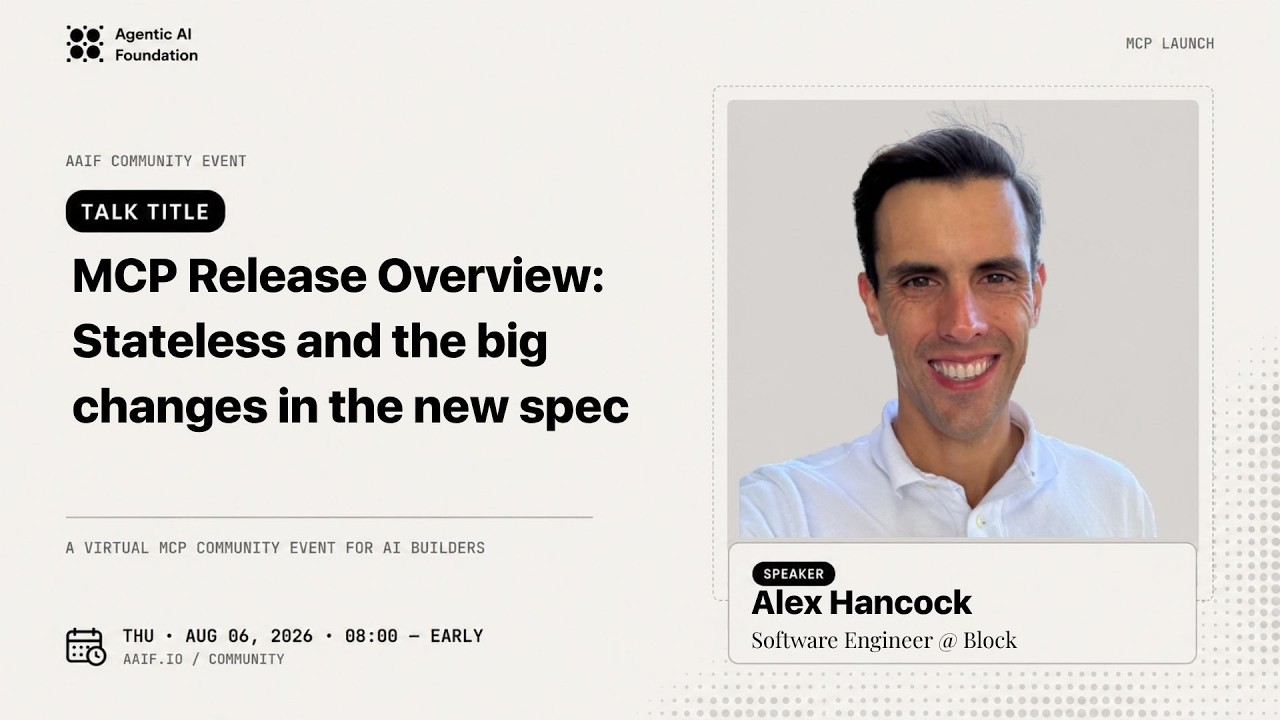
MCP Release Overview: Stateless and the Big Changes in the New Spec

The latest MCP specification introduces a major architectural shift toward statelessness, fundamentally changing how clients and servers interact. This transition addresses scalability issues inherent in previous stateful designs by ensuring every client request contains all necessary information for the server instance to process it independently. Key updates include Multi Roundtrip Requests (MRTR) for complex flows, formalizing extensions (like MCP Apps and Tasks), and enhancing authorization adherence.

Key takeaways

  1. Transition to Stateless Architecture 3:50

    MCP is moving from a stateful model that relied on session IDs and retained server-side state (requiring an `initialize` call) to a fully stateless design. This eliminates the need for complex shared session stores or sticky load balancing, enabling easier horizontal scaling across multiple server instances.

  2. Multi Roundtrip Requests (MRTR) 7:30

    MRTR simplifies complex tool calls by breaking them into multiple, discrete requests rather than relying on open streams and waiting for responses. This significantly reduces architectural overhead when deploying services behind load balancers.

  3. Formalized Extensions 9:40

    The protocol now supports formal extensions, allowing developers to add specialized functionality without modifying the core spec. Key examples include MCP Apps (for delivering rendered UI) and Tasks (for modeling long-running processes like database migrations or human-in-the-loop workflows).

  4. Authorization Improvements 12:40

    The specification enhances adherence to OAuth standards, requiring authorization servers to return the `iss` parameter. Clients must validate this before redeeming a code.

Watch on YouTube Full article

From Ambient Documentation to Clinical Intelligence — Chaitanya Asawa, Abridge thumbnail

· 21:35

From Ambient Documentation to Clinical Intelligence — Chaitanya Asawa, Abridge

The talk details Abridge's evolution from solving clinical documentation burnout—a high-stakes administrative problem in healthcare—to building comprehensive clinical intelligence tools. The speaker emphasizes that all healthcare processes are downstream of the doctor-patient conversation. Technically, the core challenges involve maintaining extremely high quality and low latency in a high-stakes environment, requiring novel approaches like decomposing complex tasks into smaller models (instead of relying solely on frontier LLMs) and developing sophisticated evaluation systems using expert human judges and rubrics to address the small generator/verifier gap.

Key takeaways

  1. The Centrality of Conversation 5:50

    All administrative processes in healthcare (billing, clinical decision support, etc.) are built around the core conversation between a doctor and a patient. Abridge aims to automate this entire downstream machinery.

  2. The Productivity Paradox in Healthcare 10:20

    Unlike many industries where productivity increases lower costs, administrative costs in healthcare have continued to rise over decades, creating a significant operational burden that technology must address.

  3. High Stakes AI Development

    In clinical decision support, the cost of being wrong is extremely high. This necessitates rigorous quality control and evaluation methods far beyond typical generative AI applications.

Watch on YouTube Full article

What should security leaders do with AI? They don’t know. thumbnail

· 29:15

What should security leaders do with AI? They don’t know.

Cybersecurity leaders face 'AI decision fatigue' due to the rapid pace of AI adoption and emerging threats. To mitigate this paralysis, experts recommend starting AI deployment with low-risk, repetitive tasks (L1/L2 alerts) or by arming red teams. The discussion highlighted sophisticated new attack vectors like Ghostjacking—which poisons trusted data sources (logs, alerts)—and questioned the reliability of AI in patching vulnerabilities. Overall, successful AI integration requires a 'human-in-the-loop' approach and strict adherence to Zero Trust principles, particularly regarding agent permissions.

Key takeaways

  1. Start AI deployment with repetitive tasks

    Initial AI adoption should focus on automating predictable, high-volume activities (e.g., triaging L1/L2 alerts or vendor risk assessments) to reduce staff fatigue and build confidence in the technology.

  2. Red Teaming is key for defensive AI use 17:25

    Equipping red teams with advanced tools allows them to simulate sophisticated threat actor behavior, enabling defenders to proactively develop countermeasures against emerging attack methods.

  3. Ghostjacking targets trusted data sources 17:25

    A new attack method involves sneaking malicious prompts into highly trusted systems like logs, alerts, and error reports. This is a sophisticated evolution of prompt injection that bypasses initial security controls.

  4. AI patching requires human oversight

    Research indicates AI-generated patches (e.g., using GPT 5.5) have a low success rate, often failing to solve the underlying vulnerability or creating new issues. Human validation and partnership are crucial.

Watch on YouTube Full article

How Claude's Text Watermarking Works thumbnail

· 47:47

How Claude's Text Watermarking Works

This video provides a deep technical explanation of how Anthropic's text watermarking for Claude models operates. The technique modifies the standard next-token sampling process by introducing determinism using a secret 'watermarking key.' Instead of relying purely on random probability distribution (e.g., via softmax and random choice), the model uses specialized functions and a tournament sampling method to ensure that certain token choices are predictable, making the generated text traceable. Detection is achieved by applying these same watermarking functions across the entire text and calculating an average score against a defined threshold.

Key takeaways

  1. Watermarking Location 0:24

    The watermark is applied at the *sampling* stage of the LLM generation process, not within the core model weights. This means existing LLMs can implement this feature without requiring full retraining or modification of the underlying model architecture. (24:45)

  2. Deterministic Sampling 0:16

    The watermarking mechanism converts standard random sampling into a deterministic process by using a secret 'watermarking key' and previous tokens to derive a fixed random seed, ensuring that the same input always yields the same sequence of watermarked tokens. (16:19)

  3. Tournament Sampling 0:36

    To make detection efficient, the process uses 'tournament sampling.' Instead of simple random choice, plausible next tokens are paired up and compared using multiple specialized watermarking functions ($G_1, G_2, ext{etc.}$), which determines the final selected token. (36:36)

  4. Detection Method 0:47

    Watermark detection is performed by running the text through the same set of watermarking functions and calculating an average score across all positions. If this average score exceeds a specific threshold, the text is flagged as watermarked. (47:13)

Watch on YouTube Full article

Infra behind Krea 2: How to train and serve at scale — Gabriel Jorge Menezes, Krea.ai thumbnail

· 16:55

Infra behind Krea 2: How to train and serve at scale — Gabriel Jorge Menezes, Krea.ai

Gabriel Jorge Menezes details the complex infrastructure required to train and serve Krea 2, a diffusion transformer model trained from scratch on thousands of GPUs. The system addresses challenges like silent failures at scale, GPU thermal throttling, and cross-node communication issues by implementing advanced monitoring (tensor core utilization, InfiniBand metrics). For serving, they built a robust architecture using Gang scheduling and Kubernetes features (virtual kubelet, taints/tolerations) to ensure training workloads can utilize the entire cluster while maintaining production uptime through seamless traffic flipping.

Key takeaways

  1. Metrics are essential for large-scale pre-training 9:50

    Do not rely on GPU utilization (which is 'a lie'). Instead, monitor tensor core utilization and collect custom metrics like InfiniBand/NVLink errors, as most failures relate to cross-node communication. [5:58], [6:48]

  2. Embrace failure for stability 4:18

    When scaling training runs, instead of debugging every crash, it is often more efficient to 'let it crash.' The system should be designed to recover and run successfully on the same nodes over extended periods. [4:18]

  3. Checkpointing must be extremely fast 8:29

    To make long training runs survivable, checkpoint aggressively against a high-speed filesystem capable of writing terabytes quickly (e.g., achieving >1 TB/30 seconds). [8:29]

  4. Decouple training and production workloads 11:01

    Use a system that allows high-priority training jobs to utilize the entire cluster while seamlessly migrating inference traffic (production) to external providers or other clusters, ensuring zero downtime. [11:01]

Watch on YouTube Full article

Generative Video at the Speed of Light — Keegan McCallum, uRun thumbnail

· 8:43

Generative Video at the Speed of Light — Keegan McCallum, uRun

The presentation shifts the focus of generative video from improving quality (e.g., Sora) to maximizing efficiency and enabling long-horizon, real-time interaction. The core argument is that the limiting factor is no longer model fidelity but the serving infrastructure required for continuous, synchronized streaming. Key technical requirements include global GPU distribution, WebRTC/ICE/TURN setup, and complex pipelines capable of integrating multiple models (e.g., video-to-video transformation) in real time.

Key takeaways

  1. Shift from Quality to Efficiency 3:55

    The most significant axis of improvement is efficiency and long horizon generation, allowing for continuous streaming at a fraction of the cost compared to slower, high-quality generations. For example, real-time generation can be produced at about 1/100th the cost of minutes-long clips.

  2. Cost and Accessibility 6:24

    Generative video is becoming highly accessible: $10 can now buy roughly three hours of continuous generated video, while $50 could provide up to 15 hours of interaction.

  3. New Interaction Paradigms 7:18

    The technology enables new use cases beyond simple content creation, such as 'magic mirrors' (transforming a webcam feed in real time) and providing visual mediums for users who do not think primarily in text.

Watch on YouTube Full article

Introducing: LangSmith Tuned Evaluators thumbnail

· 4:11

Introducing: LangSmith Tuned Evaluators

LangSmith Tuned Evaluators provide an automated, cost-effective way to attach quality feedback (signals) directly to production traces and threads for AI agents. These out-of-the-box evaluators analyze agent interactions—such as identifying perceived errors or misunderstandings—and surface failure modes that traditional system error logging misses. LangChain manages the entire evaluation pipeline, including prompt writing, judge model management, and inference infrastructure, allowing teams to focus on agent improvement workflows.

Key takeaways

  1. Automated Quality Feedback

    Tuned Evaluators automatically attach useful feedback signals to production traces and threads, helping identify agent behavior that needs attention (e.g., misunderstood user intent or contradictory answers).

  2. Perceived Error Detection

    The initial evaluator, Perceived Error, analyzes multi-turn conversations to detect potential mistakes by the agent, even when no explicit system error occurs. This signal can be derived from subtle patterns like unresolved outcomes or user pivots.

  3. Turnkey Management

    LangChain handles the entire evaluation lifecycle end-to-end: writing/testing prompts, managing judge models, benchmarking, and running inference infrastructure, eliminating the need for users to manage complex components. (See 0:28)

  4. Implementation Steps 0:12

    To use Tuned Evaluators, an organization admin must first enable the feature in LangSmith settings. After enabling, the evaluator can be attached to specific tracing projects.

Watch on YouTube Full article

Voice agents with Realtime Video — Sidney Primas, LemonSlice thumbnail

· 26:36

Voice agents with Realtime Video — Sidney Primas, LemonSlice

LemonSlice aims to break the Avatar Turing test by creating highly realistic, real-time video avatars. The core technical challenges addressed include achieving emotional expressiveness (requiring specialized audio encoders beyond monotone audiobook data), mitigating error accumulation over extended generation periods (e.g., 8+ hours), and optimizing for real-time performance. A major focus is on the 'model harness'—the complex orchestration of threads and queues across GPU/CPU to ensure uninterrupted, stutter-free video streaming at scale. The company also highlights cost parity, noting that generating high-resolution video costs comparably to running a voice model.

Key takeaways

  1. Real-Time Video Generation Challenges 17:05

    Generating real-time avatars requires training models with an attention mask that enforces looking only into the past, as future frames do not exist yet. Furthermore, speeding up generation involves collapsing many denoising steps (e.g., 30 steps) down to a single step.

  2. Error Accumulation Mitigation 20:22

    A significant technical hurdle is error accumulation, where errors introduced in previous video blocks compound over time. The company claims to have developed a novel method to generate very long videos with no noticeable error buildup.

  3. Model Harness and Cost Parity 23:54

    The most durable value lies in the 'model harness'—the orchestration of threads and queues across GPU and CPU to maintain real-time, stutter-free video. Surprisingly, serving this complex visual layer costs about the same as serving a voice model.

  4. Future Direction: Emotional Engine

    The next generation involves building an 'emotion engine' that predicts and controls emotional reactions and actions based on both audio input and text input, moving beyond current awkward interactions.

Watch on YouTube Full article

While my guitar gently speaks — Todd Fisher, Philo Ventures thumbnail

· 18:35

While my guitar gently speaks — Todd Fisher, Philo Ventures

Todd Fisher details his project to make a guitar speak, showcasing an evolution from simple audio effects to complex AI-driven speech and singing synthesis. The process involves integrating multiple technologies: using JUCE for plugin development, employing advanced signal processing techniques like Energy Gap Segmentation and Sonority Peak Syllabification for word slicing, and utilizing algorithms such as YIN pitch detection and vocoders to achieve synthesized vocals.

Key takeaways

  1. Initial Goal: Making the Guitar Speak

    The project started with the goal of having a guitar respond to questions from the room, moving beyond traditional effects like the talk box. This was initially achieved by playing pre-recorded audio files.

  2. Word Segmentation Challenges 12:30

    Automatically slicing speech into words is challenging because standard methods (like Energy Gap Segmentation, which relies on silence) fail when spoken words run together. The speaker explored Sonority Peak Syllabification as an alternative.

  3. Singing Synthesis Pipeline 17:03

    To make the guitar sing, the process requires detecting the fundamental frequency using the YIN algorithm. This pitch is then used to shape a synthesized note (via ADSR) and passed through a vocoder, which maps it onto pre-baked, pitch-shifted vocal samples.

  4. Advanced Interaction: LLM Integration

    The most advanced step involves using speech-to-text (Whisper) to capture a question, feeding it into a local Large Language Model (LLM), and then playing the resulting text response through the guitar's synthesis system.

Watch on YouTube Full article

Building an Agentic Video Editor for Mass Consumer — Ekaterina Deyneka, Reelful thumbnail

· 12:45

Building an Agentic Video Editor for Mass Consumer — Ekaterina Deyneka, Reelful

Reelful addresses the complexity of video editing by implementing an agentic workflow that automates content creation from raw footage. The system accepts user media and directional prompts, utilizing a multi-stage pipeline—including Media Understanding, Creative Planning, and execution within a sandboxed environment—to generate polished videos. Architecturally, the process is compared to agentic app building, but with the added complexity of judging optimal cuts and structure from messy, real-world footage.

Key takeaways

  1. Agentic Video Editing Definition 2:09

    The user provides raw media and context/directions (e.g., 'add captions,' 'add music'). The agent then autonomously finds usable moments, assembles the clip, and generates supplementary assets like captions, music, voiceovers, and B-roll.

  2. Architectural Parallelism 5:33

    From an infrastructure standpoint, agentic video editing is structurally similar to agentic app building. Both require a prompt/input (media + prompt for video) and execute within a remote 'sandbox' environment by an agent equipped with tools and skills.

  3. The Challenge of Editing vs. Generating 6:50

    Editing real footage is significantly more complex than generating content from scratch, as the agent must actively judge which moments to keep or omit and organize messy, incomplete material into a polished result.

  4. The Full Agentic Pipeline 8:50

    The process involves: (1) Media Understanding/Transcription $ ightarrow$ (2) Creative Plan generation (for user approval) $ ightarrow$ (3) Sandbox execution by the agent (using skills like cut rules, font pairings, B-roll generation) $ ightarrow$ (4) Remotion composition $ ightarrow$ (5) Verification Layer (to ensure renderability).

Watch on YouTube Full article

Elon's Former Battery Chief on Making Transformers 100x Smaller | Drew Baglino, Heron Power thumbnail

· 1:34:09

Elon's Former Battery Chief on Making Transformers 100x Smaller | Drew Baglino, Heron Power

The video discusses the fundamental infrastructure overhaul required to support the explosive energy demands of AI data centers. Drew Baglino, CEO of Heron Power, details how current grid-to-chip transformers are inefficient and bulky. He presents solutions utilizing wideband gap semiconductors (like Silicon Carbide/GaN) to achieve solid-state power conversion at hundreds of kilohertz, enabling transformers that are 100 times smaller volumetrically. This technology can reduce grid-to-chip power loss by a factor of two, potentially unlocking significant additional compute capacity for gigawatt data centers.

Key takeaways

  1. Data Center Energy Loss 20:56

    A data center consuming one gigawatt (GW) of power converts it into approximately 700 megawatts (MW) of heat, with about 300 MW lost to the atmosphere. This inefficiency necessitates grid-level improvements.

  2. Heron Link Transformer Innovation 22:30

    The core product, Heron Link, utilizes high-frequency switching (hundreds of kilohertz) instead of traditional 60 Hz methods. This allows for a transformer that is 100 times smaller volumetrically per unit power compared to existing oil-filled units.

  3. Wideband Gap Semiconductors 25:26

    Materials like Silicon Carbide (SiC) and GaN enable the creation of highly engineered, small transistors capable of handling extremely high voltages (e.g., 10,000 volts), allowing power devices to be smaller than traditional GPUs while maintaining superior performance.

  4. Grid Modernization Necessity 44:50

    The current utility incentive model, built on historical low load growth, is unsustainable for the projected 3-4-5% annual electrification growth required by AI and electric vehicles. This necessitates a shift to active, solid-state infrastructure.

Watch on YouTube Full article

Training Krea 2: What matters in generative model training — Sangwu Lee, Krea.ai thumbnail

· 21:46

Training Krea 2: What matters in generative model training — Sangwu Lee, Krea.ai

Sangwu Lee details the training methodology for Krea 2, an open-sourced image foundation model, emphasizing that data curation is the most critical factor after architecture is locked. The talk contrasts production models (like ChatGPT-2) which prioritize consistency and reliability but suffer from mode collapse, with Krea 2's focus on stylistic diversity and fast iteration. Key techniques covered include advanced deduplication using hash-based methods (pHash/MD5) followed by embedding-based approaches (SigLip), specialized captioning pipelines to capture contextual details (e.g., a painting being framed), and multi-stage training from low to high resolution.

Key takeaways

  1. Data is Paramount for Model Quality 9:59

    After locking in the architecture, data curation determines model performance. The goal was to maximize stylistic diversity while filtering out undesirable content (e.g., images where captions consistently fail to capture important context) and avoiding reliance on synthetic AI-generated training data due to its 'sticky' aesthetic.

  2. Balancing Consistency vs. Diversity 2:20

    Large production models often achieve high consistency by focusing on the 'average' subject (e.g., a boring average person), leading to mode collapse and limited stylistic range. Krea 2 was designed to optimize for fast generation and broad stylistic exploration, catering to creative studios that are still defining their visual goals.

  3. Advanced Deduplication and Filtering 16:55

    Deduplication runs first on basic hashes (pHash or MD5) across billions of images, followed by embedding-based methods like SigLip to remove near duplicates. Filters are also applied using large vision language models (VLMs), which are then distilled into cheap classifiers for scalable filtering over massive datasets.

  4. Multi-Stage Training Pipeline

    The training process progresses through several stages: low to high resolution pre-training (learning semantics first, then structure/detail), supervised fine-tuning (SFT), preference optimization (collecting user pairs for comparison), and Reinforcement Learning (RL). The final step involves training a prompt expander LLM to generate detailed prompts that align with the model's trained data distribution.

Watch on YouTube Full article

Every Repo Is a Software Factory Now | Don Syme, GitHub thumbnail

· 1:04:36

Every Repo Is a Software Factory Now | Don Syme, GitHub

This talk explores the concept of 'Continuous AI,' defining it as an evolution that extends traditional Continuous Integration and Continuous Deployment (CI/CD) into subjective, automated activities like documentation updates and bug triage. The core mechanism for this is the use of GitHub Agentic Workflows, which run coding agents with strong guardrails within a bounded repository context. The discussion emphasizes that while AI offers incredible power, maintaining quality gates, controlling costs, and ensuring human oversight remain critical to building reliable 'software factories.'

Key takeaways

  1. Continuous AI vs. CI/CD 5:52

    Continuous AI extends the principles of CI/CD by applying automation to subjective activities (e.g., documentation, bug triage) that are not inherently deterministic like traditional build checks. It requires operationalizing these processes on a permanent basis [00:03:52].

  2. Bounding the Context is Key 10:42

    To prevent automated AI agents from 'going off the rails,' they must operate within a strictly bounded context (e.g., restricted to creating a single pull request or issue) [00:09:42]. This situates the automation, making it manageable and auditable.

  3. The Repo as the Unit of Production 13:59

    GitHub Agentic Workflows are designed around the repository being the primary unit of production and security boundary. This repo-centric approach aligns with established CI/CD principles while enabling advanced AI automation [00:25:19].

  4. Quality Gates and Human Review 5:12

    The focus shifts from human review as a bottleneck to creating automated, high-quality pull requests. The goal is to 'equip the reviewer' with all necessary information (e.g., performance evidence) to make informed decisions [00:52:01].

  5. Complexity Management 3:59

    For maintainers, a single supervisor orchestrator pattern workflow that can perform multiple tasks is preferred over an 'agent zoo' of many individual workflows. This simplifies maintenance and provides better cost control [03:59:00].

Watch on YouTube Full article

What Is the AI Security Trilemma? Smart, Fast, or Secure AI? thumbnail

· 9:03

What Is the AI Security Trilemma? Smart, Fast, or Secure AI?

The AI Security Trilemma describes the inherent conflict in designing advanced AI systems: it is challenging to achieve high levels of intelligence (Smart), speed (Fast), and security (Secure) simultaneously. The core issue is that increasing a model's capability (e.g., giving it more tools or memory) expands its attack surface, while implementing robust security measures (like sandboxing or human oversight) introduces friction and latency.

Key takeaways

  1. The AI Security Trilemma Defined

    AI systems must balance three conflicting goals: Smartness (capability/reasoning), Speed (low latency/real-time action), and Security (preventing attacks like prompt injection). Sacrificing one often compromises the others.

  2. Capability Increases Attack Surface 3:50

    As AI agents gain abilities—such as memory, internet access, tool use (APIs), or sensor input/actuator output—the system becomes more powerful but also presents new pathways for attack.

  3. Security Measures Introduce Friction 2:30

    Implementing security controls like inspection, filtering, guardrails, sandboxing, and logging is necessary but inherently introduces friction, which slows the system down. This conflict makes achieving real-time safety difficult.

  4. Mitigation via AI Security Proxies 7:00

    A promising approach is implementing an AI security proxy—a policy enforcement layer placed outside the core model. This layer inspects inputs, sanitizes outputs, and controls tool permissions, allowing the model to remain smart and fast while externalizing the security function.

Watch on YouTube Full article

Building a distributed training framework from first principles thumbnail

· 19:34:45

Building a distributed training framework from first principles

This video provides a comprehensive, first-principles derivation and implementation guide for building modern distributed training frameworks using PyTorch. The content covers advanced topics necessary for scaling large language models (LLMs), including various forms of parallelism (Data, Tensor, Pipeline, Expert), specialized attention mechanisms (MLA, RoPE), and context window extension techniques (YaRN). A significant portion is dedicated to the mathematical foundations, such as FLOPs calculation ($6NP$) and weight initialization theory, which are crucial for build-engineering teams designing high-performance AI infrastructure.

Key takeaways

  1. Distributed Parallelism Techniques 3:00:00

    The framework combines multiple parallelism types—Pipeline, Data, Tensor, Context, and Expert—into a single working system. This approach ensures that the movement of tensors, communication operations, and gradients are tracked holistically across devices.

  2. Mixture-of-Experts (MoE) 1:43:20

    To scale models without increasing inference latency linearly with parameter count, MoE uses a router to selectively activate only the top-$k$ experts for each token. This concept is vital for achieving compute optimality.

  3. Rotary Position Embeddings (RoPE) 4:10:00

    RoPE encodes positional information by rotating query and key vectors in a complex plane, ensuring that the resulting dot product depends only on the relative distance between tokens, solving the issue of absolute position bias inherent in traditional methods.

  4. YaRN for Context Extension 6:23:20

    To extend context windows (e.g., from 4k to 16k), YaRN addresses RoPE's weakness—the model learning absolute position bias. It interpolates the frequencies, scaling low-frequency dimensions while leaving high-frequency dimensions untouched.

  5. Computational Complexity (FLOPs) 2:50:00

    The FLOPs required for training a transformer model are approximated by $6NP$ (where N is tokens and P is parameters), derived from analyzing the forward and backward passes of matrix multiplication. This metric guides resource allocation and scaling law analysis.

Watch on YouTube Full article

Build a live translation broadcast app with the Gemini Live API and LiveKit thumbnail

· 12:37

Build a live translation broadcast app with the Gemini Live API and LiveKit

This guide details building a real-time multilingual broadcast application using Gemini 3.5 Live Translate via the Gemini API, integrated with LiveKit and deployed on Google Cloud Run. The system efficiently manages multiple language streams by ensuring only one active translation session exists per target language, subscribing new listeners to existing sessions rather than creating redundant ones. The architecture leverages WebSockets for persistent connections and utilizes Next.js for deployment.

Key takeaways

  1. Efficient Session Management 0:58

    The application maintains a maximum of one session per requested target language, subscribing subsequent listeners to the existing LiveGenkit room rather than spinning up new sessions (demonstrated at 0:58).

  2. Deployment Architecture 1:59

    The solution uses Next.js deployed on Google Cloud Run, which allows for hosting long-running WebSockets and managing the necessary stateful connections (1:39).

  3. Scaling Limitations 3:20

    The current demo manages translation details in memory, limiting it to a single Cloud Run instance. Scaling beyond this requires externalizing state management using a database (3:20).

Watch on YouTube Full article

JSON Schema 2020-12 and the Contract for Context | ​Ola Hungerford | MCP Release Party - Seattle thumbnail

· 16:08

JSON Schema 2020-12 and the Contract for Context | ​Ola Hungerford | MCP Release Party - Seattle

This talk details the critical evolution of the Model Context Protocol (MCP), emphasizing that the schema acts as the 'contract for context' between tools and LLMs. The major update is the adoption of JSON Schema 2020-12 for tool definitions, replacing previous limited subsets. This upgrade significantly enhances expressiveness in both input and output schemas, allowing developers to use advanced keywords (like `allOf` and conditional constraints) and enabling better pre-LLM validation.

Key takeaways

  1. Schema as Contract

    In MCP, the schema defines the contract for context—how a tool specifies what data it accepts and returns. This is crucial for reliable LLM interaction.

  2. Adoption of JSON Schema 2020-12 2:34

    MCP now conforms to JSON Schema 2020-12, aligning with the default dialect used by OpenAPI 3.1. This was achieved via SEP 2106 and expands support beyond previous limited subsets.

  3. Enhanced Input/Output Schemas 3:55

    Input schemas gain full JSON Schema 2020-12 support, allowing for complex conditional keywords (e.g., `allOf`). Output schemas no longer face the same restrictive limitations as before.

Watch on YouTube Full article

MCP Goes Stateless | ​John Dellenbaugh & Pankaj Kumar | MCP Release Party - Seattle thumbnail

· 22:41

MCP Goes Stateless | ​John Dellenbaugh & Pankaj Kumar | MCP Release Party - Seattle

This session details the transition of the MCP protocol to a stateless architecture, significantly simplifying horizontal scaling for AI agent workflows. Previously, maintaining state required complex infrastructure like sticky gateways and dedicated session stores. The new stateless specification eliminates this dependency, allowing agents to interact with services across multiple instances using standard load balancing techniques while preserving conversational context.

Key takeaways

  1. MCP Protocol Goes Stateless 2:25

    The updated MCP specification (2026-07-28) makes the protocol stateless, eliminating session management at the protocol level. This removes a major architectural bottleneck for scaling.

  2. Scaling Challenges in Stateful Systems 5:40

    In stateful setups, scaling out instances leads to 'session not found' errors because subsequent requests may land on an instance that does not hold the session data created by a previous instance.

  3. Infrastructure Overhead of State Management 7:30

    To maintain state in legacy systems, developers must implement complex infrastructure like sticky gateways (mapping Session ID to Instance ID) and dedicated session stores, adding significant overhead.

  4. Stateless Scaling Benefits 10:50

    The stateless model allows for standard load balancing across multiple instances without requiring external state management infrastructure. The cart ID effectively replaces the need for a dedicated session store.

Watch on YouTube Full article

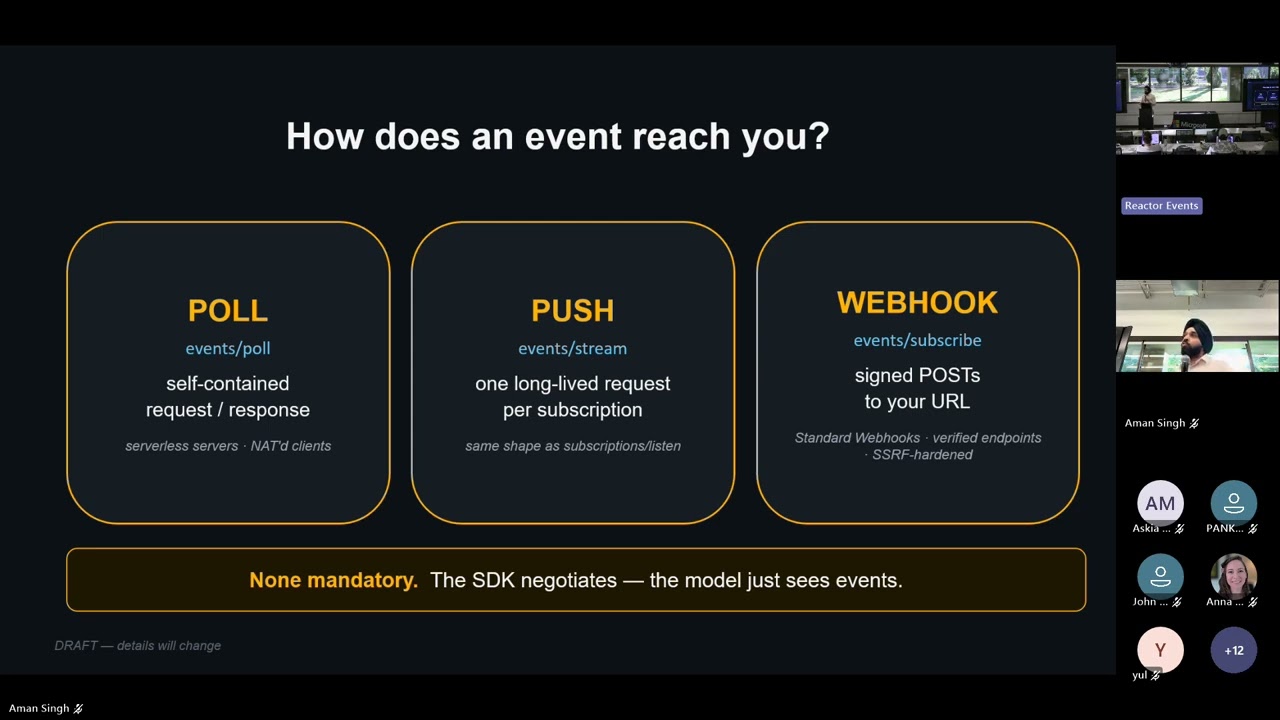
Events Notifications in MCP | ​Aman Singh | MCP Release Party - Seattle thumbnail

· 19:30

Events Notifications in MCP | ​Aman Singh | MCP Release Party - Seattle

The talk introduces a proposed protocol extension for MCP (Messaging/Communication Protocol) designed to enable structured event streams. Currently, MCP only provides lightweight notifications that something has changed without specifying *what* changed or providing a payload. The new Events feature allows agents to subscribe to real-world events (e.g., incidents, emails), supporting three delivery modes—polling, push, and webhooks—to ensure reliable, low-latency communication while maintaining stateless server architecture.

Key takeaways

  1. Structured Event Streams 2:03

    Events allow MCP servers to declare event types with a name, input schema for subscription parameters, payload schema, and supported delivery modes. This moves beyond simple URI notifications to structured data payloads.

  2. Three Delivery Modes 4:00

    The proposed system supports three non-mandatory delivery methods: Simple Polling (self-contained requests using a cursor), Push (for low-latency, long-held connections), and Webhooks (server posts events to a client-provided URL).

  3. Stateless Architecture 6:25

    The new design maintains MCP server statelessness. Polling is inherently stateless, allowing servers to sit behind load balancers and scale horizontally. The SDKs are expected to abstract the complexity of managing these modes for developers.

Watch on YouTube Full article