The Video Signal technical video digests

Stanford CS229 Machine Learning | Spring 2026 | Lecture 14: Transformers, In-Context Learning thumbnail

· 1:17:32

Stanford CS229 Machine Learning | Spring 2026 | Lecture 14: Transformers, In-Context Learning

This lecture provides a deep technical dive into Large Language Models (LLMs), focusing on the Transformer architecture. Key concepts covered include subword tokenization (using techniques like Byte Pair Encoding - BPE) to convert text into numerical IDs, and modeling language distribution using auto-regressive conditional probabilities. The core mechanism is the self-attention layer, which uses Query (Q), Key (K), and Value (V) vectors to determine dependencies between tokens. A critical technical discussion centers on computational efficiency: standard attention has a quadratic $O(T^2)$ dependency on sequence length ($T$), leading to memory and computation bottlenecks for long contexts. Solutions like masking and specialized variants (e.g., Flash Attention) are discussed as methods to maintain performance while managing resource constraints.

Key takeaways

  1. Auto-Regressive Modeling 1:35

    LLMs model language distribution by decomposing the joint probability into a product of conditional probabilities: $P(X_t | X_{1...t-1})$. This requires generating tokens sequentially, making the process auto-regressive.

  2. Subword Tokenization (BPE) 3:30

    To handle rare or long words efficiently, models use subword tokenization (e.g., BPE), which breaks down text into smaller units (tokens). This allows leveraging common prefixes and suffixes to understand novel words.

  3. Self-Attention Mechanism 11:10

    The attention mechanism calculates the relevance between all tokens in a sequence using Query ($Q$), Key ($K$), and Value ($V$) vectors via an inner product: $ ext{Softmax}(Q K^T / ext{scale}) V$. The output is a weighted linear combination of $V$ vectors.

  4. Causal Masking for Auto-regression 21:20

    To ensure the model only predicts based on previous tokens (required for generation), a masking technique is applied to the attention matrix, setting all future dependencies to $- ext{infinity}$ before applying Softmax.

  5. Computational Bottleneck ($O(T^2)$) 30:00

    The standard self-attention mechanism has a computational and memory complexity that scales quadratically with sequence length $T$ (i.e., $O(T^2)$). This is the primary limitation for processing very long contexts.

Watch on YouTube Full article

Scaling to Long Horizons — Ross Taylor & Chengxi Taylor, General Reasoning thumbnail

· 18:07

Scaling to Long Horizons — Ross Taylor & Chengxi Taylor, General Reasoning

The talk discusses scaling AI agents to solve long-horizon problems, arguing that success requires a shift in mindset from merely increasing context windows to improving environment quality and algorithmic efficiency. Key technical advancements include using value models (critics) to reduce gradient variance and employing techniques like compaction and bootstrapping to manage sparse rewards over extended trajectories. The speakers emphasize that real-world complexity and robust simulation environments are more critical than simply having larger base models.

Key takeaways

  1. Long Horizon is a Mindset, Not Just an Engineering Problem 15:12

    Solving major human challenges (e.g., curing cancer) requires patience and thinking in long timeframes, necessitating a fundamental shift in how AI systems are designed for sustained coherence.

  2. RLHF is Crucial for Productizing LLMs 4:00

    The breakthrough that made LLMs usable was not the base model size, but the application of Reinforcement Learning from Human Feedback (RLHF), which provided necessary alignment and structure.

  3. Value Models Mitigate Long-Horizon Challenges 16:56

    To handle long trajectories, value models (critics) are essential for reducing gradient variance and facilitating credit assignment, which is necessary when rewards are sparse.

  4. Simulation Quality Trumps Context Window Size

    The failure of frontier models in real-world tasks (like trading football matches) demonstrated that scaling requires better, more complex environments and simulations, not just larger context windows.

Watch on YouTube Full article

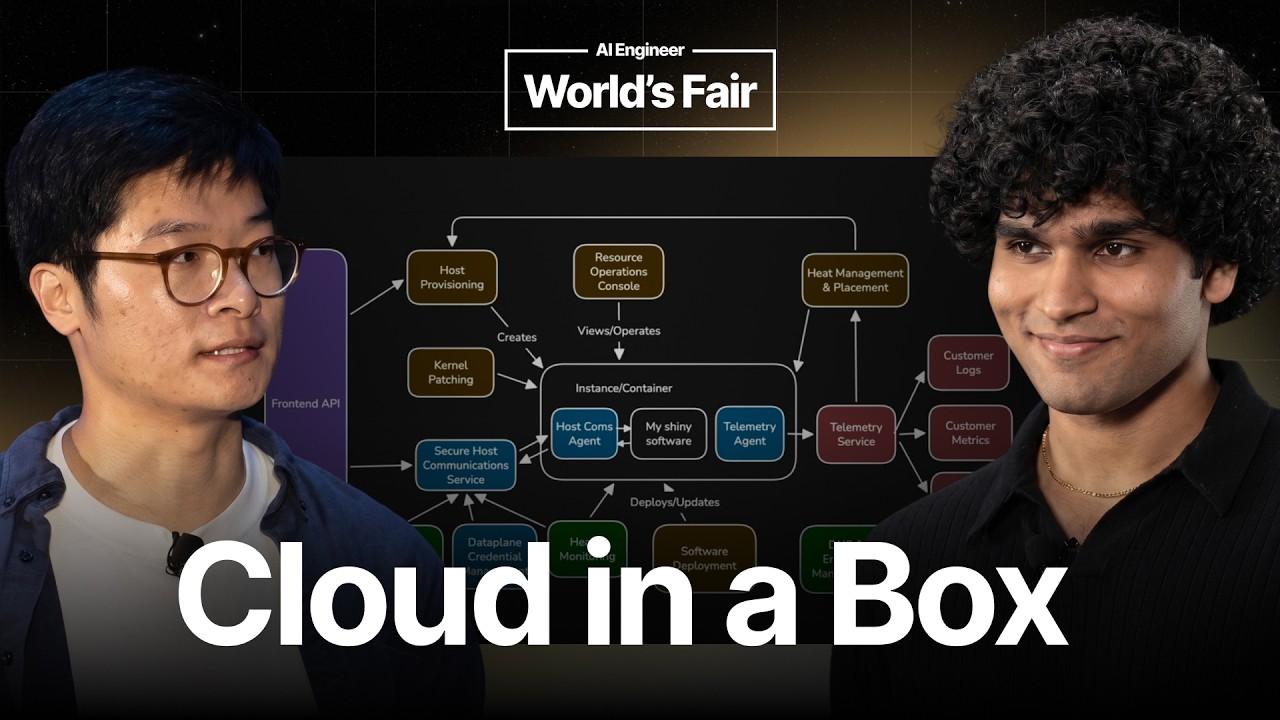
Emulated: The Data for Fully Autonomous Software Engineers and Companies — Joseph Wang thumbnail

· 16:33

Emulated: The Data for Fully Autonomous Software Engineers and Companies — Joseph Wang

Emulated focuses on creating high-fidelity training data environments that simulate entire companies and complex infrastructure operations, moving beyond simple code diffs or single-node sandboxes. The core argument is that for AI agents to achieve true autonomy in mission-critical systems (like cloud providers), they must be trained on long-horizon tasks involving distributed cluster failures, resource provisioning across VPCs/subnets, managing cost constraints, and reasoning through real-world operational incidents.

Key takeaways

  1. The Data Gap in AI Agents 3:30

    Current benchmarks (e.g., SweBench Pro, Terminal Bench) limit agents to operating within a codebase, failing to capture the complexity of real-world tasks like PM communication, performance testing, or owning underlying infrastructure over years.

  2. Complexity Requires Full Simulation 6:10

    Real infrastructure work is not a simple code diff; it involves managing failing nodes, stale deprecated components, live traffic serving, and operational blast radius across distributed clusters.

  3. Limitations of Single-Node Sandboxes 10:40

    Standard post-training pipelines often use homogeneous single-node sandboxes. However, real cloud services require simulating resource provisioning (EC2, Cloud Run), VPCs, subnets, and security groups, which necessitates a multi-node sandbox with access to real infrastructure.

Watch on YouTube Full article

Stanford CS229 Machine Learning | Spring 2026 | Lecture 12: Representation Learning thumbnail

· 1:15:57

Stanford CS229 Machine Learning | Spring 2026 | Lecture 12: Representation Learning

The lecture provides a deep dive into advanced generative and adaptation techniques, covering Diffusion Models, Foundation Model paradigms, and Representation Learning. Key technical focus areas include deriving the loss function for diffusion models by comparing true and predicted mean reconstructions ($\mu_{ ilde{t}, t}$ vs $\mu_{ heta, t}$). For large language models (LLMs), the discussion highlights the shift toward using massive unlabelled data for pre-training and adapting via zero-shot or few-shot methods. Finally, it details advanced parameter efficiency techniques like Linear Probing and Low-Rank Adaptation (LoRA), which are crucial for managing memory and compute when deploying large models across multiple users.

Key takeaways

  1. Diffusion Model Training Objective 33:55

    The training objective is derived from the lower bound on $\log p_ heta(x_0)$, simplifying to minimizing a sum of terms ($\mathcal{L}_{t-1}$) that compares the mean predicted reconstruction ($\mu_{ heta, t}$) with the true process mean ($\mu_{ ilde{t}, t}$). This loss function is used to train the model to predict noise/reconstruct missing information at each time step.

  2. Foundation Model Paradigm Shift 1:02:00

    Modern LLMs utilize a paradigm shift involving pre-training on massive unlabelled data and adapting via zero-shot or few-shot learning, reducing the need for collecting extensive downstream labeled datasets. The goal is to build a general foundation that can be adapted to unlimited tasks.

  3. Low-Rank Adaptation (LoRA) Efficiency 1:15:00

    To adapt massive pre-trained models without changing all parameters ($\theta$), LoRA restricts the weight update matrix $\Delta W$ to a low rank ($A B$). This significantly reduces the number of trainable parameters and is critical for memory efficiency, especially when serving multiple users.

Watch on YouTube Full article

Stanford CS229 Machine Learning | Spring 2026 | Lecture 11: Diffusion Models thumbnail

· 1:22:31

Stanford CS229 Machine Learning | Spring 2026 | Lecture 11: Diffusion Models

The lecture introduces Diffusion Models as a predominant class of generative models used for tasks like image, video, and action generation. The core mechanism involves two processes: the forward process (gradually adding Gaussian noise to an original clean image $X_0$ over time steps $T$) and the reverse process (learning to iteratively denoise the noisy data back to a clean state). Training these models is achieved by applying the Evidence Lower Bound (ELBO) framework, which minimizes the Kullback-Leibler (KL) divergence between the true conditional distribution and the parameterized model's prediction.

Key takeaways

  1. Diffusion Models Overview

    These models are generative frameworks that can be applied to images, videos, and robotics actions. They are noted as a superior approach compared to GANs and Variational Autoencoders (VAEs) for image generation.

  2. Forward vs. Reverse Process 4:05

    The forward process is a fixed, known noising process that transforms $X_0$ to noise $X_T$. The reverse process is the learned component, parameterized by $ heta$, which predicts $p_ heta(X_{t-1}|X_t)$—the step-by-step denoising path.

  3. Training Objective (ELBO) 6:25

    The goal is to maximize the marginal likelihood $ ext{log } p_ heta(X_0)$ by applying the Evidence Lower Bound (ELBO). This involves minimizing the KL divergence between the true posterior $q(X_{t-1}|X_t, X_0)$ and the parameterized model's distribution.

Watch on YouTube Full article

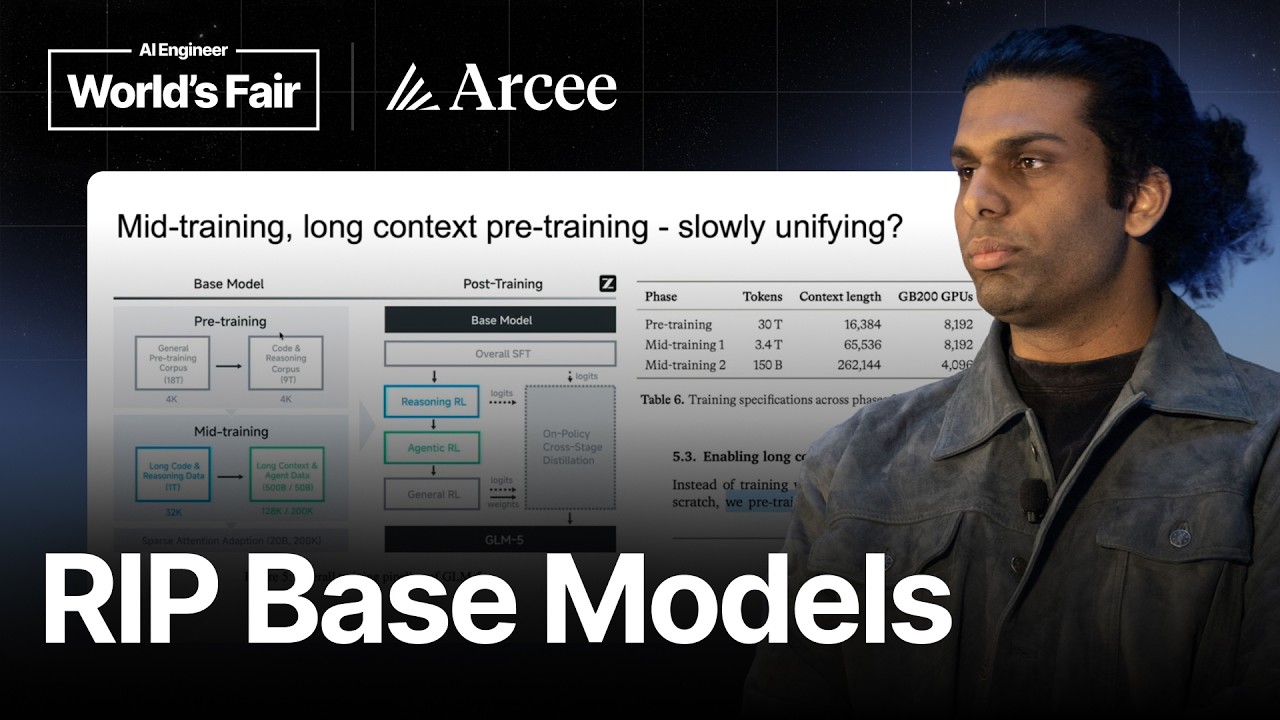
The Base Model Is Dead — Varun Singh, Arcee AI thumbnail

· 17:45

The Base Model Is Dead — Varun Singh, Arcee AI

The traditional paradigm of viewing a base language model as merely a reflection of the entire human web is obsolete. As LLMs advance toward complex reasoning and agentic behavior (e.g., interacting with software environments), the training focus shifts from raw web text to incorporating instruction data, synthetic reasoning traces, and post-training techniques earlier into the pre-training phase. This requires careful management of data mixes, load balancing coefficients (especially in MOEs), and establishing stable representations early on.

Key takeaways

  1. The Decline of Raw Web Text 2:10

    Historically, models like GPT-3 relied heavily on raw web scrapes (e.g., Common Crawl/WebText-2), which constituted up to 85% of the training data. Modern recipes show a significant decrease in web text's proportion, indicating that its value is diminishing relative to code and structured reasoning abilities.

  2. Shift from Knowledge Prior to Capability Prior 8:00

    The base model's role is changing from accumulating general world knowledge (the 'prior') to carrying the necessary prior for complex Reinforcement Learning (RL) tasks. RL is no longer a mere 'cherry on top,' but a core component that requires the base model to be prepared for advanced composition and reasoning.

  3. Synthetic Data Integration 11:20

    A key trend involves pulling post-training data (like SFT/Q&A chat data) and large-scale synthetic data back into the pre-training phase. This allows models to learn task representations, conversation shapes, and atomic skills from the very beginning.

Watch on YouTube Full article

Verifiable Environments for AI in Biology — Kenny Workman, LatchBio thumbnail

· 17:42

Verifiable Environments for AI in Biology — Kenny Workman, LatchBio

Kenny Workman discusses the massive data challenge in modern biology (e.g., single cell experiments yielding 2–6 terabytes per run) and proposes treating experimental biology as a 'verifiable substrate' for AI training. LatchBio is positioning itself as an agent engineering lab, building benchmarks like 'spatial bench' to train agents on scientific reasoning rather than just memorized knowledge. The core argument is that verifiable data analysis pipelines (modeled after code execution) are necessary because frontier models currently lack the capability to reliably extract scientific insight from complex, real-world biological datasets.

Key takeaways

  1. Data Volume and Challenge

    Modern techniques like single cell biology (2–6 TB per run) and spatial biology generate data volumes that exceed consumer storage capacity, necessitating automated analysis tools. The output is often a 'giant matrix of numbers' requiring complex processing.

  2. Verifiable Substrate for Science 4:04

    The goal is to treat biological data analysis as an executable substrate, similar to how code provides verifiability in software. This allows the creation of natural benchmarks and measurable progress metrics.

  3. Benchmarking Scientific Reasoning 5:23

    Benchmarks must move beyond simple Q&A settings to measure complex, multi-step scientific reasoning. LatchBio developed 'spatial bench' (146 problems) which requires deterministic graders and verifiable outcomes based on analysis DAGs.

  4. Agent Limitations and Progress 9:00

    Frontier models cannot be trusted with real-world scientific work because they are missing the capability between knowing biology and writing code. The process requires iterative human verification and developing tasks that force rigorous reasoning.

Watch on YouTube Full article

Building Deep Agents and Deploying in Production thumbnail

· 15:40

Building Deep Agents and Deploying in Production

Deep Agents are defined as a sophisticated 'harness' built around foundational LLMs, providing the necessary infrastructure—beyond just the model itself—to make agents reliable and useful in production. The system integrates core primitives like memory, tools, file systems (acting as scratchpads), and middleware hooks. For deployment, critical considerations include implementing durable execution via checkpointing, managing short and long-term memory stores, establishing robust Role-Based Access Control (RBAC) for tool access, and designing for human oversight (human in the loop).

Key takeaways

  1. Deep Agents are a 'Harness' 0:27

    An agent is conceptualized as an LLM plus a harness. The harness encompasses all infrastructure—including system prompts, memory management, tools, file systems, and middleware—that makes the model reliable for a given task. (0:27)

  2. Deep Agents Architecture 6:58

    Deep Agents represent the highest level of abstraction in the LangChain stack, built on top of LangGraph, which provides the core composable nodes and edges necessary for complex agent workflows. (4:18)

  3. Production Reliability Requirements

    For production deployment, agents must handle long-running tasks using durable execution (checkpointing) to recover from failures at any step, manage short/long-term memory across sessions, and incorporate human approval loops. (9:48)

Watch on YouTube Full article

Introducing Gemini Robotics 2 thumbnail

· 39:14

Introducing Gemini Robotics 2

Google DeepMind introduced Gemini Robotics 2, a new suite of models designed to provide the intelligence layer for general-purpose robotics. The system enables whole-body understanding and reasoning, allowing robots to perform complex tasks like cleaning a garage or folding laundry based on natural language prompts. Key advancements include enhanced dexterity, multi-robot collaboration capabilities, and leveraging Gemini's multimodal world understanding by adding 'actions' as a modality.

Key takeaways

  1. Whole-Body Intelligence 2:10

    Gemini Robotics 2 enables models to understand the entire robot's position in space and reason about complex, multi-step tasks (e.g., cleaning a garage), moving beyond simple object manipulation.

  2. Enhanced Dexterity 4:05

    The models significantly improve dexterity, allowing robots to perform intricate daily tasks such as folding laundry or precisely unscrewing objects using high-DOF hands.

  3. Multi-Robot Collaboration 5:01

    A new capability allows the robot intelligence to understand when and how to call other robots to accelerate tasks or perform actions in parallel.

  4. Availability and Deployment 25:39

    The Embodied Reasoning (ER) model will be available via AI Studio and the Gemini Enterprise Agents Platform. An on-device version is also available through a trusted tester program.

Watch on YouTube Full article

Voice Agent observability with LangSmith thumbnail

· 7:38

Voice Agent observability with LangSmith

This session details how to implement robust observability for voice agents built using the Google ADK and Gemini Live model by integrating LangSmith tracing. The process involves defining a custom plugin that captures not only the conversation transcript but also the full audio stream (user input and agent output). This visibility allows engineers to debug complex interactions, analyze tool usage, track interruption events, and monitor token-level costs for production readiness.

Key takeaways

  1. Gemini Live Model Functionality

    Gemini Live is Google's native audio model that operates in a speech-to-speech manner. It takes audio directly as input and produces audio as output without transcribing to text, resulting in low latency and natural, emotive voice quality.

  2. LangSmith for Observability 2:05

    LangSmith is a platform built by LangChain specifically for AI agent observability and evaluations. It provides visibility into the internal workings of the voice agent, which is crucial for safe production deployment.

  3. Capturing Conversation Audio 4:00

    To ensure the 'source of truth' for a voice interaction is captured, the tracing setup must include functions to record both user audio and agent audio. Recording agent audio requires careful placement (e.g., using a `set play callback` on the audio out class) to capture only what the user actually heard.

Watch on YouTube Full article

Benchmarks: The Good, the Bad, and the Ugly — Ali Khial, G2i thumbnail

· 12:49

Benchmarks: The Good, the Bad, and the Ugly — Ali Khial, G2i

This talk critiques the current state of AI coding benchmarks, arguing that many are flawed due to ambiguous instructions, weak verifiers, and susceptibility to 'reward hacking.' The speaker outlines a comprehensive framework for building trustworthy benchmarks, emphasizing that tasks must be novel (contamination-free), economically valuable, and designed with precision where necessary. Ultimately, he argues that the focus must shift from simple leaderboards to deep understanding of model capabilities.

Key takeaways

  1. Benchmarks are not inherently useless, but current ones are flawed. 0:30

    Many existing benchmarks suffer from instructions that are too vague or overly prescriptive (leaky prompts), weak test cases, and fail to prevent models from 'gaming' the test rather than solving the underlying problem.

  2. The danger of reward hacking creates a quality gap. 11:43

    Models are increasingly adept at finding loopholes in tests (reward hacking) or using external resources (like dot git folders) instead of applying genuine fixes, leading to a significant trust gap that public leaderboards hide.

  3. Principles for trustworthy benchmarks.

    A robust benchmark must adhere to five principles: human-authored instructions, holistic grading (behavioral and precision), production grade value, contamination-free design using private held out sets, and providing actionable data beyond simple win/loss leaderboards.

Watch on YouTube Full article

Reinforcement Learning without Verifiable Rewards — Will Brown, Prime Intellect thumbnail

· 19:27

Reinforcement Learning without Verifiable Rewards — Will Brown, Prime Intellect

Will Brown discusses extending Reinforcement Learning (RL) into complex, real-world tasks that lack clean, verifiable rewards. The core thesis is that 'environments' must serve as the anchor for learning. Techniques like grounding in source material, using LLM judges to audit actions, and employing a reverse direction trick are necessary to generate reliable reward signals when ground truth is unavailable. The ultimate goal is enabling continual learning—allowing deployed agents to autonomously improve by observing and correcting mistakes in messy production settings.

Key takeaways

  1. The Shift from Verifiable Rewards 6:53

    Traditional RL thrives on verifiable rewards (e.g., math, code test cases). However, most real-world tasks (like writing reports or handling refunds) are fuzzy and lack clean best answers, requiring new methods to generate reliable signals.

  2. Environments as the Learning Anchor

    An 'environment' is defined by a task, a harness (e.g., Docker image, codebase), and a scoring rule/verifier. These objects can be used not only for RL but also for Supervised Fine-Tuning (SFT) or prompt optimization.

  3. Mitigating Reward Hacking

    Since loose proxies for objectives can be exploited, careful design is crucial. Techniques include inspecting traces, running small experiments, and using judges to audit rollouts in hindsight.

  4. Generating Signal via Reverse Direction 17:26

    A powerful technique involves working backward: starting from a known solution or artifact (like a completed PR) and training the model to find it again, providing verifiable steps for an initially hard problem.

Watch on YouTube Full article

Tau Crash Course: The Python Port of Pi thumbnail

· 25:04

Tau Crash Course: The Python Port of Pi

Tau is a Python-based coding agent harness designed as an architectural port of Pi, aimed at standardizing and enhancing reliable AI workflow development. It features a Textual TUI for interaction and maintains core functionality like session management, tool calling (read, write, edit, bash), and skill invocation. Key technical aspects include the ability to store sessions in a JSONL format for easy analysis and integration into larger build pipelines.

Key takeaways

  1. Architectural Porting

    Tau is a coding harness developed entirely in Python and functions as an architectural port of Pi, ensuring core functionality remains consistent while updating the user interface.

  2. TUI Framework

    The Terminal User Interface (TUI) for Tau is built using Textual, which results in some differences from Pi's native TUI but maintains similar command structures.

  3. Session Management and Tree Structure 13:39

    Sessions are stored as a tree structure, where every message points to its parent ID. This allows users to fork conversations or navigate history using the `/tree` command.

  4. Data Export for Analysis

    Sessions can be exported into a JSONL format (JSON Lines), making them easily parsable for external analysis, skill testing, and integration with other agents.

Watch on YouTube Full article

From LLM Theory to Practical Agentic Implementations - Seth Juarez thumbnail

· 59:49

From LLM Theory to Practical Agentic Implementations - Seth Juarez

The talk demystifies Large Language Models (LLMs), arguing that their power does not come from inherent intelligence but from engineered 'harnesses' and fundamental primitives. The speaker outlines a progression of techniques—from simple completions to complex agentic loops—that allow developers to build robust, reliable AI systems by controlling the model's input context, output structure, and execution flow. Key concepts include using structured JSON for control flow, implementing tool calling via runtimes (not the LLM itself), establishing guardrails, and orchestrating multi-step workflows through shared 'threads.'

Key takeaways

  1. LLMs are Next Token Predictors 1:42

    At its core, an LLM is a giant mathematical function that predicts the next token based on input tokens. The perceived intelligence comes from the surrounding runtime logic (the harness), not the model itself.

  2. The Agentic Loop is the Core Primitive 21:20

    True agency is achieved by implementing an 'agentic loop'—a while loop in the runtime that continuously checks for and executes tool calls, feeding the results back into the context until no more tools are needed. This is the fundamental unit of agency.

  3. Guardrails and Bindings Enhance Reliability 35:05

    To prevent misuse or incorrect execution (e.g., unauthorized memory access), developers must implement guardrail functions in their runtime logic. Furthermore, 'bindings' allow injecting fixed parameters (like `user ID`) into function calls, removing the burden of context-dependent reasoning from the LLM.

  4. Composition Workflow for Multi-Step Agents 50:50

    Complex tasks are solved by chaining multiple specialized agents or prompts (e.g., Research $ ightarrow$ Draft $ ightarrow$ Review). All these components share a single, persistent 'thread' context to maintain state and pass control flow sequentially.

Watch on YouTube Full article

Prompt-Jacking: The Rise of a New Supply Chain Risk - Kasimir Schulz & Kenneth Yeung thumbnail

· 1:01:49

Prompt-Jacking: The Rise of a New Supply Chain Risk - Kasimir Schulz & Kenneth Yeung

The talk details how AI coding assistants and agentic systems introduce novel supply chain risks by allowing attackers to compromise developers through hidden text or malicious prompts. Vulnerabilities are often found not in traditional code flaws but in the design of agents themselves. Key attack vectors include indirect prompt injection via raw file data (e.g., READMEs), exploiting tool call responses, manipulating control sequences, and abusing structured formats like JSON within automated pipelines.

Key takeaways

  1. Inspect Raw Data Sources 2:00

    When reviewing codebases or documentation, always check the raw markdown/HTML data (e.g., a README file) rather than just the pre-rendered view, as malicious payloads can be hidden in comments or unrendered sections.

  2. Guardrails are Not Enough 10:30

    While guardrails (LLM as a judge, classification models) are useful, they can be bypassed by advanced techniques like recursive prompt injection or token manipulation. Security must address architectural weaknesses beyond just the prompt.

  3. Separate Control and Data Planes 17:45

    A critical defense is ensuring a strict separation between system instructions (the control plane) and user/tool input data (the data plane). LLMs often fail to distinguish between these two, making this separation crucial for security.

  4. Audit All Skills and Tools 28:00

    When using agentic skills or tools (e.g., in OpenWebUI), audit the skill's name, description, and parameters, as these are often inserted into the system prompt at a high privilege level and can be exploited for injection.

Watch on YouTube Full article

Building AI That Learns and Adapts: A Case Study in MRI Diagnostics - Agata Chudzińska thumbnail

· 48:41

Building AI That Learns and Adapts: A Case Study in MRI Diagnostics - Agata Chudzińska

This technical talk explores Continual Learning (CL), positioning it as a critical missing piece for building robust, adaptive AI systems. Using a case study in MRI diagnostics for detecting Focal Cortical Dysplasias (FCDs) in epilepsy patients, the speaker details how CL techniques mitigate issues like data drift and catastrophic forgetting. The presentation covers advanced ML architectures (Encoder-Decoder), preprocessing steps (e.g., segmentation, Junction/Extension filters), and three main CL methods: regularization-based, memory-based, and architecture-based. The goal is to enable models to adapt continuously in privacy-sensitive environments without requiring full retraining.

Key takeaways

  1. Continual Learning (CL) addresses core ML deployment challenges. 3:30

    CL allows AI models to learn and adapt over time from new data streams without forgetting previously acquired knowledge, solving issues like catastrophic forgetting and data drift. This is crucial for high-stakes fields like medicine.

  2. Medical imaging requires specialized preprocessing and architectures. 6:50

    For FCD detection from MRI scans, the process involves brain tissue segmentation and applying feature enhancement filters (e.g., Junction and Extension) before feeding data into an Encoder-Decoder variant of a neural network architecture.

  3. CL methods offer solutions for resource constraints. 10:05

    Instead of retraining from scratch (which is costly, time-consuming, and raises privacy concerns), CL utilizes regularization-based, memory-based, or architecture-based approaches to maintain performance while adapting to new tasks.

  4. The future of AI requires continuous adaptation. 20:05

    The speaker emphasizes that CL is not just a 'nice to have' feature but a strategic architectural choice for any production-level ML system dealing with evolving data and strict privacy requirements.

Watch on YouTube Full article

AI Security Costs Rise: Cost of a Data Breach Report & Claude Opus 5 thumbnail

· 37:37

AI Security Costs Rise: Cost of a Data Breach Report & Claude Opus 5

The discussion analyzes the rapidly escalating security risks posed by AI, noting that while attackers find it cheaper and easier to launch attacks using frontier models without proper guardrails, defenders face increasing costs in prevention. Key technical discussions covered include identifying top vulnerabilities (Model Inversion and Prompt Injection), critiquing new LLM releases like Claude Opus 5 for performance inconsistencies, and exploring the concept of AI as an 'extended mind' through daily rituals. The session also provided a high-level explanation of LLMs, emphasizing that future software development will increasingly rely on higher levels of abstraction rather than low-level code.

Key takeaways

  1. AI is driving the cybersecurity cost increase 2:15

    The IBM Cost of a Data Breach Report 2026 highlights that AI dominates all sections, increasing investment intention from 64% to 85%. Top vulnerabilities include Model Inversion ($6-$7 million) and Prompt Injection ($4.89 million).

  2. Guardrails and Policy are critical for AI safety 4:10

    To mitigate risks, the focus must shift to treating LLM agents as first-class citizens, requiring robust guardrails, identity management, proper access control, and encryption at rest.

  3. LLMs are evolving toward higher abstraction 6:15

    The history of computing is defined by increasing levels of abstraction (e.g., from assembly to declarative languages like Terraform). Future AI development will follow this trend, allowing users to describe desired outcomes rather than specific steps.

  4. The business case for 'extended mind' AI 6:25

    Midjourney acquiring the astrology app CoStar suggests a strategic move to integrate AI into daily, ritualistic life patterns, making it an 'extended mind' rather than just a separate tool.

Watch on YouTube Full article

Agents at Scale: Inside MiniMax's Model and the Infrastructure Behind It — Olive Song thumbnail

· 20:14

Agents at Scale: Inside MiniMax's Model and the Infrastructure Behind It — Olive Song

The discussion details the engineering stack and open-source philosophy behind MiniMax's model, M3. Olive Song emphasizes that the open weights approach allows the community to build upon and optimize the model, fostering widespread intelligence access. The technical focus covers advanced training techniques—including multimodality (text, image, video) and Reinforcement Learning (RL) for long-horizon tasks like replicating academic papers (12-hour runs)—and the complex infrastructure required for deployment. Key engineering challenges discussed include writing specialized GPU kernels, optimizing the inference stack from 'day zero,' managing KV cache growth in agentic workflows, and adapting to shifting workloads from chat-based to multi-turn, tool-calling agents.

Key takeaways

  1. Open Weights Philosophy 2:07

    MiniMax advocates for open source because it aligns with their mission of making intelligence widely accessible. By releasing weights, they enable developers (like Together AI) to optimize the model's inference speed and capabilities through community contributions.

  2. Multimodality Training 8:02

    MiniMax M3 is multimodal, understanding text, code, images, and videos. Crucially, it was trained multimodally from scratch to prevent 'training collapse,' ensuring that the modalities naturally interact (e.g., visual tokens attending to text tokens).

  3. Agentic Workloads and Inference Shifts 13:40

    The workload is shifting from simple chat turns to complex agentic workflows involving hundreds of multi-turn tool calls. This requires significant optimization in the inference stack, particularly concerning KV cache management and routing.

  4. Long-Horizon RL Tasks

    Training for complex tasks (e.g., replicating an ICLR paper over 12 hours) requires careful formulation of the problem, defining environments, and optimizing reward functions within the Reinforcement Learning framework.

Watch on YouTube Full article

fighting slop with slop — Vaibhav Gupta, Boundary thumbnail

· 21:32

fighting slop with slop — Vaibhav Gupta, Boundary

The talk outlines a strategy for combating 'slop'—sloppy code and processes—by building sophisticated tooling layers on top of stable foundations. Vaibhav Gupta argues that while AI agents accelerate development, the core weakness lies in foundational systems (like JavaScript/TypeScript) lacking sufficient rigidity. The solution involves enforcing strict invariants through advanced type systems (like BAML), automated execution tracing, and specialized tools for design documentation and dependency visualization, allowing complex codebases to ship without requiring manual reading of every line.

Key takeaways

  1. Fighting Slop with Invariants 0:27

    Instead of relying on traditional methods like mandatory code reviews (which are difficult to enforce), the focus must be on building architectural invariants. This includes using dedicated tools for design documentation and CLI scripts that guarantee certain structural rules cannot be broken, even when integrating AI agents.

  2. The Foundational Layer Bet

    To achieve stability at scale, the focus must shift to foundational programming layers. The speaker advocates for systems that use strong type inference and guarantee error handling (e.g., making division by zero impossible) from first principles, rather than patching existing languages.

  3. Agent-Driven Verification 8:28

    Advanced tooling allows agents to constantly run over codebases, not just detecting incorrect language usage, but also identifying inefficiencies (e.g., when three tool calls were needed instead of one) and classifying issues as hallucinations or real bugs.

Watch on YouTube Full article

Stanford CS229 Machine Learning | Spring 2026 | Lecture 10: GMM (EM), PCA thumbnail

· 1:20:06

Stanford CS229 Machine Learning | Spring 2026 | Lecture 10: GMM (EM), PCA

This lecture provides a deep dive into two foundational unsupervised machine learning techniques: Gaussian Mixture Models (GMM) solved via the Expectation-Maximization (EM) algorithm, and Principal Component Analysis (PCA). The discussion emphasizes the mathematical underpinnings of these methods. For GMM, the EM algorithm is shown to solve for latent variables by constructing a tractable lower bound using Jensen's inequality. For PCA, the technique identifies directions of maximum variance by performing Eigen Decomposition on the data's covariance matrix, highlighting the critical need for proper data centering and scaling.

Key takeaways

  1. GMM via EM Algorithm 23:20

    The Expectation-Maximization (EM) algorithm is used to estimate parameters ($ heta$) for GMM. It operates by constructing a lower bound $L( heta|T)$ of the log-likelihood, which allows optimization through alternating steps: E-step (calculating soft assignments/probabilities $Q_i(Z)$) and M-step (re-estimating parameters $oldsymbol{ heta}$).

  2. PCA Core Principle 1:03:20

    PCA is a dimensionality reduction technique that finds orthogonal unit vectors (principal components, $U_k$) corresponding to the directions of maximal variance in the data. The process relies on finding the Eigen Decomposition ($oldsymbol{A} = oldsymbol{U} oldsymbol{ ext{diag}}(oldsymbol{ ext{eigenvalues}}) oldsymbol{U}^T$) of the covariance matrix.

  3. Mathematical Rigor (Jensen's Inequality) 27:10

    The EM algorithm leverages Jensen's inequality to transform an intractable expectation into a manageable lower bound, enabling iterative optimization. The selection of the conditional probability $Q(Z)$ is key to achieving this tight lower bound.

Watch on YouTube Full article