The Video Signal technical video digests

· 5:16

CoreWeave ARIA: The autoresearch loop for continuous improvement

CoreWeave ARIA is an AI Research and Iteration Agent designed to automate the full autoresearch loop for continuous model and agent improvement. The demonstration shows how ARIA autonomously forms hypotheses, analyzes prior run results (including raw system metrics and plots), sets filters, and executes new training jobs via Weights & Biases Launch, allowing human users to focus on high-level problem definition.

Key takeaways

  1. Autonomous Research Loop

    ARIA autonomously manages the research process by forming hypotheses, running experiments, evaluating results, and executing optimal next actions without constant human intervention. This capability helps models and agents improve continuously.

  2. Run Analysis and Filtering 1:44

    ARIA can analyze complex run data—including plots, tables, and raw system metrics—to determine what worked best. It can also set UI filters based on previous sweeps (e.g., setting a filter for 'auto research runs').

  3. Parallel Experimentation 1:18

    Users can run multiple ARIA instances in parallel to accelerate the workflow, allowing simultaneous management of different research tracks (e.g., running two distinct ARIA variants).

Watch on YouTube Full article

· 1:09:03

Building retrieval harness for enterprise agents

This technical walkthrough details the architecture of an enterprise agentic retrieval harness, moving beyond traditional Retrieval Augmented Generation (RAG) systems. The core argument is that effective data access requires giving agents a comprehensive set of tools—including local file system traversal (GP), semantic search, keyword search, and multimodal analysis—rather than relying on a single indexing method. Key focus areas include managing complex document parsing, ensuring multi-tenancy via custom metadata, and optimizing vector storage for scale and cost.

Key takeaways

  1. Harness over RAG 2:00

    The most capable approach is not to select a single retrieval method (e.g., pure semantic search or pure GP access) but to build an agentic harness that allows the agent to decide how to combine multiple tools for data exploration and verification.

  2. The Role of File Primitives 4:20

    For document-driven workflows, critical primitives include: (1) Retrieval (hybrid search), (2) Directory listing/hierarchy traversal, (3) Grep for exact text matching, (4) Chunk-by-chunk analysis, and (5) Multimodal processing via localized screenshots.

  3. Enterprise Scaling Challenges 6:45

    Scaling to multi-tenant or million-file situations requires specialized indexing pipelines that manage data freshness, security, and permissioning. Using custom metadata attached during the parsing process is crucial for filtering access at the vector storage layer.

Watch on YouTube Full article

· 1:48:40

🔬 "The Most Innovative Diffusion Research Is Happening in Drug Discovery, Not Image Generation"

The video discusses the shift of advanced AI research from image generation into complex biological domains, specifically drug discovery and protein-ligand interaction modeling. Genesis Molecular AI introduces PEARL, a foundation model that uses diffusion techniques to predict how proteins flex to accommodate ligands (induced fit). The discussion highlights that modern drug design requires multi-parameter prediction (ADMET) and sophisticated agentic systems (SAPPHIRE) capable of reasoning like a chemist, moving far beyond simple structural predictions. Achieving high accuracy (sub-Angstrom resolution) is crucial for these models to be useful in physical chemistry workflows.

Key takeaways

  1. Diffusion Models in 3D Structure Prediction 1:42

    Diffusion techniques are proving to be a highly effective primitive for 3D structure prediction, particularly in modeling protein-ligand complexes. This represents a major advancement over previous methods like GANs and is central to Genesis's PEARL model.

  2. PEARL Model Capabilities 9:30

    The PEARL model predicts not only where a ligand binds but also models the conformational flexibility of the protein itself (induced fit). It demonstrated strong zero-shot performance on the OpenBind benchmark against notoriously difficult targets.

  3. Agentic Drug Discovery Systems 10:10

    Genesis's SAPPHIRE system represents an agentic approach to drug discovery. This AI agent is designed to mimic a chemist by reasoning about poses, forming hypotheses, reading literature, and proposing the next round of candidates.

  4. The Need for High Resolution 10:40

    Traditional benchmarks like 2Ă… RMSD are considered insufficient because they lack the resolution needed to discern critical details (e.g., aromatic ring flips) required for accurate physical chemistry predictions, necessitating a focus on sub-Angstrom accuracy.

Watch on YouTube Full article

· 26:20

GLM-5.2 vs MiniMax-M3: Opus Has REAL COMPETITION (Model Stacking)

The video argues that proprietary models like Opus 4.8 face real competition from open-weight alternatives such as GLM-5.2 and MiniMax-M3. The core thesis for build engineers is not to select a single model but to implement a resilient 'model stack.' This strategy involves strategically choosing models across three tiers—State-of-the-Art (SOTA), Workhorse, and Lightweight/Local—to optimize the trade-off between performance, cost, and speed for both engineering agents and product deployment.

Key takeaways

  1. GLM 5.2 vs MiniMax M3: Performance vs Cost 17:54

    GLM 5.2 is highlighted as the better model in terms of raw performance (A-tier), while MiniMax M3 is considered the better deal due to its optimized cost structure, making it ideal for high-volume product agents.

  2. The Three-Tier Model Stack Framework 2:50

    Engineers should categorize models into three tiers: State-of-the-Art (e.g., Opus 4.8, Fable 5), Workhorse (GLM 5.2, MiniMax M3), and Lightweight/Local (Qwen 3.6). This framework guides decision-making based on the required trade-off.

  3. Resilience through Open Weights 6:49

    Due to concerns about vendor lock-in or potential service shutdowns (e.g., Fable), relying solely on closed-source models is risky. Utilizing open-weight models like GLM 5.2 and MiniMax M3 ensures greater control and ownership over the AI infrastructure.

Watch on YouTube Full article

· 23:15

The Blueprint for Autonomous Work Agents | Gavriel Cohen, NanoClaw

This discussion explores the architecture and deployment of autonomous work agents, focusing on how they can function as 'second brain' knowledge management systems. The speaker details a shift in agent adoption strategy—from centralized 'agent factories' to personalized assistants for individual employees. Architecturally, secure deployment requires robust isolation models (e.g., running each agent in its own container) and strict credential handling via proxy vaults to mitigate risks like prompt injection.

Key takeaways

  1. Agent Adoption Strategy Shift 12:48

    The most effective way for businesses to introduce agents is by providing each person with their own personal assistant, as this manages the learning curve associated with prompting and utilizing complex AI tools. (10:58)

  2. The Killer Use Case: Second Brain 14:30

    For autonomous agents today, the most valuable use case is the 'second brain' model—where the agent collects and builds an internal knowledge graph or wiki (e.g., LLM Wiki) from unstructured data rather than just providing ready-made output. (12:30)

  3. Agent Architecture Security Principles 16:10

    Secure deployment requires three key elements: running each agent in its own isolated container; ensuring agents have no credentials in their environment to prevent leakage from prompt injection; and proxying all outgoing requests through a vault for credential management. (14:50)

Watch on YouTube Full article

· 42:38

When millions of AI agents meet

This discussion explores the shift from traditional Large Language Models (LLMs) to autonomous AI agents capable of executing multi-step plans, transacting, and delegating tasks. The concept of an 'agentic economy' suggests a future where intelligence is distributed across specialized agents rather than residing in single systems. Key technical challenges discussed include managing agent failure rates, preventing automation bias, securing the system against malicious 'agentic traps,' and developing robust orchestration protocols for complex, real-world workflows.

Key takeaways

  1. Agent vs. Language Model 0:35

    An LLM merely provides continuation or a reply to a prompt; an AI agent observes a state of the world and performs actions in an environment (e.g., purchasing tickets, sending emails). Agents use LLMs under the hood but are wrapped in a harness that enables multi-step planning and automation [0:35].

  2. Distributed Intelligence 28:40

    The future may not be defined by Artificial General Intelligence (AGI) as a single entity, but rather by 'distributed intelligence'—a 'society of specialists.' This model suggests that specialized, smaller models are cheaper to run and more reliable than one massive generalist model [17:20].

  3. Agentic Security Risks 22:26

    The deployment of agents at scale introduces significant cybersecurity risks. These include 'agentic traps' (malicious code or prompts in the environment) and 'dynamic cloaking,' where web pages display different content for humans versus agents, potentially inducing jailbreaking [1:50].

Watch on YouTube Full article

· 46:40

Logs Are All You Need: Rethinking Observability with AI Agents

Sherwood Callaway introduces Sazabi, an AI-native observability platform designed to disrupt traditional tools like Datadog by focusing on logs as the primary source of truth. The core philosophy is that in the age of coding agents, engineers should interact with production data via natural language chat rather than complex dashboards. Key technical innovations include using Git for persistent agent memory across multiple threads and implementing a read-only sandbox environment to safely execute investigative tasks.

Key takeaways

  1. Logs are Sufficient: Rethinking Observability 22:20

    The traditional 'three pillars' (metrics, logs, traces) are considered overkill for modern agentic workflows. By focusing solely on logs, instrumentation becomes significantly simpler, requiring only basic logging statements, as the platform can reconstruct metrics and traces from log data.

  2. AI Agents Generate Alerts, They Don't Evaluate Them 28:00

    Instead of using AI to triage noisy alerts (alert fatigue), Sazabi autonomously generates actionable alerts directly from logs and codebase analysis. The agent determines what is meaningful to the user at runtime.

  3. Agent Memory via Git for Shared State 34:05

    Sazabi maintains persistent, shared memory across multiple parallel sub-agents and threads by committing findings (e.g., issue lists, facts) to a dedicated Git branch within the sandbox environment. This allows agents to benefit from collective findings.

  4. Sandbox Isolation and Read-Only Access 30:30

    The platform operates in a read-only system with no public internet access, ensuring security. All actions are routed through an isolated sandbox environment (e.g., using `bash` tools) to prevent data exfiltration or unauthorized changes.

Watch on YouTube Full article

· 1:02:49

PLANS For Fable 5: Rebuilding My /Plan Skill for Mythos Class Models

This deep-dive devlog details the rebuilding of a comprehensive `/plan` meta skill (`PlanF3`) designed for next-generation Large Language Models (LLMs) like Fable 5 and Mythos class models. The core thesis is that superior engineering results depend on rigorous, upfront planning—a concept termed 'great planning is great engineering.' By investing heavily in structured templates, the speaker creates a meta skill that forces agents to output highly detailed, standardized plans in HTML format, thereby improving performance over speed or cost (the 'trade-off trifecta'). The resulting plan acts as a living artifact for the entire codebase, integrating complex workflows like image generation and agent-to-agent communication.

Key takeaways

  1. The Importance of Planning in Agentic Engineering 2:00

    Planning is identified as the single most critical tool an engineer has. The speaker warns against outsourcing thinking or planning to models, arguing that detailed, structured plans are necessary for end-to-end control and reliable results at scale.

  2. The PlanF3 Meta Skill Architecture 4:00

    The new skill is designed to be a 'meta skill'—a prompt that creates other prompts or skills. It mandates structured output in HTML format, which is preferred for its ability to convey rich information and utilize tokens efficiently across the 'trifecta' of users: human engineers, engineering teams, and AI agents.

  3. Structured Planning as an Artifact 7:30

    The plan is treated as a living artifact containing mandatory sections like Purpose, Problem, Solution (P/S/R), Relevant Files (existing and new), Implementation Phases (with embedded checklists), Testing Strategy, and detailed Metadata Headers (tracking agent name, session ID, back/forward references).

  4. Advanced Workflow Integration 11:20

    The skill is modularized into dedicated workflows: `create plan`, `update plan`, `update references`, `build plan`, and `image generation`. This structure allows for complex, multi-step processes (e.g., running a build cycle that updates status markers in the plan).

Watch on YouTube Full article

· 42:20

Autonomous Agents at Work: From OpenClaw Hype to Enterprise Reality

Autonomous agents represent a significant shift from simple chat interfaces to systems that actively perform actions. To transition these agents from experimental hype (like the OpenClaw movement) to reliable enterprise production models, organizations must implement rigorous governance and control frameworks. PwC outlines a comprehensive approach focusing on risk classification, establishing a minimum control stack (Identity, Input/Output Controls, Auditability), and implementing multi-faceted evaluation processes across Quality, Performance, Safety, Cost, and Business Impact.

Key takeaways

  1. 3-Tier Work Classification for Risk Management 1:45

    Agents must be classified based on the potential blast radius: 1) Reversible work (e.g., ticket enrichment); 2) Sensitive work (affecting system stability, requiring tighter controls); and 3) Consequential work (touching legal or customer policy documents, highest risk).

  2. The Minimum Control Stack for Production Agents 4:00

    Before deployment, four non-negotiable controls must be in place: Agent Identity (credentials treated as first-class data with strict expiration/authorization); Input Controls (guardrails against prompt injection and ensuring tool allow-listing); Output Controls (limiting tool calls, retries, and preventing toxic output); and Auditability.

  3. Five Pillars of Agent Auditability 5:10

    Auditing must go beyond simple logging. A comprehensive framework requires monitoring Quality (using LLM-as-judge), Performance (focusing on P99 latency), Safety (PII redaction/filters), Cost (tracking expenditure at the run level), and Business Impact (logging the agent's chain of thought decision process).

  4. Ownership and Architecture are Paramount 8:00

    Engineers must maintain ownership over the system architecture, even if AI generates the code. The core logic and blueprints must be human-owned to ensure accountability and proper review processes.

Watch on YouTube Full article

· 16:33

The Best AI Automation Stack to Learn in 2026

The video outlines a comprehensive five-layer stack for building production-ready AI automation and engineering solutions. The recommended architecture emphasizes foundational software engineering principles—backend, database, frontend, AI models, and infrastructure—rather than relying solely on high-level no-code tools. Core technologies include Python/FastAPI/Celery for the backend, Postgres/Supabase for data storage, React/Vite/ShadCN UI for the frontend, and cloud providers (AWS, Azure, GCP) or specialized services for model integration and deployment.

Key takeaways

  1. Focus on Foundational Layers

    To build a career in AI engineering, understanding how to integrate core components—backend, database, frontend, AI layer, and infrastructure—is more valuable than mastering specific high-level tools.

  2. Backend Core Stack

    Python is the recommended language. FastAPI serves as the API entry point (handling GET/POST/PUT/DELETE webhooks), while Celery manages background workers and scheduled cron jobs, ensuring robustness and scalability.

  3. Database Recommendation 7:15

    Postgres is recommended as the primary database layer. Supabase is suggested as a wrapper around Postgres that simplifies authentication and provides an out-of-the-box admin GUI.

  4. Frontend Stack 12:00

    The recommended frontend stack is React (industry standard UI library), Vite (development server/bundler), and ShadCN UI (a component library for rapid, customizable development).

  5. Deployment Strategy

    For custom deployments, the industry standard is using Docker. For ease of use, platforms like Railway are recommended to simplify deployment setup (e.g., deploying FastAPI/Celery and React code). Advanced options include container services from major cloud providers or dedicated VPS hosting.

Watch on YouTube Full article

· 3:51:50

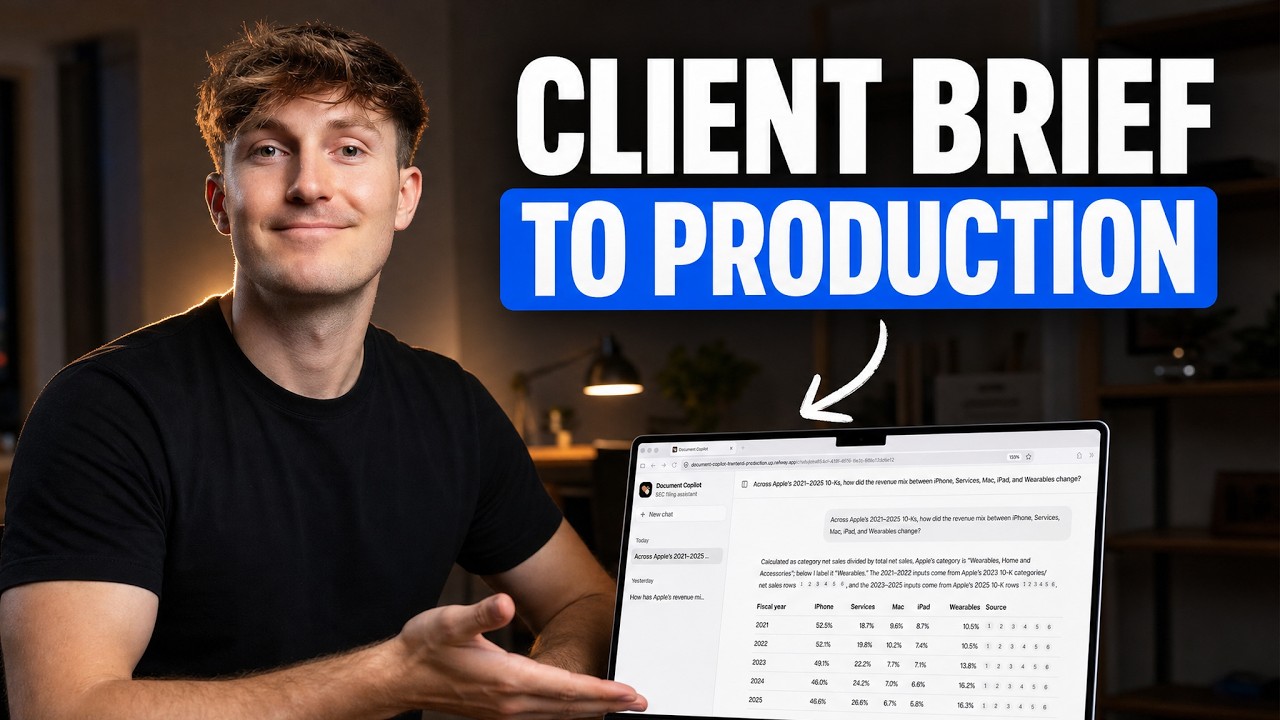
Build a Full-Stack GenAI Project in 4 Hours (FastAPI, React, Supabase)

This tutorial provides an end-to-end guide for building a production-grade Retrieval Augmented Generation (RAG) application—a Document Copilot. The project uses SEC filings data and demonstrates the complete AI engineering workflow: from initial client brief analysis to setting up the full stack (FastAPI, React/TypeScript, Supabase Postgres with pgvector). Key phases covered include database schema design using SQLAlchemy/Alembic, implementing user authentication via Supabase Auth, building a front-end chat interface, and establishing a robust document ingestion pipeline that converts messy HTM files into structured Markdown chunks for vector embedding.

Key takeaways

  1. Full Stack GenAI Architecture 30:45

    The system is designed as a mono repo using FastAPI (backend) and React/TypeScript (frontend), connected via Supabase Postgres, which utilizes the pgvector extension for efficient vector storage and retrieval.

  2. Data Ingestion Pipeline 3:44:09

    Raw SEC filings (HTM format) are processed using Dockling to convert them into clean Markdown. This structured data is then chunked, embedded via OpenAI, and stored in the database for RAG retrieval.

  3. Database Management

    The project utilizes SQLAlchemy and Alembic for defining models (Users, Documents, Chunks, Messages) and managing schema migrations, ensuring a structured development process.

Watch on YouTube Full article

· 25:58

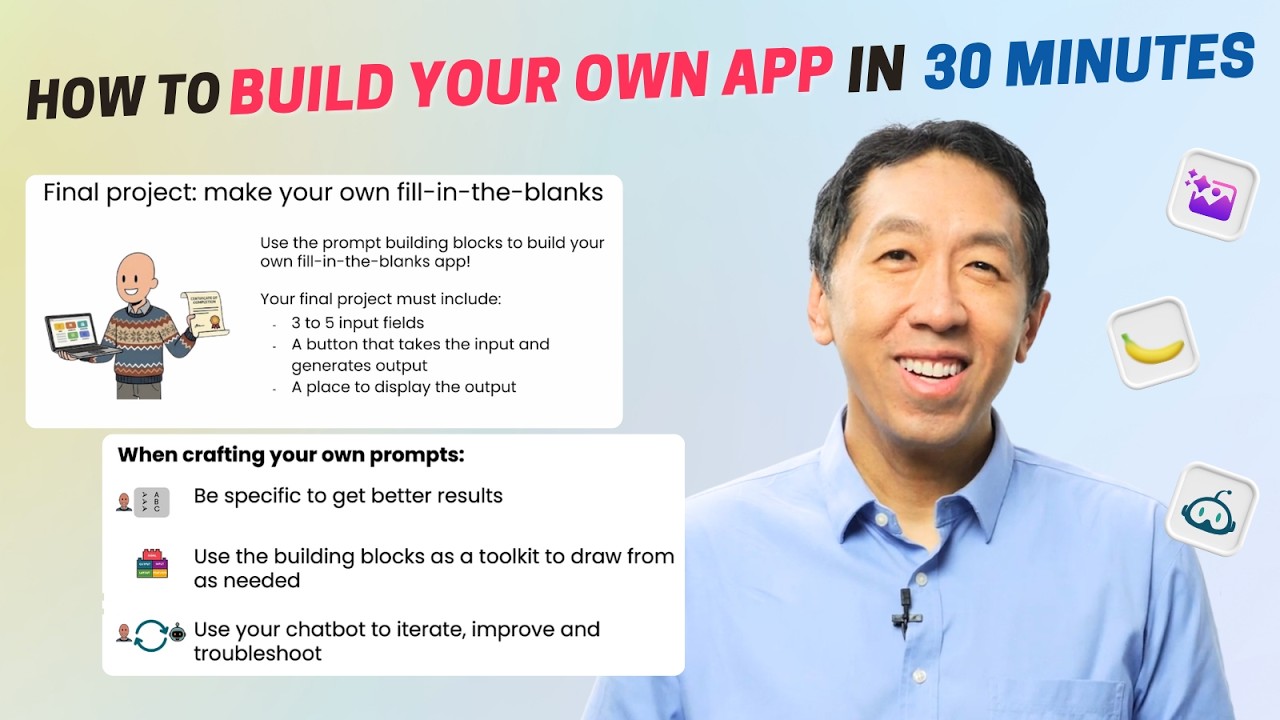
Build Your Own App In Just 30 Minutes! Full Course with Andrew Ng

This course teaches build-engineering principles for modern software development by leveraging AI tools (like ChatGPT or Gemini). Instead of writing code manually, users learn 'prompting'—the art of giving precise instructions to an AI system to generate functional web applications (HTML files). The process emphasizes iterative refinement and mastering five key building blocks: Goal, Input, Layout, Special Features, and Output. By following this framework, users can build complex tools, such as a birthday card generator or a ping pong game, with minimal coding experience.

Key takeaways

  1. The Power of Prompting 4:30

    Creating software in the AI era involves telling the AI what to do (prompting) rather than typing out code. The more specific and precise the prompt, the more predictable the resulting application will be.

  2. The Five Building Blocks of Prompts 6:10

    To build effective prompts, consider these five components: 1) The Goal (what to create), 2) User Input (data the user provides), 3) Layout (arrangement of parts), 4) Special Features (additional functionality), and 5) Output (the desired result format).

  3. Iterative Development and Troubleshooting 11:20

    Software development is an iterative process. If the initial AI-generated app has bugs or needs improvement, users must continue the conversation with specific instructions (e.g., 'Nothing happens when I click on the generate card button. Can you fix it for me?').

Watch on YouTube Full article