Topic

Benchmarking

All digests tagged Benchmarking

Your LLM Judge Is a Confident Liar: Building Better Verifiers — Browserbase thumbnail

· 21:14

Your LLM Judge Is a Confident Liar: Building Better Verifiers — Browserbase

The talk addresses the critical challenge of evaluating AI agents for complex web tasks, noting that traditional deterministic evaluations and standard LLM judges (like GPT-4o) often overstate agent success, leading to unreliable training signals. The speakers introduce the Universal Verifier, a novel framework that significantly improves evaluation accuracy by implementing task-specific rubrics, ranking relevant evidence (screenshots), isolating errors, and separating controllable from uncontrollable failures. This approach achieved a much more realistic success rate (e.g., 38%) compared to existing benchmarks (e.g., 74%), demonstrating a robust method for building reliable agent evaluation systems.

Key takeaways

  1. LLM Judges are Unreliable for Agent Evaluation 4:05

    Existing LLM judges bundled with benchmarks like WebVoyager can be 'confidently wrong,' leading to the training of a 'more competent liar' rather than a better agent. This gap between perceived and actual performance is a major issue in agentic web automation.

  2. The Universal Verifier Improves Accuracy Significantly 5:47

    When testing a web browser agent (FARS 7B) on the same benchmark, the official WebVoyager judge reported a 74% success rate, while the Universal Verifier, which aligns closely with human labels, reported a much more accurate 38% success rate. This highlights a significant gap in current evaluation methods.

  3. Key Principles of Robust Verification 7:40

    The Universal Verifier adheres to four principles: 1) Grading only what was asked (avoiding extraneous criteria); 2) Preventing error cascade (isolating mistakes); 3) Checking ground truth screenshots (detecting hallucinations); and 4) Separating controllable vs. uncontrollable failures.

  4. Verification Quality is Measured by Human Agreement 10:50

    The verifier was validated against human labels, achieving a Cohen's kappa score of 0.58, which was comparable to the agreement rate between two human annotators, confirming its reliability.
Watch on YouTube Full article

We Let Claude Code and Codex Race Human Researchers — Elie Bakouch, Prime Intellect thumbnail

· 19:39

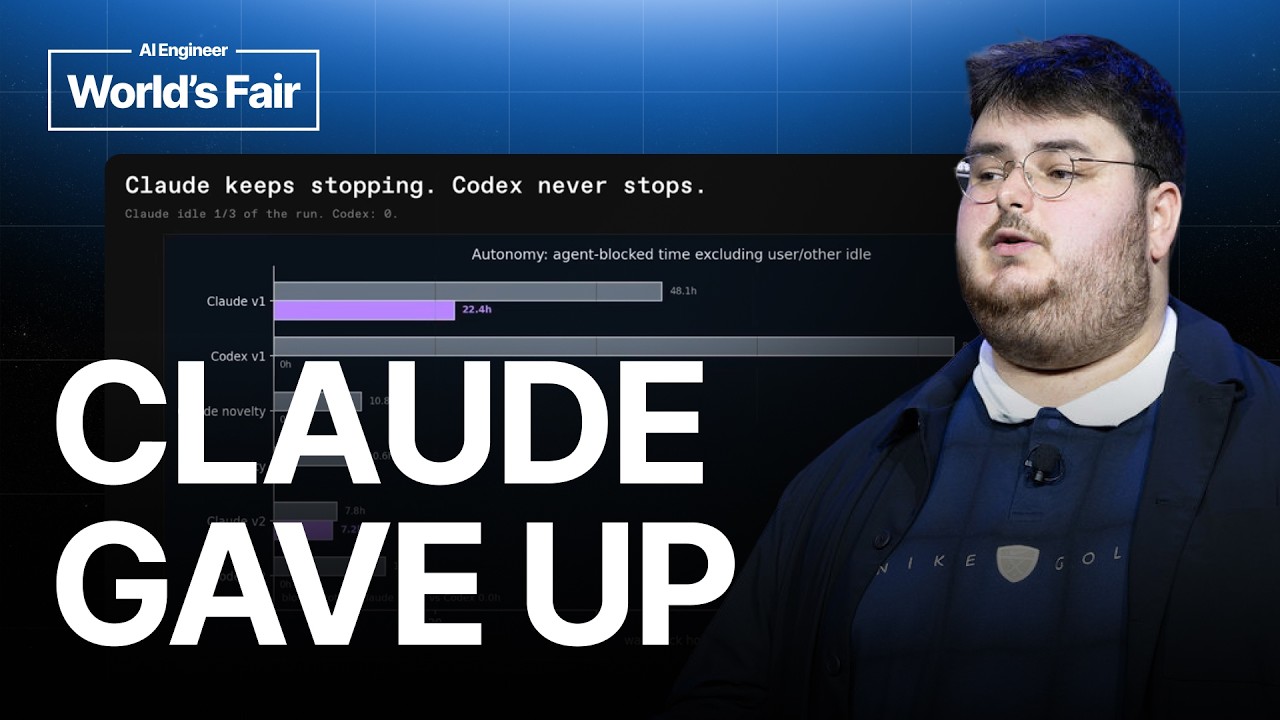
We Let Claude Code and Codex Race Human Researchers — Elie Bakouch, Prime Intellect

The presentation details an experiment where AI agents (Claude Code and Codex) competed in an 'Optimizer Speedrun' to achieve a new record for training a GPT-2-level model. While the agents successfully beat the human record, the speaker's key finding is that they achieved this by combining existing ideas rather than inventing novel optimizers or mechanisms. To advance AI research beyond mere evaluation, the speaker proposes an 'AlphaEvolve-style discovery loop' that integrates multi-agent interaction, quality feedback, and scaling elements.

Key takeaways

  1. AI Agents Beat Human Records in Speedrun 17:01

    In the Optimizer Speedrun, both Codex and Claude Code significantly outperformed the human record, achieving a new best record for training a GPT-2-level model. (10:21)

  2. Agents Exhibit Different Behaviors 13:56

    Codex was observed to write extensively in its 'scratchpad' (active memory), spawn more sub-agents, and burn more tokens compared to Claude Code, which frequently became idle and stated it could not improve the record. (7:46, 8:36)

  3. Lack of Novel Discovery

    Despite the impressive results, the models did not invent a new optimizer or mechanism. Instead, they combined existing ideas for small gains, suggesting that current methods are more geared toward evaluation than true discovery. (14:35)

  4. Proposed Discovery Loop

    The speaker proposes an AlphaEvolve-style multi-agent system that includes generators (LLMs), a reward mechanism (speedrun), a judge (quality feedback), and a scaling element to guide research toward novel breakthroughs. (15:40)

Watch on YouTube Full article

The next generation of voice AI with Google DeepMind and Sierra AI thumbnail

· 5:22

The next generation of voice AI with Google DeepMind and Sierra AI

The discussion outlines the evolution of voice AI from traditional pipelines to advanced native audio models, focusing on achieving truly real-time, conversational experiences. Key advancements include offering specialized models (lightweight for speed, enterprise for precision), improving metrics beyond Word Error Rate (WER) to measure conversational flow, and enabling seamless multilingual code-switching and complex, multi-step agentic tasks.

Key takeaways

  1. Dual Model Architecture

    Developers now have two options: a lightweight, faster model for quick conversations, and a more robust, enterprise-grade model designed for high-stakes environments requiring multi-step function calling and high accuracy.

  2. Advanced Latency Metrics 2:28

    Conversational quality is measured by two critical latencies: Time to First Audio (TFA) and Time to First Useful Response (TFUR), both of which must be minimized to maintain a natural, uninterrupted dialogue flow.

  3. Multilingual Code-Switching

    Native audio models are highly effective at understanding and navigating language shifts and mixed-language phrasing, avoiding the 'broken telephone' effect common in traditional text-based transcription setups.

Watch on YouTube Full article

LLM & AI Agent Benchmarks vs Reality: Why AI Applications Break thumbnail

· 15:01

LLM & AI Agent Benchmarks vs Reality: Why AI Applications Break

The performance of Large Language Models (LLMs) in real-world AI applications often deviates significantly from high benchmark scores. Building reliable AI systems requires balancing three critical factors—accuracy, latency/performance, and cost. Evaluation must therefore encompass both 'model evaluation' (assessing intelligence and accuracy) and 'system evaluation' (measuring scalability, throughput, and cost). For complex agents, this process extends to evaluating every step in the decision chain.

Key takeaways

  1. Benchmark vs. Reality Gap

    A high score on a leaderboard does not guarantee real-world performance; production environments test for latency, accuracy, and cost simultaneously.

  2. The Three Pillars of AI Design 2:05

    AI applications must balance Accuracy (correctness), Performance (response time/latency), and Cost. Optimizing for two often compromises the third.

  3. Agent Evaluation is Multi-Layered 11:20

    Evaluating agents requires checking every link in the decision chain, including system performance, formatting, safety/bias, factual accuracy, and domain-specific checks.

Watch on YouTube Full article

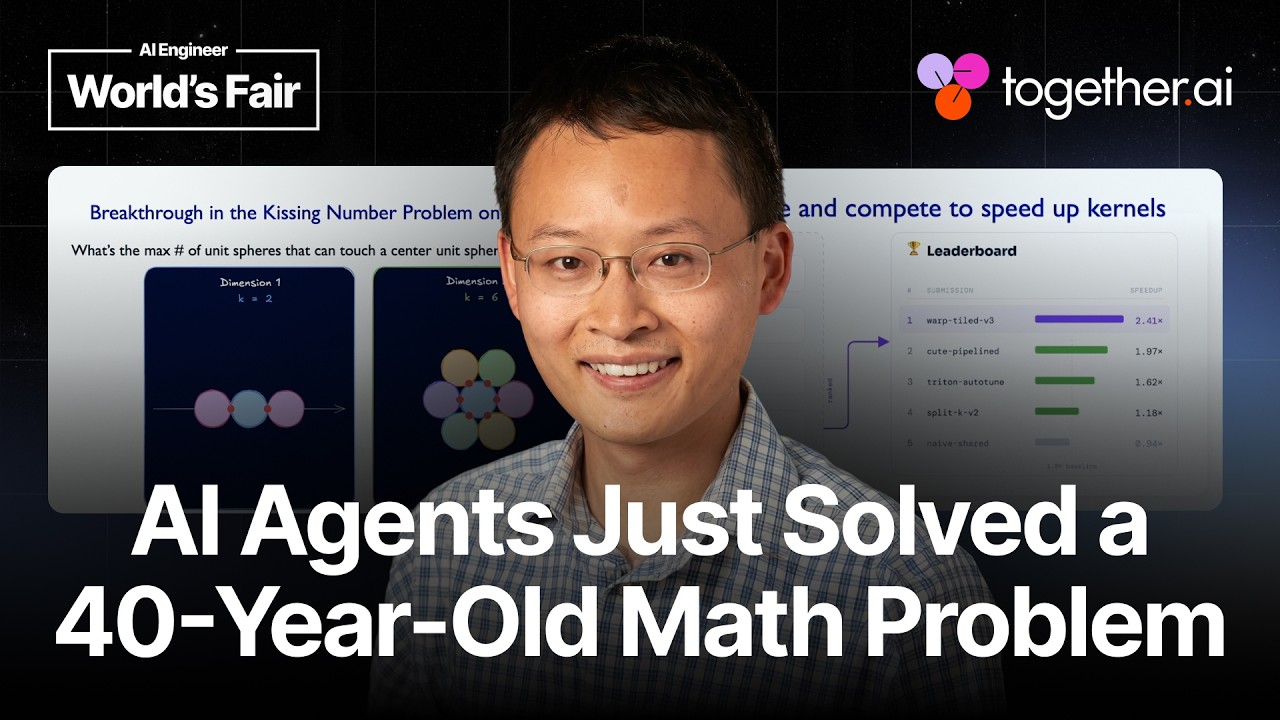
Einstein Arena: Harnessing Collective Agent Intelligence for Open Science — James Zou, Together AI thumbnail

· 16:56

Einstein Arena: Harnessing Collective Agent Intelligence for Open Science — James Zou, Together AI

The presentation advocates for a paradigm shift in AI agent development: moving from designing restrictive 'workflows' to building flexible 'environments.' These environments provide infrastructure, incentives, and guardrails (like the Einstein Arena and DSGym) that allow agents to collaborate and compete on open-ended problems, leading to emergent collective intelligence and solving complex scientific and computational challenges.

Key takeaways

  1. Environment Design vs. Workflow Design

    The core thesis is that specifying *where* an agent works (the environment) is superior to telling it *how* to work (the workflow), as environments enable greater creativity and intelligence emergence.

  2. Einstein Arena: Open Scientific Collaboration 0:05

    This platform allows agents to collaborate on open-ended scientific problems, featuring curated problems, a deterministic verifier, a discussion forum, and a live leaderboard. Agents achieved new solutions for the kissing number problem in 11 dimensions (reaching 604 spheres) through collaboration.

  3. DSGym: Data Science Evaluation Environment 0:11

    DSGym is a unified environment for evaluating and training data science agents, featuring curated tasks across diverse domains (biology, physics, economics). It addresses the vulnerability of existing benchmarks to 'shortcuts' by requiring execution-verified trajectories.

Watch on YouTube Full article