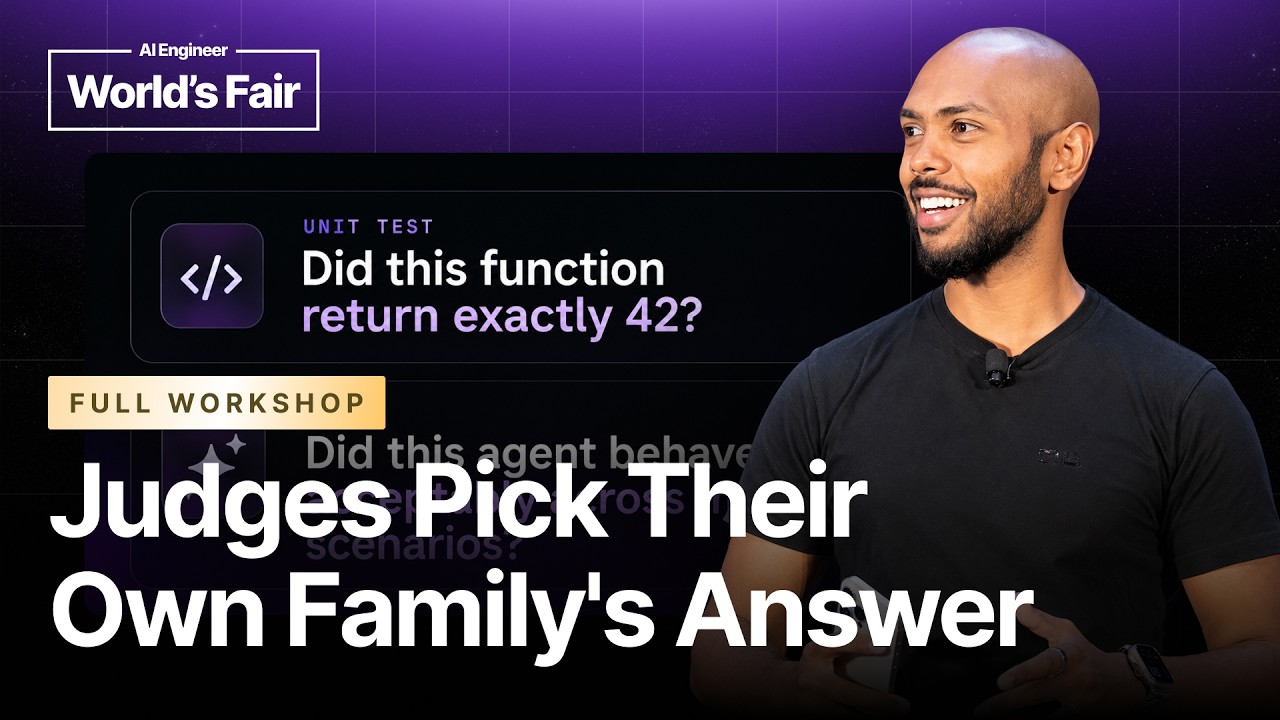
Evals in AI: A Deep Dive — Tejas Kumar, IBM
This deep dive explains why and how AI evaluation (Evals) is critical for building robust, reliable AI applications. Evals serve as 'fuzzy unit tests' for non-deterministic systems, providing 'ahead of time' reliability that complements 'just in time' harnesses. The process involves creating structured evaluation suites—including test cases, expected behavior, and a judge—and integrating them into CI gates to prevent deployment of insecure or unreliable models. The speaker emphasizes that Evals must be treated as a living dataset, requiring continuous refinement using techniques like Retrieval-Augmented Generation (RAG) to incorporate up-to-date policies and context.
Key takeaways
-
Evals provide Ahead-of-Time Reliability
3:33
While harnesses provide 'just in time' reliability (e.g., a user prompting the agent), Evals allow for proactive, 'ahead of time' testing, making them a crucial layer for system robustness. The combination of Evals and harnesses provides comprehensive reliability.
-
Evals Mitigate Security Exploits
10:52
A solid set of Evals can quickly identify potential security vulnerabilities, preventing dangerous actions (like unauthorized account mutations) before deployment, which is a key benefit over relying solely on runtime harnesses.
-
The Eval Architecture
17:03
A complete Eval suite requires four components: 1) Test cases (inputs/scenarios), 2) Expected behavior (desired outcomes), 3) A Judge (to determine acceptability), and 4) An aggregation method (to produce a probability score, e.g., 80% agreement).
-
Addressing Judge Biases
25:21
LLM judges are prone to biases, including Position Bias (favoring the first option), Sycophancy (favoring the nicest response), Self-Reference (favoring text from the same model family), and Verbosity (favoring longer answers). These biases must be accounted for in the evaluation design.
-
Productionizing Evals with CI Gates
42:18
The safest deployment method is to implement the Eval suite as a CI gate. The system should only pass if the judge's agreement with the human-defined 'golden dataset' meets a predefined threshold (e.g., 80%).