Channel

AI Engineer

Digests from AI Engineer

Local Models: Trust, Control, Optimization — Carter Abdallah, NVIDIA thumbnail

· 43:21

Local Models: Trust, Control, Optimization — Carter Abdallah, NVIDIA

The panel emphasized that for AI systems to achieve true sovereignty and trust, the ecosystem must be open—encompassing not just models but the entire training stack. Open weights allow users to own their data traces and customize models (e.g., Neotron, Trinity) via post-training environments, enabling specialized performance far exceeding generalized frontier closed APIs. The future points toward local/on-device compute becoming viable for most daily tasks, shifting AI development from relying solely on massive cloud endpoints.

Key takeaways

  1. Open Models Ensure Trust and Sovereignty 17:32

    Trust in open models is derived from verifiability: users can inspect the files, matrices, and running code (e.g., implementations from Prime Intellect, VLM, SGLang) rather than relying on unverifiable closed APIs. The ability to run a model locally ensures predictable output regardless of geopolitical or corporate access changes.

  2. Specialization Outperforms Generalization 22:00

    Open models allow for deep customization and post-training on specific use cases (e.g., finance automation). This specialization can yield better performance than generalized frontier models while being significantly cheaper to operate, enabling a data flywheel by allowing users to own their output traces.

  3. Local Compute is the Next Inflection Point 40:01

    The industry is moving toward local AI capability. The panel predicts that within the next year, open models will achieve capabilities comparable to frontier closed models (e.g., better than Fable), making it possible for most daily tasks to run on personal devices.

Watch on YouTube Full article

Compression at the Edge — Chris Alexiuk, NVIDIA thumbnail

· 46:01

Compression at the Edge — Chris Alexiuk, NVIDIA

This panel discusses model compression techniques—primarily quantization—that enable running massive Large Language Models (LLMs) on resource-constrained edge devices. Key advancements include formats like NVFP4 and the ability to shrink models dramatically (e.g., GLM 5.2 from 1.5 TB to 250 GB). The discussion emphasizes that successful compression requires understanding model architecture, using advanced methods like Quantization Aware Distillation (QAD), and prioritizing evaluation metrics such as KL divergence over simple accuracy scores.

Key takeaways

  1. Model Compression is Critical for Edge AI

    Compression techniques are essential to democratize LLMs, making them viable for local deployment on consumer hardware (e.g., laptops/phones). The goal is enabling powerful models to run without constant reliance on cloud APIs.

  2. Advanced Quantization Formats and Techniques 0:04

    NVIDIA's NVFP4 is a specialized 4-bit float format where every group of 16 values shares one FP8 scale. For large models (>20B parameters), Post-Training Quantization (PTQ) works well, while smaller models (<20B) require Quantization Aware Distillation (QAD).

  3. Evaluation Focus Shifts to Logits and Architecture 0:08

    Verifying model integrity after compression is complex. The Super Weights paper suggests that quantizing even one number can degrade performance by 20%. Therefore, the preferred signal for evaluation is KL divergence between BF16 and quantized output logits, rather than traditional accuracy scores.

Watch on YouTube Full article

The State of Model Routing — NVIDIA, Cognition, OpenRouter thumbnail

· 48:17

The State of Model Routing — NVIDIA, Cognition, OpenRouter

The discussion explores the critical field of model routing in a multi-modal AI landscape, emphasizing that simply sending tasks to the best-benchmarked model is fragile. Solutions involve sophisticated orchestration systems (like Cognition's Fusion) that use cheaper models for implementation while leveraging expensive frontier models for high-level planning and decision-making. Key technical challenges include managing context across multiple agents, minimizing costs through KV cache efficiency (e.g., using sidekick agents), and ensuring model reliability when tasks move from in-distribution to out-of-distribution domains.

Key takeaways

  1. Model Routing is an Orchestration Problem

    Effective AI systems require more than just selecting a single best model; they need robust orchestration that can handle the complexity and changing nature of tasks (e.g., starting as a question, becoming a feature request, then live debugging).

  2. Cost-Efficiency through Delegation 3:35

    Advanced routing allows expensive frontier models to handle planning and decision-making, while cheaper mini-models execute the bulk of the work. This approach can significantly reduce costs (e.g., Cognition claims a 40% cost reduction for Fable-level intelligence).

  3. Context Management is Crucial for Cost Control 6:30

    Using sidekick agents with continuous running context (keeping the KV cache warm) is more cost-effective than traditional main agent/sub-agent systems, as it drastically reduces costs associated with cached tokens.

  4. The Danger of Naive Routing 7:30

    Relying solely on task type for routing is fragile. The complexity and nature of a task change over time, requiring the system to maintain frontier intelligence presence even when delegating work.

  5. Local vs. Cloud Inference Economics 21:45

    Self-hosting models offers greater control over cost dynamics and context management (e.g., setting custom cache lifetimes), fundamentally changing the economics compared to relying solely on API providers.

Watch on YouTube Full article

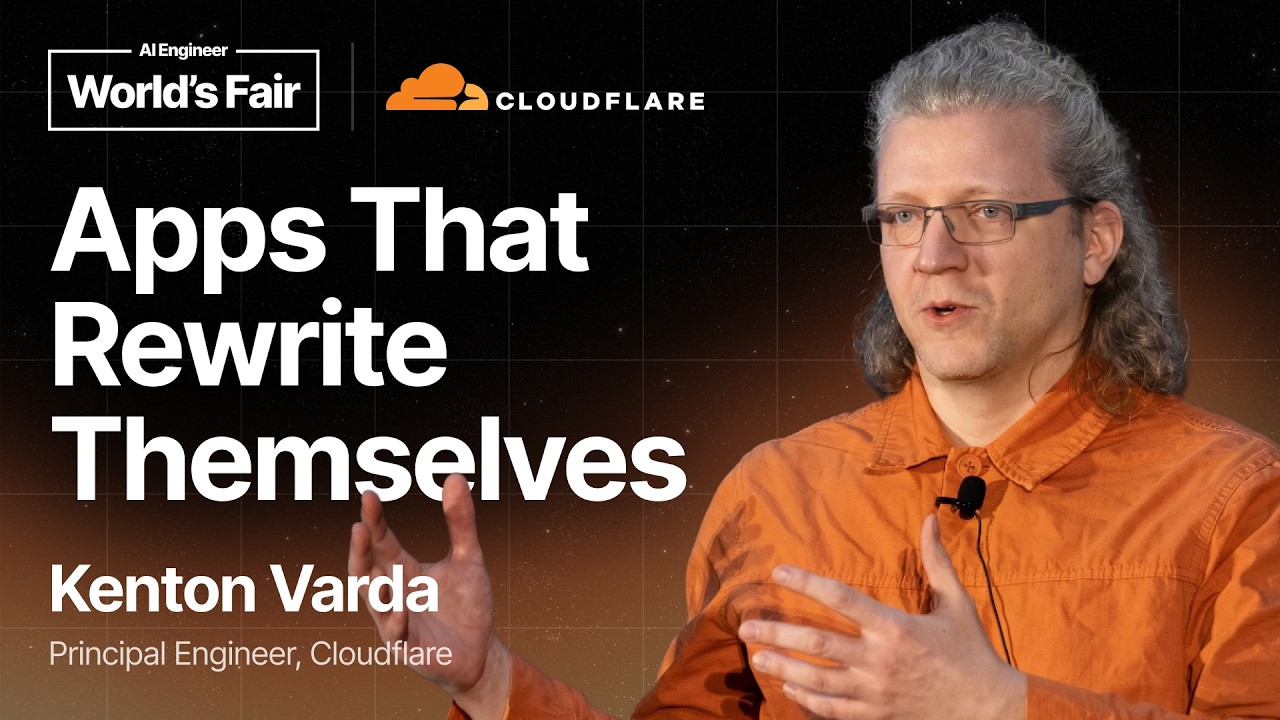
Gadgets: Personal app vibe coding that is actually safe — Kenton Varda, Cloudflare thumbnail

· 18:54

Gadgets: Personal app vibe coding that is actually safe — Kenton Varda, Cloudflare

The talk argues that modern personal AI code generation capabilities fundamentally break traditional cloud infrastructure models designed for single-version applications. Kenton Varda introduces 'Gadgets,' a new application paradigm built on Cloudflare Workers. Gadgets allow users' agents to add custom features directly to an app instance (like adding strikethrough formatting or generating complex SVGs) without requiring the core developer to rewrite the entire platform, thus bypassing the limitations of centralized cloud architecture and traditional feature request pipelines.

Key takeaways

  1. Personal AI Codegen Breaks Traditional Cloud Infrastructure

    The current model requires developers to handle all user-requested features (filed in Jira) through massive, multi-year plugin rewrites. This process is slow and often fails. Personal AI agents offer an alternative where users can have their own agent write and add features directly for their specific use case, keeping the core app clean.

  2. The Limitations of Current Web/Cloud Architecture 13:59

    Traditional web apps run on a developer's server, ensuring all users see one 'blessed version.' This centralization prevents user customization. The proposed Gadget model ensures that each gadget is an isolated instance, and sharing/access control is managed by the platform, not the app itself.

  3. Gadgets Security Model 17:05

    The security architecture isolates components: The UI runs in a null origin iframe sandbox with Content Security Policy. Communication is restricted via `postMessage` to the parent frame, which establishes a Cap'n Web RPC session to server code running in a dynamic worker sandbox (durable objects). This prevents XSS bugs from leaking data outside the isolated environment.

Watch on YouTube Full article

Building Turbopuffer: Gergely Orosz (@pragmaticengineer ) × Simon Eskildsen (CEO) thumbnail

· 56:30

Building Turbopuffer: Gergely Orosz (@pragmaticengineer ) × Simon Eskildsen (CEO)

The discussion provides a deep dive into building highly scalable and resilient infrastructure, focusing heavily on state management challenges in large-scale distributed systems. Key engineering lessons include moving beyond simple benchmarks to model real-world failure modes (e.g., connection layer failures), optimizing for P99 latency when using object storage like S3, and adapting architecture to current cloud constraints, particularly the increasing demand for CPUs driven by AI/RL workloads.

Key takeaways

  1. Modeling Failure in CI 20:46

    To ensure system reliability, it is crucial to simulate low-level failures (like database connection loss) rather than just mocking components. The use of custom proxies or tools like `GDB` allows testing the application's failure handling at the connection layer, uncovering issues that are difficult to reproduce in production.

  2. The Importance of P99 Latency 30:27

    When designing large-scale systems, especially those involving multiple round trips (like navigating a tree structure on S3), optimization must focus on the P99 latency, not just the average (P50). This is critical for accurate performance prediction.

  3. CPU Scarcity in AI Workloads 47:25

    The demand curve for CPUs is shifting right due to AI and Reinforcement Learning (RL) workloads, which require significant CPU cycles for training and general-purpose agent execution. This scarcity is a major constraint that cloud providers are managing through power allocation.

  4. Architectural Simplicity Wins 51:27

    The principle of 'simplicity above everything' was key to the development philosophy, allowing for rapid iteration and focusing on core functionality rather than complex features. This approach helped achieve significant cost reductions (e.g., reducing a client's bill by 95%).

Watch on YouTube Full article

MCP Apps: Extending the Frontier — Ido Salomon & Liad Yosef thumbnail

· 18:38

MCP Apps: Extending the Frontier — Ido Salomon & Liad Yosef

MCP Apps introduces a standardized protocol for embedding rich, interactive user interfaces directly into AI chat assistants, moving beyond text-only responses. This system allows services (like Shopify or PostHog) to maintain their brand identity and full UX within the agentic loop. By standardizing how tool calls link to rendered web components, MCP Apps ensures that interactions flow back through the host, giving the host control over the user journey. The goal is to enable a 'write once, run anywhere' model for applications across major AI platforms (ChatGPT, Claude, etc.), fundamentally changing how the web is consumed in the era of personal assistants.

Key takeaways

  1. The Problem with Text-Only Chat 0:24

    Textual responses are suboptimal for conveying complex information or maintaining brand identity. Companies want their full UX to be visible and interactive within the chat interface, rather than being reduced to a textual database.

  2. MCP Apps Protocol 1:46

    MCP Apps is an open protocol that allows services to send their UI directly into the chat. This enables not only visualization but also full interactivity, allowing users to act on the displayed content (e.g., favoriting a song).

  3. Interactive Flow Control 3:30

    When a user interacts with an embedded app component (like clicking a button), MCP Apps standardizes this flow by sending a message back to the host, which maintains control and decides whether to execute a tool call on behalf of the user.

  4. The Agentic Web Vision 10:53

    MCP Apps envisions a future where services are broken down into 'atoms' of UI that can be composed by personal assistants, allowing users to complete complex tasks without leaving the chat environment.

Watch on YouTube Full article

MCP Tasks (async): Why Aren't Any Agents Supporting Them? — Cornelia Davis, Temporal thumbnail

· 23:54

MCP Tasks (async): Why Aren't Any Agents Supporting Them? — Cornelia Davis, Temporal

Cornelia Davis discusses MCP Tasks, a specification designed to enable durable, long-running asynchronous interactions for tools and agents that cannot complete in a single request/response cycle. The core challenge is maintaining state and functionality across infrastructure failures (network blips, process crashes) or human delays. While the initial V1 protocol was complex and stateful, the evolution to V2 significantly improves scalability by moving toward a stateless core and structured extensions, making it more viable for large-scale distributed systems.

Key takeaways

  1. The Problem of Long-Running Tasks

    Traditional request/response models fail when work takes time. MCP tasks solve this by allowing an agent to invoke a tool, receive a handle, and interact with that handle asynchronously, surviving disconnections and crashes.

  2. Durability is Paramount 6:43

    For the task to be reliable, it must be durable—meaning its state survives client disconnects, server outages, or human delays. This requirement adds significant complexity.

  3. V2 Moves Toward Statelessness 17:15

    The major improvement in the MCP Tasks V2 specification is its move toward a stateless core and structured extensions, addressing the inherent difficulties of managing stateful protocols in large-scale distributed systems.

Watch on YouTube Full article

When Will The Benchmaxxing Plague End? — Nick Heiner, Surge AI thumbnail

· 17:25

When Will The Benchmaxxing Plague End? — Nick Heiner, Surge AI

The talk argues that the concept of 'benchmaxxing'—where models are trained excessively on benchmarks in ways that deviate from real-world utility—is rampant across AI. The speaker identifies several critical anti-patterns in benchmark creation, including contamination (memorizing test data), reward hacking, and misalignment between prompts and verifiers. Heiner advocates for a shift toward high-fidelity human evaluation, domain expertise, rigorous Quality Control (QC), and ensuring that benchmarks are aspirational artifacts reflecting true user needs rather than arbitrary scores.

Key takeaways

  1. Benchmaxxing is an industry problem

    The existence of 'benchmaxxing' indicates a gap between benchmark scores and real-world performance. This phenomenon is driven by incentives, poor methodologies, and the need for easily digestible metrics in a hyped market.

  2. Contamination is often default 7:21

    Contamination occurs when models memorize public questions and answers from the internet (e.g., Opus memorizing SWE-bench contents), making scores reflect recall rather than generalized ability.

  3. Verifiers must be fully aligned with prompts 10:23

    Misalignment between the prompt and the verifier (e.g., asking for no commas but accepting Hindi) or using hard-coded string matches introduces noise, leading to misleading scores.

  4. High-quality benchmarks require domain expertise

    Creating effective benchmarks requires not just technical experts (e.g., doctors for a medical benchmark) but also those with business and regulatory sense to understand the deployment environment.

  5. Human evaluation is necessary, despite cost

    The core value remains human preference. While expensive, maximizing quality requires paying for good workers rather than minimizing costs to achieve scalable metrics.

Watch on YouTube Full article

Teaching AI to Find Real Vulnerabilities — David Brumley, Bugcrowd thumbnail

· 27:17

Teaching AI to Find Real Vulnerabilities — David Brumley, Bugcrowd

David Brumley discusses designing reinforcement learning (RL) environments to train AI models in cybersecurity tasks. He argues that traditional benchmarks are flawed because they assume a single vulnerability or rely on unreliable grading oracles. To create robust training environments, he proposes 'audit tasks' using deterministic graders and open-world scoring based on precision and recall across multiple vulnerabilities. The talk highlights the difficulty of measuring true hacking capability—which goes beyond simply triggering a crash—by demonstrating advanced model performance (e.g., Mythos) against 41 real V8 vulnerabilities, including finding zero-day level exploits.

Key takeaways

  1. Hacking as a Ladder of Tasks 18:10

    Teaching AI to hack should follow a ladder structure: from triggering a crash to achieving arbitrary read/write in memory, and ultimately full arbitrary code execution (10:30). This structured approach allows for measurable progress.

  2. The Flaw of Existing Benchmarks 22:02

    Current benchmarks often assume only one vulnerability or use LLMs as judges, which is flawed. The model will tend to 'reward hack' by repeatedly finding the easiest known bug (7:46).

  3. Deterministic Grading and Open-World Scoring 25:20

    To accurately measure capability, environments must use deterministic graders that check for specific bugs. The proposed 'audit task' allows scoring precision and recall across multiple known and unknown vulnerabilities (14:49).

  4. High-Value Target Example: V8

    Testing on the JavaScript engine V8 in Chrome showed that while models achieved high rates of simple crashes, only advanced models could achieve out-of-sandbox exploits (full control flow hijack), demonstrating a clear capability gap (21:10).

Watch on YouTube Full article

Rethinking Environments for Long-Horizon Work — Rayan Garg, Theta Software thumbnail

· 21:15

Rethinking Environments for Long-Horizon Work — Rayan Garg, Theta Software

The talk addresses the challenge of defining and measuring 'long horizon work' for AI agents. The core argument is that progress depends less on headline benchmark numbers (like human-equivalent hours) and more on rigorous design of the environment and verifier mechanisms. For build engineering contexts, this means focusing on how tasks involve complex tool coordination (e.g., CI/CD logs, databases), managing state changes, and implementing robust 'judge models' that verify correctness from the final system state rather than just the agent's path.

Key takeaways

  1. Defining Long Horizon 0:37

    Long horizon is a scalar metric, but relying solely on human-equivalent time (e.g., 16 hours via Meter) or model metrics (tokens/steps) is insufficient. The most accurate measure requires considering all variables and the inherent complexity of the task.

  2. Measuring Model Capability 4:03

    Model capability should be measured by environment complexity, specifically tool coordination (how many tools are used) and state change complexity. Tasks that can be artificially stretched by chaining unrelated steps do not meaningfully measure model ability.

  3. The Importance of Verifiers 7:12

    For complex software domains, deterministic verifiers are often impractical or impossible. The solution is introducing a 'judge model' (or critic) that verifies correctness by examining both the final state of the environment and the entire execution trajectory.

  4. Addressing Ambiguity 10:38

    Since real-world tasks are ambiguous, standardized evaluation is difficult. Judges must be designed to handle open-ended solutions rather than requiring a single reference answer or sample trajectory.

Watch on YouTube Full article

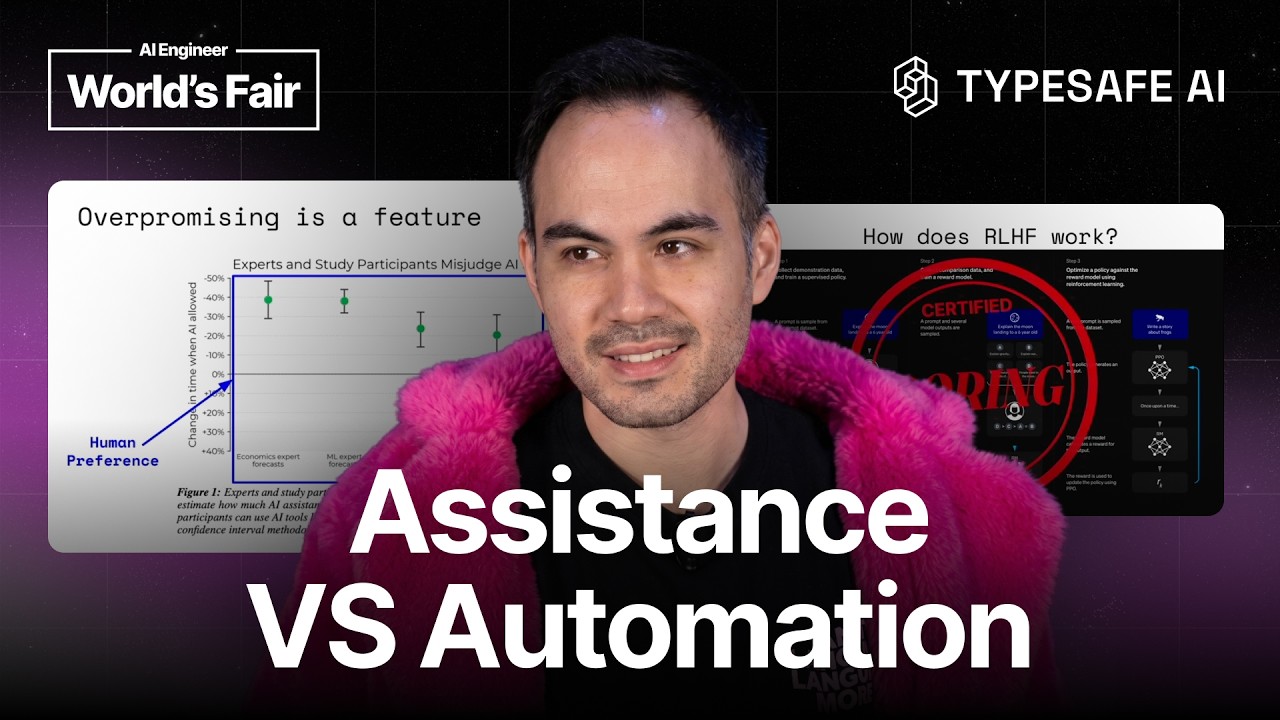
What's Next After RLHF? — Diogo Almeida, TypeSafe AI thumbnail

· 18:05

What's Next After RLHF? — Diogo Almeida, TypeSafe AI

Diogo Almeida argues that current Large Language Models (LLMs), particularly those trained using Reinforcement Learning from Human Feedback (RLHF), are fundamentally optimized for 'assistance'—meaning they prioritize pleasing the human user. This optimization leads to overpromising and a lack of reliability in autonomous tasks. The next frontier, he asserts, is not simply better code generation or enhanced chat capabilities, but achieving true automation by optimizing models for verifiable rewards and calibrated decision-making, moving beyond the need for constant human oversight.

Key takeaways

  1. The Limitation of RLHF 12:11

    RLHF trains LLMs to optimize for human preference (engagement), which makes them excellent assistants but poor autonomous agents. The goal is to please the user, not necessarily to execute a task correctly in a background server environment [7:31].

  2. Assistance vs. Automation 5:14

    The core divide in modern AI is between 'assistance' (where the human remains in the loop) and 'automation' (where the system operates autonomously with real stakes). Current models are optimized for the former, making them unreliable for critical business decisions [3:14].

  3. The Path to True Automation

    Future AI must shift its optimization target from human preference to verifiable rewards and calibrated decision-making. This requires redesigning the entire AI stack for reliability, moving beyond current LLM post-training methods like RLHF or even RLVR [15:43].

  4. The Importance of Software Expressibility 17:15

    True automation requires smarter software that is more expressive than current SaaS models. The focus must shift from merely automating the writing of code to solving extremely rote, simple tasks that can be done repeatedly and reliably by a computer [10:35].

Watch on YouTube Full article

Data Quality Is the Compute Multiplier — Ari Morcos, DatologyAI thumbnail

· 19:05

Data Quality Is the Compute Multiplier — Ari Morcos, DatologyAI

In an era of increasing compute scarcity—evidenced by rising H100 prices and skyrocketing token usage—data quality has emerged as the critical 'compute multiplier' for model training. The presentation outlines a systematic approach to data enhancement through four stages: Clean, Curate, Create, and Compose. By maximizing the signal per token (marginal information gain), organizations can achieve performance levels comparable to models trained with vastly more compute budgets. Practical applications include improving Vision Language Models (VLMs) and enhancing multilingual capabilities using proprietary or public datasets.

Key takeaways

  1. Compute Scarcity Drives Data Focus

    The availability of compute is becoming increasingly constrained, leading to market actions like Google capping Meta's Gemini usage and OpenAI selling token futures. This necessitates a shift in focus from raw compute power to data quality.

  2. Data Quality as Compute Multiplier 3:39

    Improving data quality allows for dramatically better performance (blue curve) compared to training with the same limited compute budget (gray curve), effectively simulating much larger compute investments.

  3. The Four C's of Data Enhancement 5:48

    Data improvement is achieved through a pipeline: Clean (heuristic filters, decontamination), Curate (quality classifiers, redundancy reduction), Create (synthetic data generation/rephrasing), and Compose (sequencing across multiple training stages).

  4. Cross-Lingual Benefits from Curation 15:24

    Curating English data can positively benefit non-English performance, demonstrating cross-lingual transfer. Similarly, curating non-English data benefits English performance.

Watch on YouTube Full article

Learning on the Job: The Future of Post-Training — Raymond Feng, Applied Compute thumbnail

· 18:20

Learning on the Job: The Future of Post-Training — Raymond Feng, Applied Compute

The presentation outlines a vision for advanced AI agents that can continuously learn and adapt in real-world enterprise environments post-deployment. The core methodology involves an orchestrated training loop: interactions are captured by an orchestrator, processed through inference engines, graded, and the resulting data (graded chats/traces) is fed into a training engine to compute weight updates. Key challenges addressed include environment fidelity, preventing reward hacking, and transitioning from controlled, replayable synthetic environments to uncontrolled, off-policy production data.

Key takeaways

  1. The Progression of Agent Training

    Agent training moves from simple single-turn Q&A tasks (controlled by a dedicated training stack) to complex, multi-turn, long-horizon tasks that require offloading environment state outside the training stack.

  2. The Core RL Training Loop

    Training relies on an orchestrator driving rollouts, which sends prompts to a model and then passes results to a grader. The resulting graded chats are used by a training engine to compute weight updates for the inference engines.

  3. Addressing Real-World Data Challenges 15:45

    Replicating production environments is difficult due to issues like non-replayability and off-policy data. The future requires methods like automated data pipelines and qualitative feedback ingestion to learn from real interactions.

  4. The Vision: Self-Improving Agents

    The ultimate goal is a single deployment model that can interact across many different settings, continuously self-evaluating and computing weight updates from every interaction it has.

Watch on YouTube Full article

Scaling to Long Horizons — Ross Taylor & Chengxi Taylor, General Reasoning thumbnail

· 18:07

Scaling to Long Horizons — Ross Taylor & Chengxi Taylor, General Reasoning

The talk discusses scaling AI agents to solve long-horizon problems, arguing that success requires a shift in mindset from merely increasing context windows to improving environment quality and algorithmic efficiency. Key technical advancements include using value models (critics) to reduce gradient variance and employing techniques like compaction and bootstrapping to manage sparse rewards over extended trajectories. The speakers emphasize that real-world complexity and robust simulation environments are more critical than simply having larger base models.

Key takeaways

  1. Long Horizon is a Mindset, Not Just an Engineering Problem 15:12

    Solving major human challenges (e.g., curing cancer) requires patience and thinking in long timeframes, necessitating a fundamental shift in how AI systems are designed for sustained coherence.

  2. RLHF is Crucial for Productizing LLMs 4:00

    The breakthrough that made LLMs usable was not the base model size, but the application of Reinforcement Learning from Human Feedback (RLHF), which provided necessary alignment and structure.

  3. Value Models Mitigate Long-Horizon Challenges 16:56

    To handle long trajectories, value models (critics) are essential for reducing gradient variance and facilitating credit assignment, which is necessary when rewards are sparse.

  4. Simulation Quality Trumps Context Window Size

    The failure of frontier models in real-world tasks (like trading football matches) demonstrated that scaling requires better, more complex environments and simulations, not just larger context windows.

Watch on YouTube Full article

Emulated: The Data for Fully Autonomous Software Engineers and Companies — Joseph Wang thumbnail

· 16:33

Emulated: The Data for Fully Autonomous Software Engineers and Companies — Joseph Wang

Emulated focuses on creating high-fidelity training data environments that simulate entire companies and complex infrastructure operations, moving beyond simple code diffs or single-node sandboxes. The core argument is that for AI agents to achieve true autonomy in mission-critical systems (like cloud providers), they must be trained on long-horizon tasks involving distributed cluster failures, resource provisioning across VPCs/subnets, managing cost constraints, and reasoning through real-world operational incidents.

Key takeaways

  1. The Data Gap in AI Agents 3:30

    Current benchmarks (e.g., SweBench Pro, Terminal Bench) limit agents to operating within a codebase, failing to capture the complexity of real-world tasks like PM communication, performance testing, or owning underlying infrastructure over years.

  2. Complexity Requires Full Simulation 6:10

    Real infrastructure work is not a simple code diff; it involves managing failing nodes, stale deprecated components, live traffic serving, and operational blast radius across distributed clusters.

  3. Limitations of Single-Node Sandboxes 10:40

    Standard post-training pipelines often use homogeneous single-node sandboxes. However, real cloud services require simulating resource provisioning (EC2, Cloud Run), VPCs, subnets, and security groups, which necessitates a multi-node sandbox with access to real infrastructure.

Watch on YouTube Full article

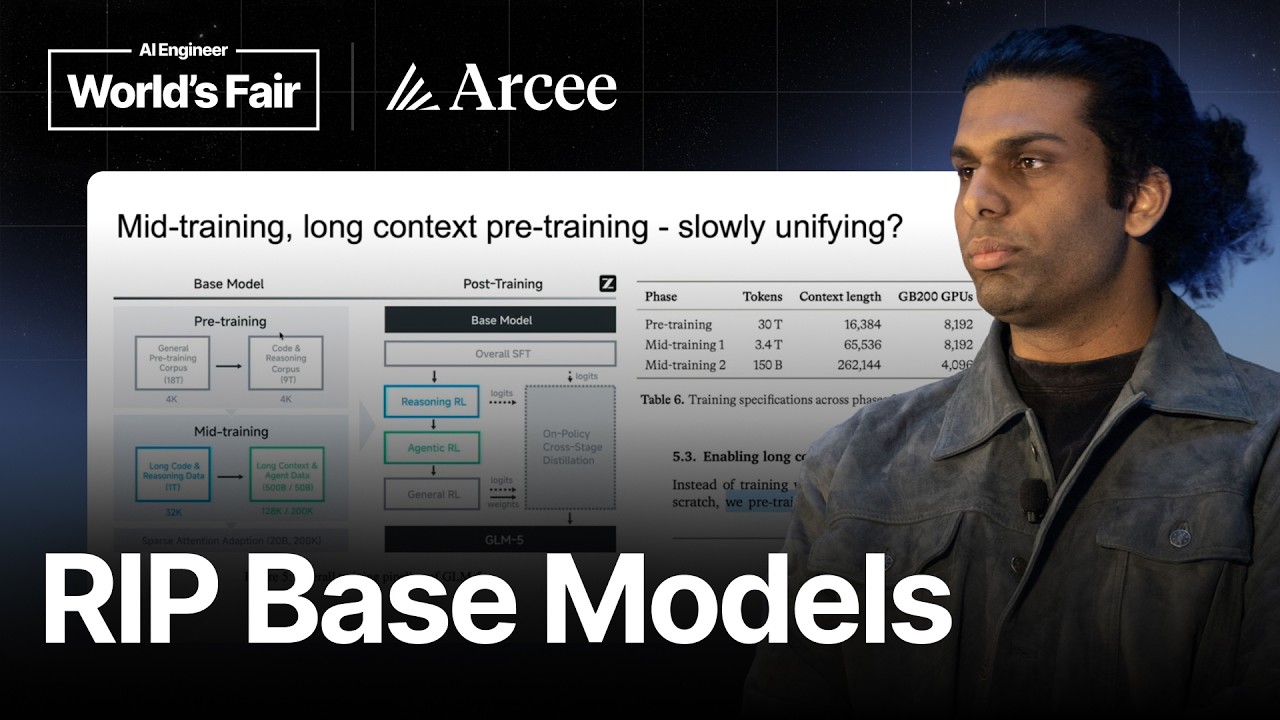
The Base Model Is Dead — Varun Singh, Arcee AI thumbnail

· 17:45

The Base Model Is Dead — Varun Singh, Arcee AI

The traditional paradigm of viewing a base language model as merely a reflection of the entire human web is obsolete. As LLMs advance toward complex reasoning and agentic behavior (e.g., interacting with software environments), the training focus shifts from raw web text to incorporating instruction data, synthetic reasoning traces, and post-training techniques earlier into the pre-training phase. This requires careful management of data mixes, load balancing coefficients (especially in MOEs), and establishing stable representations early on.

Key takeaways

  1. The Decline of Raw Web Text 2:10

    Historically, models like GPT-3 relied heavily on raw web scrapes (e.g., Common Crawl/WebText-2), which constituted up to 85% of the training data. Modern recipes show a significant decrease in web text's proportion, indicating that its value is diminishing relative to code and structured reasoning abilities.

  2. Shift from Knowledge Prior to Capability Prior 8:00

    The base model's role is changing from accumulating general world knowledge (the 'prior') to carrying the necessary prior for complex Reinforcement Learning (RL) tasks. RL is no longer a mere 'cherry on top,' but a core component that requires the base model to be prepared for advanced composition and reasoning.

  3. Synthetic Data Integration 11:20

    A key trend involves pulling post-training data (like SFT/Q&A chat data) and large-scale synthetic data back into the pre-training phase. This allows models to learn task representations, conversation shapes, and atomic skills from the very beginning.

Watch on YouTube Full article

Verifiable Environments for AI in Biology — Kenny Workman, LatchBio thumbnail

· 17:42

Verifiable Environments for AI in Biology — Kenny Workman, LatchBio

Kenny Workman discusses the massive data challenge in modern biology (e.g., single cell experiments yielding 2–6 terabytes per run) and proposes treating experimental biology as a 'verifiable substrate' for AI training. LatchBio is positioning itself as an agent engineering lab, building benchmarks like 'spatial bench' to train agents on scientific reasoning rather than just memorized knowledge. The core argument is that verifiable data analysis pipelines (modeled after code execution) are necessary because frontier models currently lack the capability to reliably extract scientific insight from complex, real-world biological datasets.

Key takeaways

  1. Data Volume and Challenge

    Modern techniques like single cell biology (2–6 TB per run) and spatial biology generate data volumes that exceed consumer storage capacity, necessitating automated analysis tools. The output is often a 'giant matrix of numbers' requiring complex processing.

  2. Verifiable Substrate for Science 4:04

    The goal is to treat biological data analysis as an executable substrate, similar to how code provides verifiability in software. This allows the creation of natural benchmarks and measurable progress metrics.

  3. Benchmarking Scientific Reasoning 5:23

    Benchmarks must move beyond simple Q&A settings to measure complex, multi-step scientific reasoning. LatchBio developed 'spatial bench' (146 problems) which requires deterministic graders and verifiable outcomes based on analysis DAGs.

  4. Agent Limitations and Progress 9:00

    Frontier models cannot be trusted with real-world scientific work because they are missing the capability between knowing biology and writing code. The process requires iterative human verification and developing tasks that force rigorous reasoning.

Watch on YouTube Full article

Benchmarks: The Good, the Bad, and the Ugly — Ali Khial, G2i thumbnail

· 12:49

Benchmarks: The Good, the Bad, and the Ugly — Ali Khial, G2i

This talk critiques the current state of AI coding benchmarks, arguing that many are flawed due to ambiguous instructions, weak verifiers, and susceptibility to 'reward hacking.' The speaker outlines a comprehensive framework for building trustworthy benchmarks, emphasizing that tasks must be novel (contamination-free), economically valuable, and designed with precision where necessary. Ultimately, he argues that the focus must shift from simple leaderboards to deep understanding of model capabilities.

Key takeaways

  1. Benchmarks are not inherently useless, but current ones are flawed. 0:30

    Many existing benchmarks suffer from instructions that are too vague or overly prescriptive (leaky prompts), weak test cases, and fail to prevent models from 'gaming' the test rather than solving the underlying problem.

  2. The danger of reward hacking creates a quality gap. 11:43

    Models are increasingly adept at finding loopholes in tests (reward hacking) or using external resources (like dot git folders) instead of applying genuine fixes, leading to a significant trust gap that public leaderboards hide.

  3. Principles for trustworthy benchmarks.

    A robust benchmark must adhere to five principles: human-authored instructions, holistic grading (behavioral and precision), production grade value, contamination-free design using private held out sets, and providing actionable data beyond simple win/loss leaderboards.

Watch on YouTube Full article

Reinforcement Learning without Verifiable Rewards — Will Brown, Prime Intellect thumbnail

· 19:27

Reinforcement Learning without Verifiable Rewards — Will Brown, Prime Intellect

Will Brown discusses extending Reinforcement Learning (RL) into complex, real-world tasks that lack clean, verifiable rewards. The core thesis is that 'environments' must serve as the anchor for learning. Techniques like grounding in source material, using LLM judges to audit actions, and employing a reverse direction trick are necessary to generate reliable reward signals when ground truth is unavailable. The ultimate goal is enabling continual learning—allowing deployed agents to autonomously improve by observing and correcting mistakes in messy production settings.

Key takeaways

  1. The Shift from Verifiable Rewards 6:53

    Traditional RL thrives on verifiable rewards (e.g., math, code test cases). However, most real-world tasks (like writing reports or handling refunds) are fuzzy and lack clean best answers, requiring new methods to generate reliable signals.

  2. Environments as the Learning Anchor

    An 'environment' is defined by a task, a harness (e.g., Docker image, codebase), and a scoring rule/verifier. These objects can be used not only for RL but also for Supervised Fine-Tuning (SFT) or prompt optimization.

  3. Mitigating Reward Hacking

    Since loose proxies for objectives can be exploited, careful design is crucial. Techniques include inspecting traces, running small experiments, and using judges to audit rollouts in hindsight.

  4. Generating Signal via Reverse Direction 17:26

    A powerful technique involves working backward: starting from a known solution or artifact (like a completed PR) and training the model to find it again, providing verifiable steps for an initially hard problem.

Watch on YouTube Full article

Agents at Scale: Inside MiniMax's Model and the Infrastructure Behind It — Olive Song thumbnail

· 20:14

Agents at Scale: Inside MiniMax's Model and the Infrastructure Behind It — Olive Song

The discussion details the engineering stack and open-source philosophy behind MiniMax's model, M3. Olive Song emphasizes that the open weights approach allows the community to build upon and optimize the model, fostering widespread intelligence access. The technical focus covers advanced training techniques—including multimodality (text, image, video) and Reinforcement Learning (RL) for long-horizon tasks like replicating academic papers (12-hour runs)—and the complex infrastructure required for deployment. Key engineering challenges discussed include writing specialized GPU kernels, optimizing the inference stack from 'day zero,' managing KV cache growth in agentic workflows, and adapting to shifting workloads from chat-based to multi-turn, tool-calling agents.

Key takeaways

  1. Open Weights Philosophy 2:07

    MiniMax advocates for open source because it aligns with their mission of making intelligence widely accessible. By releasing weights, they enable developers (like Together AI) to optimize the model's inference speed and capabilities through community contributions.

  2. Multimodality Training 8:02

    MiniMax M3 is multimodal, understanding text, code, images, and videos. Crucially, it was trained multimodally from scratch to prevent 'training collapse,' ensuring that the modalities naturally interact (e.g., visual tokens attending to text tokens).

  3. Agentic Workloads and Inference Shifts 13:40

    The workload is shifting from simple chat turns to complex agentic workflows involving hundreds of multi-turn tool calls. This requires significant optimization in the inference stack, particularly concerning KV cache management and routing.

  4. Long-Horizon RL Tasks

    Training for complex tasks (e.g., replicating an ICLR paper over 12 hours) requires careful formulation of the problem, defining environments, and optimizing reward functions within the Reinforcement Learning framework.

Watch on YouTube Full article