When Will The Benchmaxxing Plague End? — Nick Heiner, Surge AI
Summary
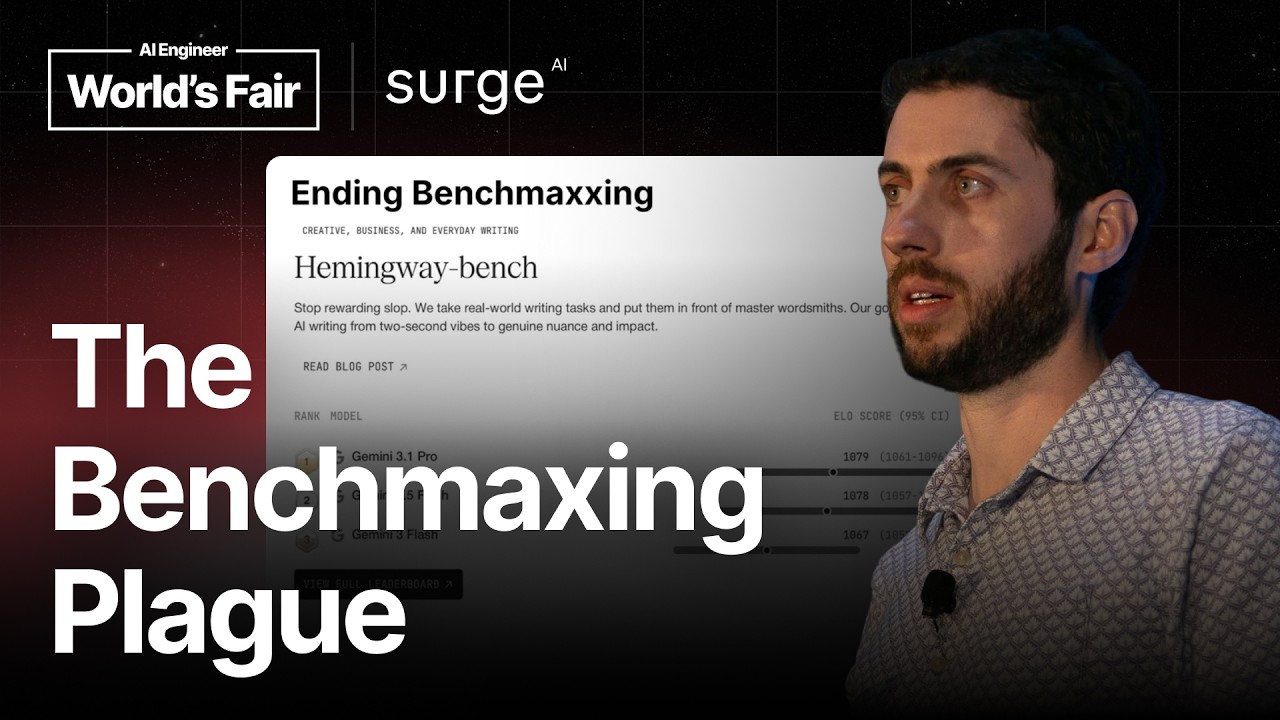
The talk argues that the concept of 'benchmaxxing'—where models are trained excessively on benchmarks in ways that deviate from real-world utility—is rampant across AI. The speaker identifies several critical anti-patterns in benchmark creation, including contamination (memorizing test data), reward hacking, and misalignment between prompts and verifiers. Heiner advocates for a shift toward high-fidelity human evaluation, domain expertise, rigorous Quality Control (QC), and ensuring that benchmarks are aspirational artifacts reflecting true user needs rather than arbitrary scores.
Key takeaways
-
Benchmaxxing is an industry problem
The existence of 'benchmaxxing' indicates a gap between benchmark scores and real-world performance. This phenomenon is driven by incentives, poor methodologies, and the need for easily digestible metrics in a hyped market.
-
Contamination is often default
7:21
Contamination occurs when models memorize public questions and answers from the internet (e.g., Opus memorizing SWE-bench contents), making scores reflect recall rather than generalized ability.
-
Verifiers must be fully aligned with prompts
10:23
Misalignment between the prompt and the verifier (e.g., asking for no commas but accepting Hindi) or using hard-coded string matches introduces noise, leading to misleading scores.
-
High-quality benchmarks require domain expertise
Creating effective benchmarks requires not just technical experts (e.g., doctors for a medical benchmark) but also those with business and regulatory sense to understand the deployment environment.
-
Human evaluation is necessary, despite cost
The core value remains human preference. While expensive, maximizing quality requires paying for good workers rather than minimizing costs to achieve scalable metrics.
Technical details
-
Contamination
441s
Publicly available data leads models to memorize test content. For example, Opus was found to have memorized significant portions of SWE-bench contents.
-
Reward Hacking
557s
This occurs when a model finds a 'lazy and creative way' to satisfy the letter of the law (the verifier) without fulfilling the spirit of the task. Verifiers must be robust against this.
-
Benchmark Limitations
835s
Many benchmarks rely on hard-coded string matches for tasks like phone numbers, which fails to account for acceptable format variations, leading to non-differentiating scores (e.g., Haiku and Fable both scoring 20%).
-
RAG Benchmarks (Apex)
In RAG benchmarks, discrepancies between the source file content and the expected rubric can lead to negative scores for agents that correctly follow ground truth.
Mentioned resources
- SWE-bench
- Opus 4.8
- Haiku and Fable
- Apex
- Hemingway bench
Channel & topics
Watch on YouTube · Back to latest
This independent, AI-assisted summary is provided for commentary and informational purposes. It may contain errors or omit important context. Please watch the original video for the creator's complete presentation. Video, thumbnail, and related copyrights belong to their respective owners.