Software Engineering Is Becoming Factory Engineering — Zach Lloyd, Warp
Summary
Zach Lloyd argues that software engineering is evolving into 'factory engineering,' where the entire Software Development Life Cycle (SDLC) is managed by self-improving, automated systems. He details the architecture of this 'software factory,' which moves beyond simple CI/CD to incorporate agents for triage, specification generation (Product and Tech Specs), implementation, review, verification, and continuous monitoring. The core thesis is that while software is cheap to build and clone, value is captured by building and managing the automated ecosystem (the factory) in the open.
Key takeaways
-
The Shift to Automation
3:30
Development is moving from AI autocomplete/cursor co-pilots to interactive agents, and ultimately towards full automation of the SDLC. This shift requires engineers to become factory managers rather than just coders.
-
The Software Factory Loop
5:40
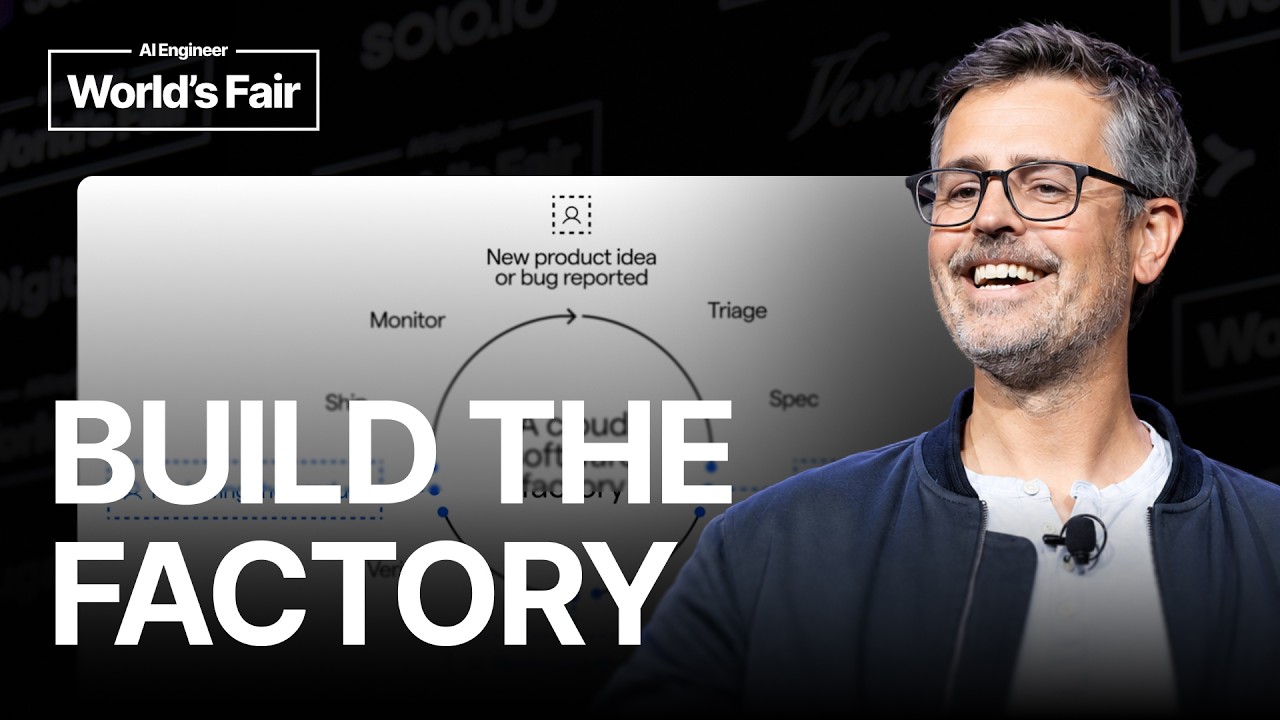
The automated factory follows a loop: Ideas $\rightarrow$ Triage $\rightarrow$ Spec Generation (Product/Tech) $\rightarrow$ Implementation $\rightarrow$ Review $\rightarrow$ Verification $\rightarrow$ Monitoring $\rightarrow$ (Feedback to Ideas).
-
Building in the Open
11:45
Because software is cheap to build and clone, companies must build an ecosystem (e.g., open-sourcing the factory itself) to capture value and build community.
Technical details
-
Software Factory Architecture
925s
The factory requires several components: 1) Inputs (ideas from users, teams, monitoring systems); 2) Triage (agents determining if an issue is easy/unambiguous); 3) Specification (agents producing Product Specs and Tech Specs); 4) Implementation (cloud-based coding agents making diffs); 5) Review (agent-assisted code review); 6) Verification (automated testing, e.g., computer using the UI); 7) Monitoring (observing shipped code for crashes/usage).
-
Factory Architecture Layers
A scalable factory requires three main layers: a Control Plane (for work distribution), Cloud Sandboxes (where work happens, determining the agent/model), and a Data Plane (allowing agents to remember, learn, and improve over time).
-
Self-Improvement Loops
The factory must incorporate self-improvement loops (e.g., skill loops). Observer agents monitor the performance of other agents (e.g., a code review agent) and feed corrections back to improve the skills for the next run.
Mentioned resources
Channel & topics
Watch on YouTube · Back to latest
This independent, AI-assisted summary is provided for commentary and informational purposes. It may contain errors or omit important context. Please watch the original video for the creator's complete presentation. Video, thumbnail, and related copyrights belong to their respective owners.