Topic

AI Coding

All digests tagged AI Coding

Why AI Didn't Actually Make You Ship Faster — Gabriel Spencer-Harper, Meticulous thumbnail

· 11:15

Why AI Didn't Actually Make You Ship Faster — Gabriel Spencer-Harper, Meticulous

As AI accelerates code generation, verification has become the primary bottleneck in software development. Traditional assertion-based testing is insufficient because the space of possible regressions is too vast to cover exhaustively. Meticulous addresses this by providing near-exhaustive front-end verification with zero developer effort. It records real user flows and replays them on every Pull Request (PR), generating visual diffs (before/after screenshots) to show exactly what changes are introduced by a code merge, allowing developers to review changes with complete confidence.

Key takeaways

  1. Verification is the New Bottleneck

    The rapid pace of AI-generated code means that manual review and traditional testing are no longer the limiting factor; verification is. Organizations are forced to trade off velocity against bugs and user experience.

  2. Limitations of Assertion-Based Testing 3:27

    Defining correct behavior upfront in assertions cannot exhaustively cover the vast space of possible regressions, regardless of how hard a human or agent tries to define the behavior.

  3. Exhaustive Verification via Visual Diffing 6:56

    Meticulous instruments the web browser using a single JavaScript injection to record thousands of user flows. When a PR is opened, it replays a subset of these flows and generates visual diffs, showing what is different about the application's UI between the 'before' and 'after' states.
Watch on YouTube Full article

Prompt to Production: The Future of AI Code Workflows thumbnail

· 7:15

Prompt to Production: The Future of AI Code Workflows

The video argues that as AI coding systems become highly capable, writing code is becoming the easiest part of the software development lifecycle. The true complexity and bottleneck shift to the planning, coordination, validation, and verification of large-scale changes. Effective 'prompt-to-production' workflows require detailed planning, understanding system dependencies, and generating verifiable evidence to build developer confidence at scale.

Key takeaways

  1. Planning is the New Core Skill

    Complex engineering work requires a detailed plan, as the quality of the solution is determined long before the first line of code is written. The prompter must set the stage by defining what is important for success (e.g., customer data availability, budget).

  2. Implementation is a Complex Workflow

    A code change is not just 'prompt to code.' It is a massive workflow requiring updates across code, tests, configs, infrastructure, documentation, monitoring, pipelines, dependencies, security, and compliance, often across multiple repositories.

  3. The Bottleneck Shifts to Verification 0:03

    AI can scale execution dramatically faster than humans can scale verification. When an agent updates hundreds of files across multiple repos and pipelines, the challenge is no longer output, but the confidence that the solution's outcomes are successful.

  4. The Future is Continuous and Evidence-Driven 0:06

    The strongest AI workflows will connect planning, execution, validation, and verification into a continuous path from idea to outcome, generating evidence through testing, impact analysis, and explanations to build trust.

Watch on YouTube Full article

AI-Generated Code Is Already Competing With Human Code — Daksh Gupta, Greptile thumbnail

· 12:41

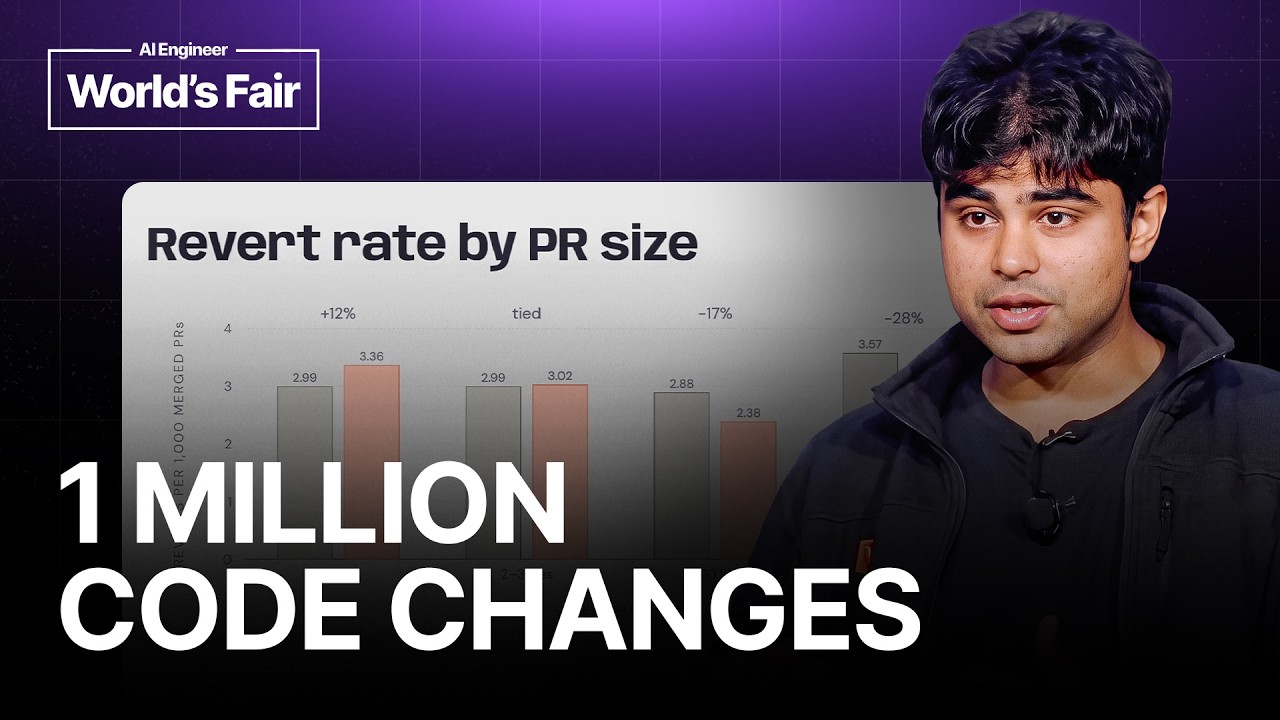
AI-Generated Code Is Already Competing With Human Code — Daksh Gupta, Greptile

The presentation analyzes the quality of AI-generated pull requests (PRs) compared to human-written code, using data from over a million PRs reviewed monthly at Greptile. Findings show that while AI agents (like Claude, Devin, and Codex) are highly capable, they exhibit distinct failure modes compared to humans. Specifically, Claude is 1.5x more likely than humans to introduce SQL injection, and N+1 queries are common from Cursor. The speaker argues that traditional manual code review is insufficient for modern enterprise scale (median user: <50 commits/month; 99th percentile: ~1,000 commits/month), proposing a validation framework that answers three questions: 1) Does the change violate the user contract? 2) Does it increase the propensity for future violations? 3) Does it fulfill the author's intent?

Key takeaways

  1. AI PR Adoption Rate is Rapidly Increasing 5:33

    A quarter (25%+) of PRs reviewed by Greptile in April were largely or entirely AI-generated, a significant increase from under 1% a year prior. This trend is accelerating as model performance improves.

  2. AI PR Quality is Comparable to Human Code 7:40

    When measured by revert rates, P0/P1/P2 bug counts, and review cycles to merge, agent-written PRs performed similarly to human-written ones. However, failure modes differ significantly.

  3. AI Agents Show Distinct Failure Patterns 9:00

    Specific agents have unique failure propensities: Claude is 1.5x more likely than humans to introduce SQL injection; Devin is half as likely to cause auth bypasses; and N+1 queries are noted as common from Cursor.

  4. Code Validation Must Scale Beyond Manual Review 11:20

    Given that the 99th percentile Greptile user writes nearly 1,000 PRs monthly, manual review is impossible. Validation must focus on answering if the change violates the user contract, increases future violation risk, and fulfills author intent.

Watch on YouTube Full article

How AI Coding Agents Understand Your Codebase & Developer Tools thumbnail

· 6:54

How AI Coding Agents Understand Your Codebase & Developer Tools

While AI coding agents excel at generating fast, syntactically correct code, their utility in production environments hinges on 'understanding' rather than just speed. The core argument emphasizes that good code must not only run but also fit the existing architectural patterns and rules of a codebase. To improve, AI tools must demonstrate deep repository awareness, respect established architectural boundaries (like service layers), and adopt a structured workflow: Read $ ightarrow$ Plan $ ightarrow$ Patch $ ightarrow$ Verify $ ightarrow$ Review.

Key takeaways

  1. Codebase Integrity Over Speed

    AI agents often create 'fast chaos' by making technically correct but architecturally inappropriate changes, such as bypassing established service layers (e.g., for logging or permissions).

  2. The Need for Contextual Awareness 2:05

    Effective AI requires more than just the file being edited; it needs repository awareness to understand API contracts, type definitions, and existing utilities without dumping irrelevant files into the prompt.

  3. Structured Workflow is Essential 5:40

    AI tools should not immediately patch. The ideal workflow involves making reasoning visible (planning), allowing developers to review assumptions before any code changes are made.

Watch on YouTube Full article