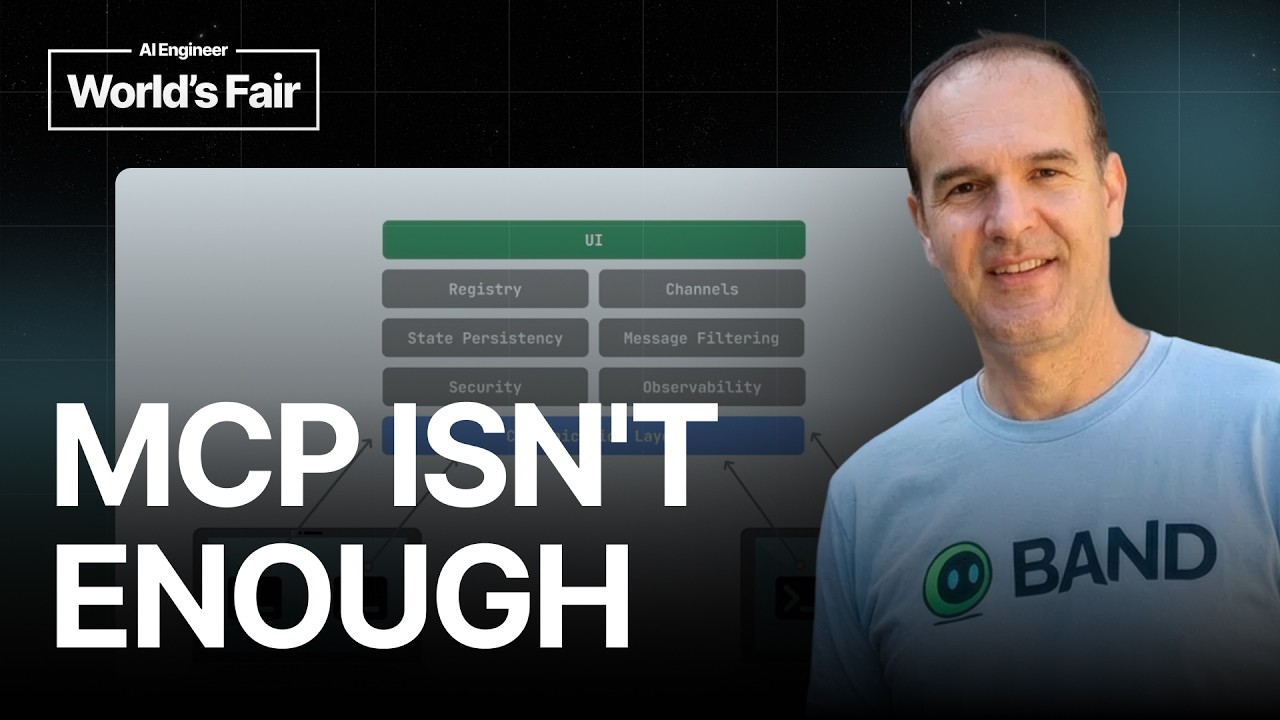
Your Agents Are in Solitary Confinement: Why MCP & A2A Aren't Enough — Vlad Luzin, Band
Multi-agent coordination is fundamentally a distributed systems problem, not a simple scripting task. Current methods—including low-level protocols like MCP and A2A, or messaging platforms like Slack—are insufficient because they lack necessary features such as real-time ordered transport, persistence, discovery, and runtime binding across diverse frameworks. The speaker introduces Band, a global interaction layer designed to abstract these complexities, enabling autonomous agents (like Codex and LangGraph) to communicate and collaborate seamlessly regardless of their underlying framework or deployment environment.
Key takeaways
-
The Multi-Agent Problem
0:02
Attempting to coordinate agents by hand (e.g., copy-pasting between two sessions) or using basic protocols (MCP/A2A) requires the developer to act as a 'router,' which is inefficient and fails to manage state, persistence, or discovery. (2:04, 5:33)
-
Limitations of Existing Protocols
0:05
Protocols like MCP are completely stateless, and A2A is client-server. Chaining multiple agents involves managing REST API timeouts, and developers must manually implement queues, persistence, and discovery mechanisms. (5:33)
-
The Distributed Systems Requirement
0:08
For agents to work together reliably, the system must solve the transport layer (ordered, real-time delivery, retries), continuity (handling crashes/rehydration), and runtime binding across different agentic frameworks. (8:17)
-
The Solution: Band
0:10
Band provides a global collaboration layer that abstracts the technical stack to concepts like 'rooms,' 'channels,' and 'participants.' It handles the necessary primitives for agent-to-agent communication, allowing agents from different frameworks (e.g., Codex, LangGraph) to connect and collaborate autonomously. (10:17)