Your Agents Are in Solitary Confinement: Why MCP & A2A Aren't Enough — Vlad Luzin, Band
Summary
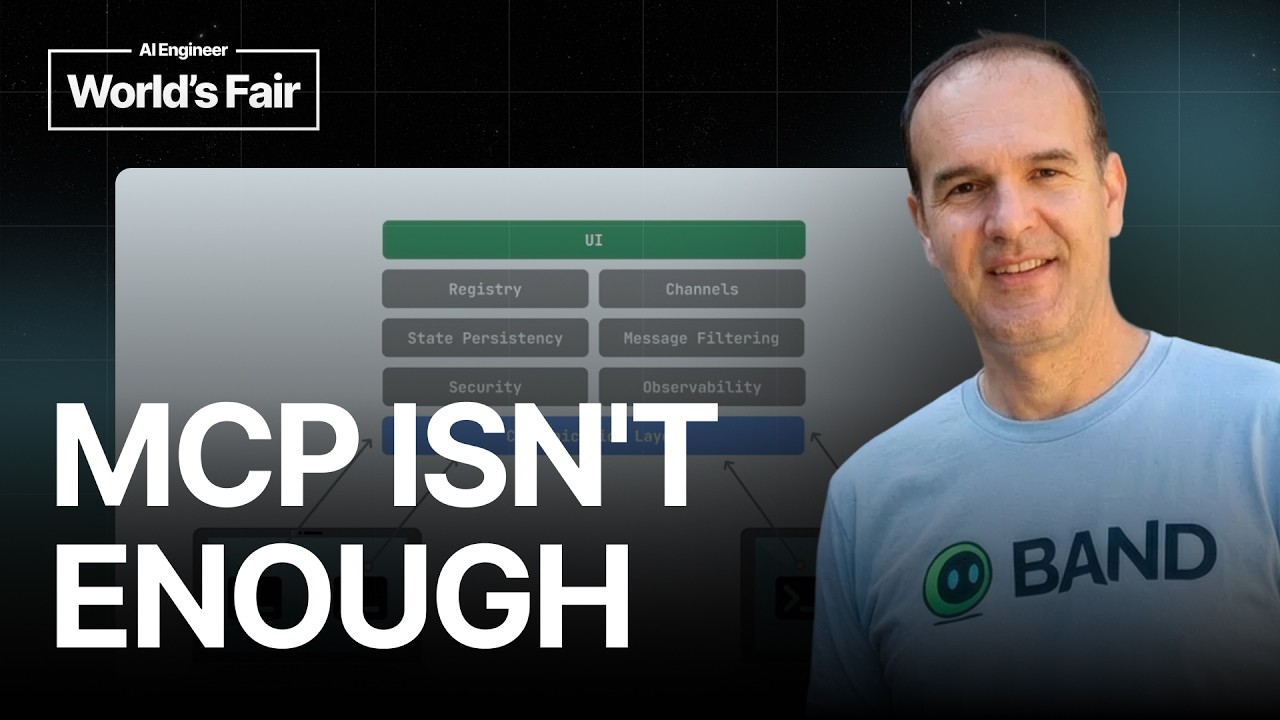
Multi-agent coordination is fundamentally a distributed systems problem, not a simple scripting task. Current methods—including low-level protocols like MCP and A2A, or messaging platforms like Slack—are insufficient because they lack necessary features such as real-time ordered transport, persistence, discovery, and runtime binding across diverse frameworks. The speaker introduces Band, a global interaction layer designed to abstract these complexities, enabling autonomous agents (like Codex and LangGraph) to communicate and collaborate seamlessly regardless of their underlying framework or deployment environment.
Key takeaways
-
The Multi-Agent Problem
0:02
Attempting to coordinate agents by hand (e.g., copy-pasting between two sessions) or using basic protocols (MCP/A2A) requires the developer to act as a 'router,' which is inefficient and fails to manage state, persistence, or discovery. (2:04, 5:33)
-
Limitations of Existing Protocols
0:05
Protocols like MCP are completely stateless, and A2A is client-server. Chaining multiple agents involves managing REST API timeouts, and developers must manually implement queues, persistence, and discovery mechanisms. (5:33)
-
The Distributed Systems Requirement
0:08
For agents to work together reliably, the system must solve the transport layer (ordered, real-time delivery, retries), continuity (handling crashes/rehydration), and runtime binding across different agentic frameworks. (8:17)
-
The Solution: Band
0:10
Band provides a global collaboration layer that abstracts the technical stack to concepts like 'rooms,' 'channels,' and 'participants.' It handles the necessary primitives for agent-to-agent communication, allowing agents from different frameworks (e.g., Codex, LangGraph) to connect and collaborate autonomously. (10:17)
Technical details
-
Agent Communication Architecture
0s
The future requires agents to communicate autonomously, forming conversational spaces where they can discover each other and solve tasks without human intervention. (0:00)
-
Protocol Deficiencies
5s
Protocols like MCP and A2A are criticized for being too low-level, lacking built-in state management, discovery, and robust handling of message queues and timeouts. (5:33)
-
Required Abstractions
8s
A robust solution must provide ordered message delivery, consistency hydration, and runtime binding across diverse agentic frameworks. (8:17)
-
Observability and Governance
14s
The platform must provide full visibility into multi-agent work, including tracking token usage, cost attribution, and identifying which human or agent was involved in a specific task (user chain cost). (14:11)
Mentioned resources
- Band
- Codex
- LangGraph
- Claude Code
Channel & topics
Watch on YouTube · Back to latest
This independent, AI-assisted summary is provided for commentary and informational purposes. It may contain errors or omit important context. Please watch the original video for the creator's complete presentation. Video, thumbnail, and related copyrights belong to their respective owners.