Channel

IBM Technology

Digests from IBM Technology

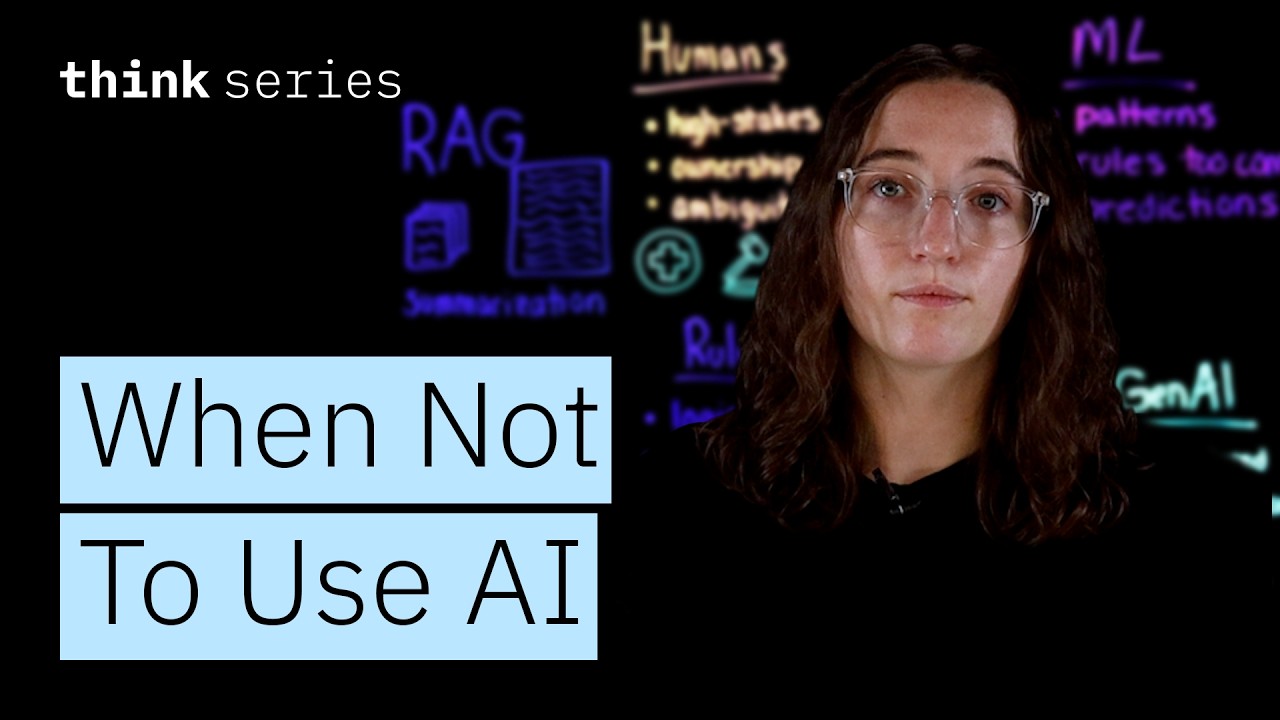
Knowing When Not to Use AI: AI Agents vs Rules vs ML thumbnail

· 10:35

Knowing When Not to Use AI: AI Agents vs Rules vs ML

System design requires disciplined choices regarding intelligence types—Human judgment, Rules/Code, Machine Learning, or Generative AI—rather than defaulting to AI agents for every problem. The choice must balance trade-offs across accuracy, cost, complexity, and risk. Successful modern systems are typically hybrid, combining the determinism of code with the pattern recognition of ML and the flexibility of LLMs.

Key takeaways

  1. Human Judgment 2:00

    Best for high-stakes decisions, ambiguity, ethical considerations, or situations requiring accountability (e.g., medical diagnosis, legal interpretation). Trade-offs include being expensive, slow, and difficult to scale.

  2. Rules/Code-Based Solutions 3:00

    Ideal for tasks requiring clear, stable logic, consistent exact outputs, and zero error tolerance (e.g., payment processing, input validation, security access control). Code is fast, cheap, reliable, and highly interpretable.

  3. Machine Learning (ML) 4:10

    Excels at finding patterns in structured data and making probabilistic predictions when rules are too complex to define manually (e.g., fraud detection, customer churn prediction). Requires monitoring for model drift.

  4. Generative AI (LLMs/Agents) 5:40

    Best used when inputs are unstructured (text, documents) and tasks require reasoning or transformation. Flexibility is prioritized over precision, and some error is tolerated (e.g., summarization, intent understanding). Trade-offs include non-determinism and higher cost at scale.

Watch on YouTube Full article

GPT-Red: Can AI red teams stop prompt injections? thumbnail

· 31:30

GPT-Red: Can AI red teams stop prompt injections?

This technical discussion explores how AI is being used in advanced cybersecurity defense mechanisms, specifically focusing on automated red teaming and scam interception. Key tools discussed include OpenAI's internal GPT-Red model, which significantly improves model resilience against prompt injections (e.g., reducing attack effectiveness from 95% to 10%). Another tool, ScamBuster, uses AI to bait scammers into revealing their tactics and infrastructure for threat intelligence gathering. The conversation concludes by addressing the widening gap between technical skill and raw ability in cybersecurity, warning that while AI provides immense power, human professionals must maintain foundational skills to remain effective.

Key takeaways

  1. GPT-Red's Effectiveness Against Prompt Injection 0:23

    OpenAI utilizes GPT-Red, an internal automated red teaming model, which performs better than human red teamers. This process was key in making models like GPT 5.6 Sol more robust; for instance, 'fake chain of thought attacks' that were 95% effective on GPT 5.1 are only 10% effective on GPT 5.6.

  2. ScamBuster for Threat Intelligence 5:21

    ScamBuster is an open-source AI tool designed to interact with email scammers, subtly gathering information about their tactics and infrastructure (IOCs) that can be fed back into security teams and law enforcement.

  3. The Skill vs. Ability Gap 10:35

    Bruce Schneier's essay highlights that AI is decoupling skills from abilities in cybersecurity, meaning individuals can now perform sophisticated hacks without the years of training and ethical framework traditionally required.

  4. Maintaining Foundational Skills 20:05

    The consensus takeaway for professionals is that while AI acts as a force multiplier, individuals must continue to develop their personal skills (e.g., the ability to blue/red team) to handle scenarios where the AI fails or cannot complete the task.

Watch on YouTube Full article

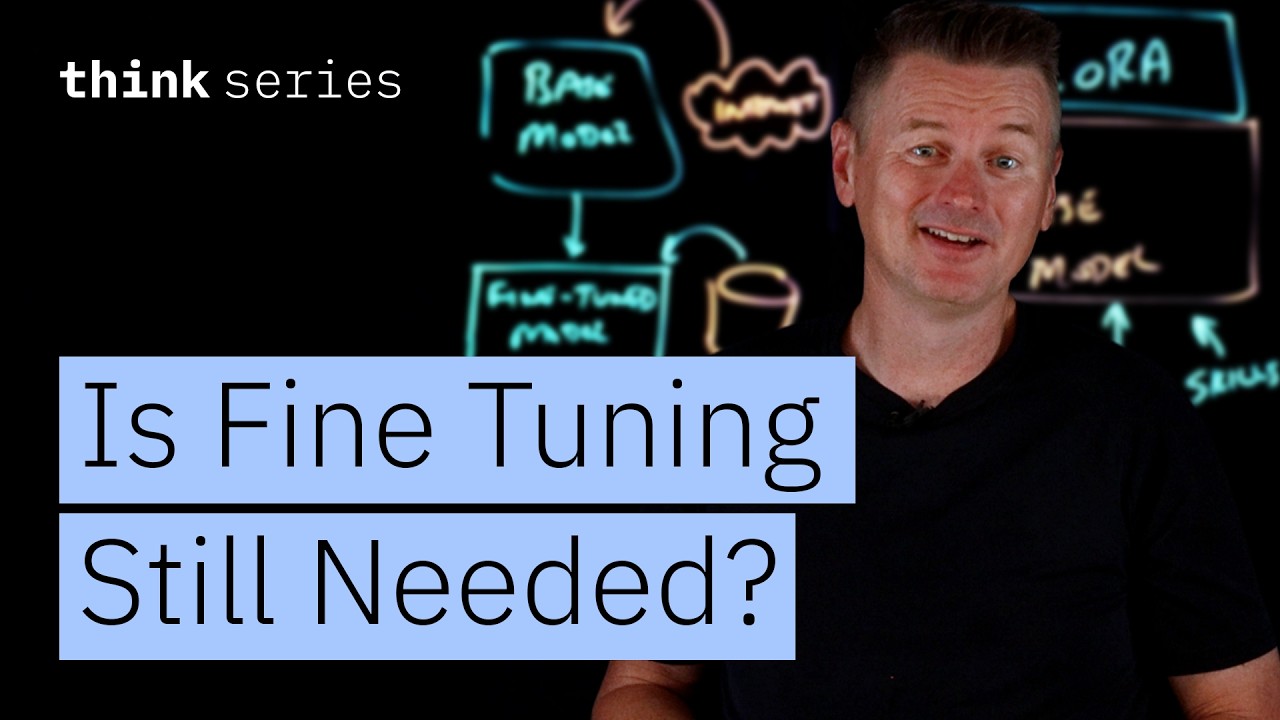
Is Fine-Tuning Still Needed? LLMs, RAG, & LoRA thumbnail

· 10:52

Is Fine-Tuning Still Needed? LLMs, RAG, & LoRA

While early successes demonstrated that fine-tuning custom LLMs could outperform general models (e.g., legal AI in 2023), the landscape has shifted significantly. Modern frontier models are rapidly closing the gap due to massive context windows and improved reasoning capabilities. The current architectural best practice suggests prioritizing non-weight modification techniques like Retrieval Augmented Generation (RAG), Context Engineering, and Agent Skills before resorting to fine-tuning. Fine-tuning remains valuable for specific bottlenecks, such as achieving low latency or when using parameter-efficient methods like LoRA.

Key takeaways

  1. Fine-Tuning vs. General Models

    Historically, custom fine-tuned models outperformed off-the-shelf leaders (e.g., legal AI over GPT-4 in 2023). However, general models are catching up due to massive context windows and improved inference reasoning.

  2. Modern Customization Stack 6:20

    The preferred order for customization is: Base Model $\rightarrow$ Prompt/Context Engineering $\rightarrow$ RAG (for proprietary knowledge) $\rightarrow$ Agent Skills (for procedural know-how). Fine-tuning should be the last resort.

  3. Cost and Complexity of Customization 7:45

    Fine-tuning is costly, involving not only training runs but also data collection, evaluation, regression avoidance, and continuous maintenance as frontier models advance.

Watch on YouTube Full article

6 Ways to Enhance Developer Productivity with AI thumbnail

· 12:53

6 Ways to Enhance Developer Productivity with AI

While AI is projected to write a significant portion of future code (e.g., 41% by 2026), achieving maximum developer productivity requires more than just adopting tools. Top-performing teams are restructuring their processes around AI's strengths—syntax and boilerplate—while protecting human focus for complex tasks like design, judgment, and learning. The six key areas for improvement involve automating repetitive work, prioritizing design over coding, fostering deep work (flow), minimizing context switching, investing in growth, and optimizing the entire toolchain.

Key takeaways

  1. AI's Role: Augmentation, Not Replacement 2:00

    The difference between average and top-tier teams is not the AI vendor used, but how they restructure their practices. AI excels at syntax, boilerplate, and well-defined transformations; humans must focus on design judgment and taste.

  2. Way One: Automate Smartly (CI/CD) 2:30

    Automation should target repetitive, error-prone tasks (e.g., automated testing, linters, security scanners). The goal is not to reduce work, but to free up cycles for higher-value engineering effort.

  3. Way Two: Design First, Experiment Later 3:25

    Before writing code, spend time on architectural sketches or flow charts. Using AI to brainstorm approaches and critique designs (finding edge cases) saves significant refactoring time.

  4. Way Three: Foster Flow State 4:30

    Productivity gains come from protecting deep work. Blocking calendars, minimizing notifications, and respecting 'heads down' time are critical for maintaining flow state.

  5. Way Four: Lessen Cognitive Load 5:40

    Mitigate context switching (the 'silent killer') by rotating on-call duties, enforcing targeted meeting agendas, and using AI coding assistants (e.g., GitHub Copilot) to enforce style guides automatically.

  6. Way Five: Make Room for Growth 7:10

    Treat code reviews as teaching opportunities rather than just gatekeeping. AI should compress the boring parts of growth, allowing human mentoring to focus on complex problem-solving.

  7. Way Six: Sharpen Tools of the Trade 8:40

    The toolchain (IDEs, frameworks, version control) must be modern and well-supported. Developer experience decisions should prioritize tools that 'get out of your way.'

Watch on YouTube Full article

Why RAG Solutions Fail with Complex Documents & Vector Databases thumbnail

· 7:46

Why RAG Solutions Fail with Complex Documents & Vector Databases

Standard Retrieval Augmented Generation (RAG) solutions often fail when processing complex, ambiguous, or contradictory real-world documents (such as evolving laws or policies). The video outlines practical architectural improvements—including robust document management and clarification loops—to ensure that AI systems can accurately handle data ambiguity and avoid presenting single answers where multiple valid interpretations exist.

Key takeaways

  1. RAG Failure Point: Data Contradiction 2:33

    Because real-world document sets are compiled over time by multiple people, they frequently contain contradictions (e.g., a 2012 law contradicting a 1912 law). A standard RAG solution must be designed to handle the possibility of multiple correct answers rather than assuming singularity.

  2. Solution 1: Preventing Unforced Errors 3:55

    Implement strong document management processes to prevent 'unforced errors' in the vector database. This means ensuring that outdated or superseded policies are removed, preventing confusion when a newer policy replaces an older one.

  3. Solution 2: Implementing Clarification Loops 4:45

    A clarification loop is a mechanism built into the AI solution that prompts the user to rephrase or specify their question if it is too vague (e.g., asking 'Who won the championship in 2010?' without specifying the sport). This ensures the input question is specific enough for accurate retrieval.

Watch on YouTube Full article

Thinking Machines Lab drops Inkling & Meta’s Muse Spark 1.1 thumbnail

· 39:02

Thinking Machines Lab drops Inkling & Meta’s Muse Spark 1.1

The AI landscape is shifting its focus from pure benchmark performance to customizable intelligence and architectural efficiency. This analysis covers three major model releases: Thinking Machines' open-weight Inkling (emphasizing customization via fine-tuning), Meta’s Muse Spark 1.1 (targeting cost-efficient agent workloads for enterprise use), and OpenAI's GPT-5.6 Sol, which showed progress on the challenging ARC-AGI-3 benchmark. Furthermore, Anthropic's J-space paper introduces a novel method to view internal model processing, offering potential new avenues for AI safety and control in agent development.

Key takeaways

  1. Shift from Benchmarks to Customization

    The industry debate is moving away from which closed model is the 'best' toward utilizing open base models combined with robust fine-tuning platforms (e.g., Inkling/Tinker API) for tailored, customizable intelligence.

Watch on YouTube Full article