Why Your Company Needs a Context Graph (and How to Build It) — Gil Feig, Merge
Summary
The talk outlines the necessity of a 'context graph'—a comprehensive 'company brain'—for building production-grade AI agents. The core argument is that simple live API lookups (like those from MCP servers) fail when attempting semantic queries across vast, historical datasets (e.g., 'Which customers were upset last year?'). The solution requires a multi-layered architecture that combines live data lookups with synced, cached data stored in a vector database. This data flow is managed by a Router and a Summarizer, and crucially, must incorporate company-specific 'skills' and 'memories' to ensure the agent follows defined business processes. Traceability and provenance are mandatory for all data used in business-critical decisions.
Key takeaways
-
Context is more than tools; it's data and process.
3:47
A context graph must integrate third-party data (e.g., NetSuite, Jira), structured context, memories, and company-defined skills/processes, not just API connections.
-
Live lookups are insufficient for semantic queries.
6:42
Live API lookups are effective for simple, single-action lookups (e.g., checking a specific customer's status in Stripe), but fail when the query requires searching across large datasets or complex semantic analysis.
-
The architecture requires a Router and a Summarizer.
10:17
A Router directs the incoming prompt to the correct handler, while the Summarizer aggregates and synthesizes data retrieved from both synced and live context sources before sending the final answer to the agent.
-
Traceability and Provenance are non-negotiable.
Every answer must track its data source, fetch time, associated ID, and what conditions (e.g., age, invalidation) might render the data outdated, especially for business-critical decisions.
Technical details
-
Context Graph Components
227s
The graph integrates third-party data, structured context, memories (agent-formed knowledge), and skills (company processes).
-
Data Tiers and Retrieval Strategy
832s
Four tiers of context are used: 1) Live API Calls (simple, cheap, preferred for single lookups); 2) Cached Data (essential for semantic, complex lookups, requires a vector database); 3) Derived Context (summarizing pulled data for future use); and 4) Prompt/Skills/Memory (the guiding logic).
-
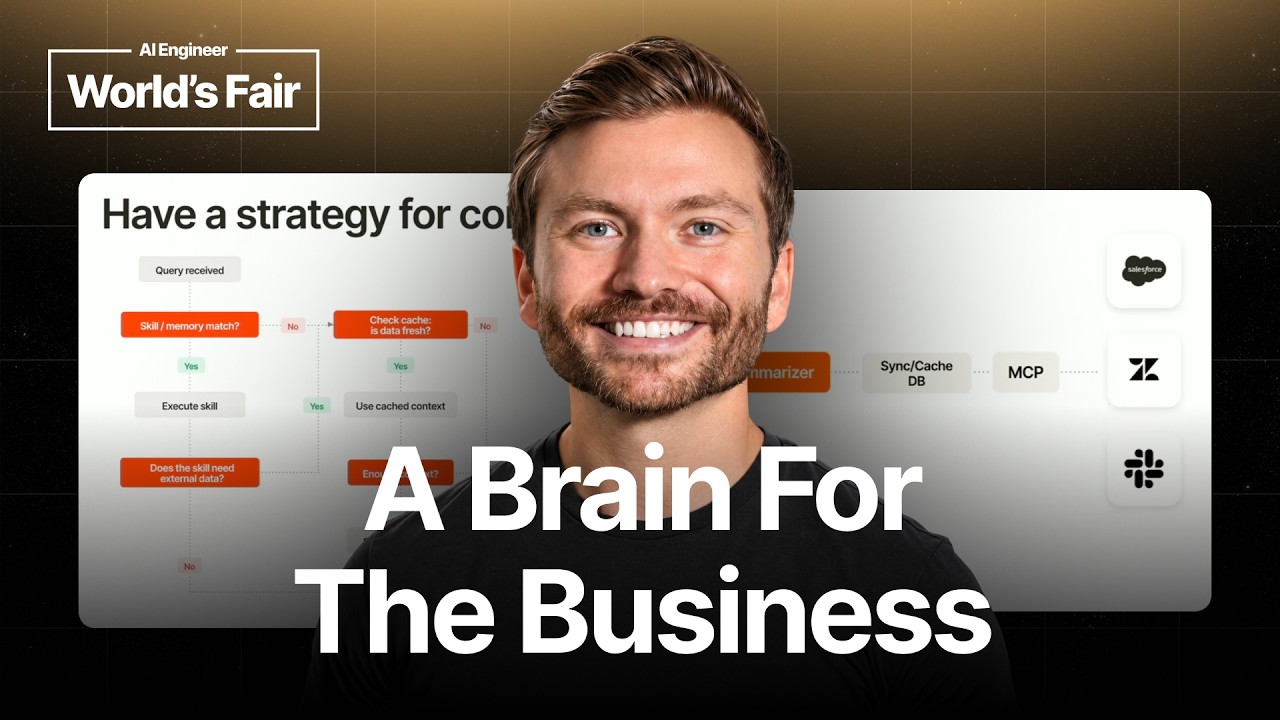
Context Selection Flowchart
The process flow dictates checking for a Skill or Memory match first. If external data is needed, the system checks the cache for freshness/SLA compliance. If the cache fails, it falls back to a live API call. The final context is then summarized and returned.
Mentioned resources
- Merge
- Unified
- Agent Handler
- Gateway
Channel & topics
Watch on YouTube · Back to latest
This independent, AI-assisted summary is provided for commentary and informational purposes. It may contain errors or omit important context. Please watch the original video for the creator's complete presentation. Video, thumbnail, and related copyrights belong to their respective owners.