Managed Deep Agents | Deploying mission critical agents to production
Summary
Managed Deep Agents is a product offering that bundles the Deep Agents harness with managed LangSmith infrastructure, designed to simplify the deployment of mission-critical, domain-specific AI agents into production. It allows developers to define an agent as a folder of instructions, skills, and tools, test it locally, and deploy it using the `mda CLI`. The system addresses complex production challenges such as caller identity reconciliation across multiple surfaces (e.g., Slack and web), user-scoped credentials, versioned context management via Context Hub, and robust evaluation tracing using Harbor.
Key takeaways
-
Simplified Agent Deployment Pipeline
10:37
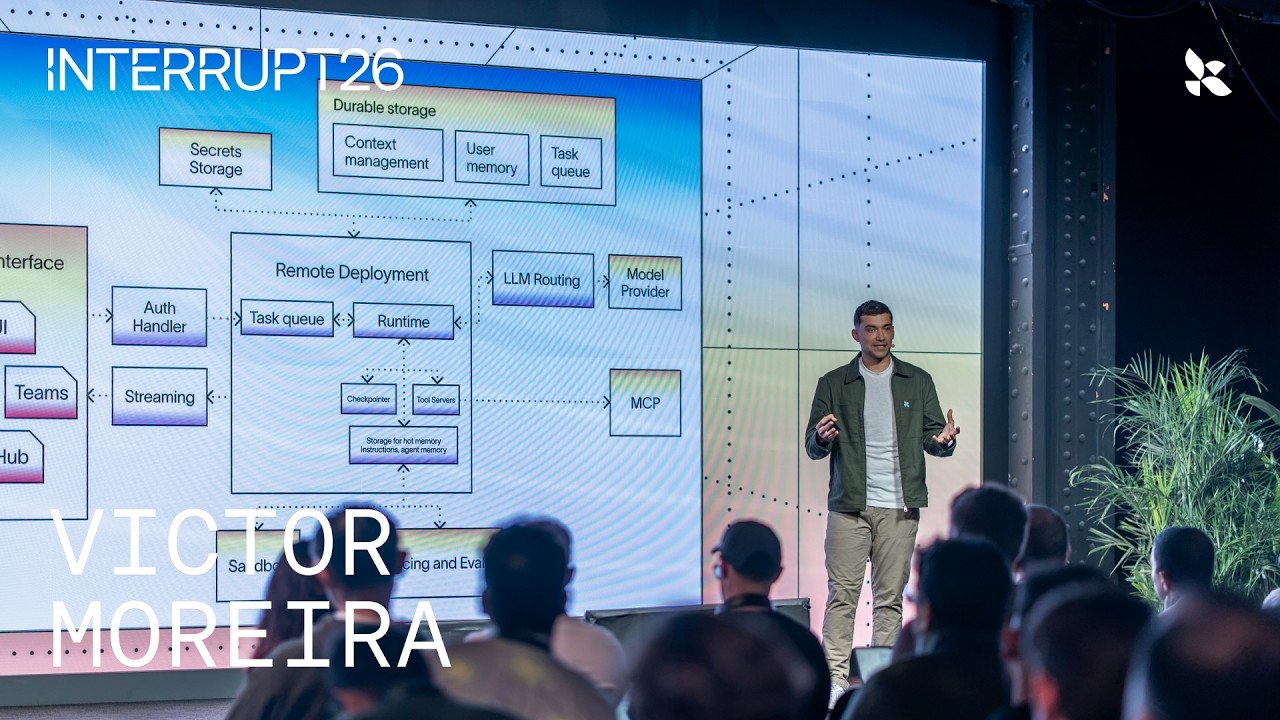
Managed Deep Agents streamlines the process from local prototype to production by bundling the harness and infrastructure. Developers can focus on business logic rather than managing complex infrastructure components like streaming, checkpointing, and auth handlers. The workflow is managed via `mda init` (scaffolding), `mda dev` (local testing), and `mda deploy` (production deployment).
-
Robust Identity and Memory Management
13:54
The platform handles complex identity issues by reconciling caller identity across different surfaces (e.g., Slack DMs vs. web UI). It supports user-scoped memory and credentials, and can pause mid-task to prompt the user for authentication when an on-behalf-of token is required.
-
Advanced Context and Evaluation
Context management is enhanced through Context Hub, which provides version control for instructions, skills, and memory. Furthermore, the system integrates with Harbor for evaluation runs, allowing agents to be continuously improved and 'hill-climbed' using LangSmith experiments.
Technical details
-
Deep Agent Anatomy
126s
A Deep Agent is built upon four core areas: 1) Execution Environment (abstracting the file system for context management, supporting S3, sandboxes, and REPLs); 2) Delegation (allowing the model to plan and kick off subagents); 3) Human in the Loop (built on LangGraph runtime for pausing/interrupting); and 4) Customizable Harness (allowing domain-specific logic).
-
Managed Deep Agents Architecture
637s
The system uses a folder structure to define the agent, containing separate files for instructions, skills, tools, and identity primitives. It runs on LangSmith Deployment for infrastructure, integrates with LangSmith Sandboxes for code execution, and uses Context Hub for coordinated context management.
-
New Features (0.8 Release)
Updates include support for HTTP channels (allowing custom event-based integrations), improved APIs for accessing sandbox file systems, user-scoped memories, first-class file transfers in Slack, and built-in search powered by Parallel.
Mentioned resources
- Managed Deep Agents
- Deep Agents
- LangSmith
- LangGraph
- Context Hub
- Harbor
Channel & topics
Watch on YouTube · Back to latest
This independent, AI-assisted summary is provided for commentary and informational purposes. It may contain errors or omit important context. Please watch the original video for the creator's complete presentation. Video, thumbnail, and related copyrights belong to their respective owners.