AI Scientists Are Here: Autonomous Labs & Synthesis Superintelligence — Periodic Labs
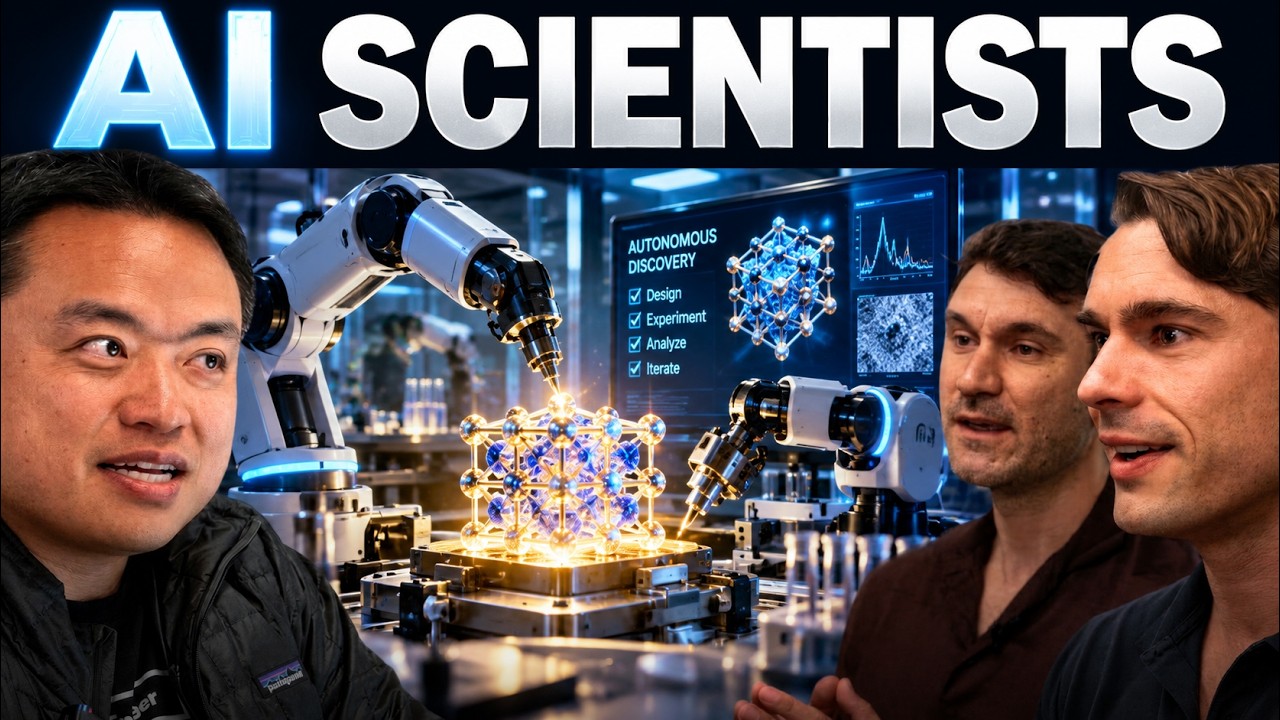
Periodic Labs outlines its vision for 'synthesis superintelligence,' arguing that the next frontier of AI will come from letting models experiment with the physical world, rather than simply training on digital data. The core thesis is that scientific discovery requires reasoning under uncertainty, noise, and missing information—a challenge fundamentally different from optimization in math or coding. The lab builds an end-to-end loop integrating AI systems, high-throughput physical experimentation, advanced characterization (like XRD), and computational tools (like DFT) to accelerate materials discovery.
Key takeaways
-
Science vs. Machine Learning: The Role of Uncertainty
3:40
Unlike ML, which excels at what it has been trained on, scientific discovery is defined by what hasn't been trained on. The physical world introduces noise, stochastic labeling, and measurement uncertainties (e.g., temperature variations in a furnace), requiring AI systems to employ different reasoning strategies than those used in purely digital environments.
-
The Synthesis Superintelligence Loop
12:00
The discovery process is a loop: 1) Determining stable materials (Synthesis), 2) Developing processes to create them (Synthesis Conditions), and 3) Characterizing the resulting material (Characterization). The AI must manage this entire flow, moving beyond simple 'kick off an experiment' models.
-
Scaling and Automation: The '140 IQ' Lab
23:00
To overcome physical bottlenecks, the lab is building AI systems directly onto machinery (e.g., SEM) to achieve '140 IQ'—meaning the equipment has full context regarding the experiment's intent, allowing for intelligent data capture and maximizing data utility.
-
Data Lineage and Negative Results
28:20
The most valuable data is not the positive result, but the full lineage of the scientific process, including negative results and failed experiments. This allows the construction of sophisticated RL environments that train on the *process* of science, not just the final output.