AI Scientists Are Here: Autonomous Labs & Synthesis Superintelligence — Periodic Labs
Summary
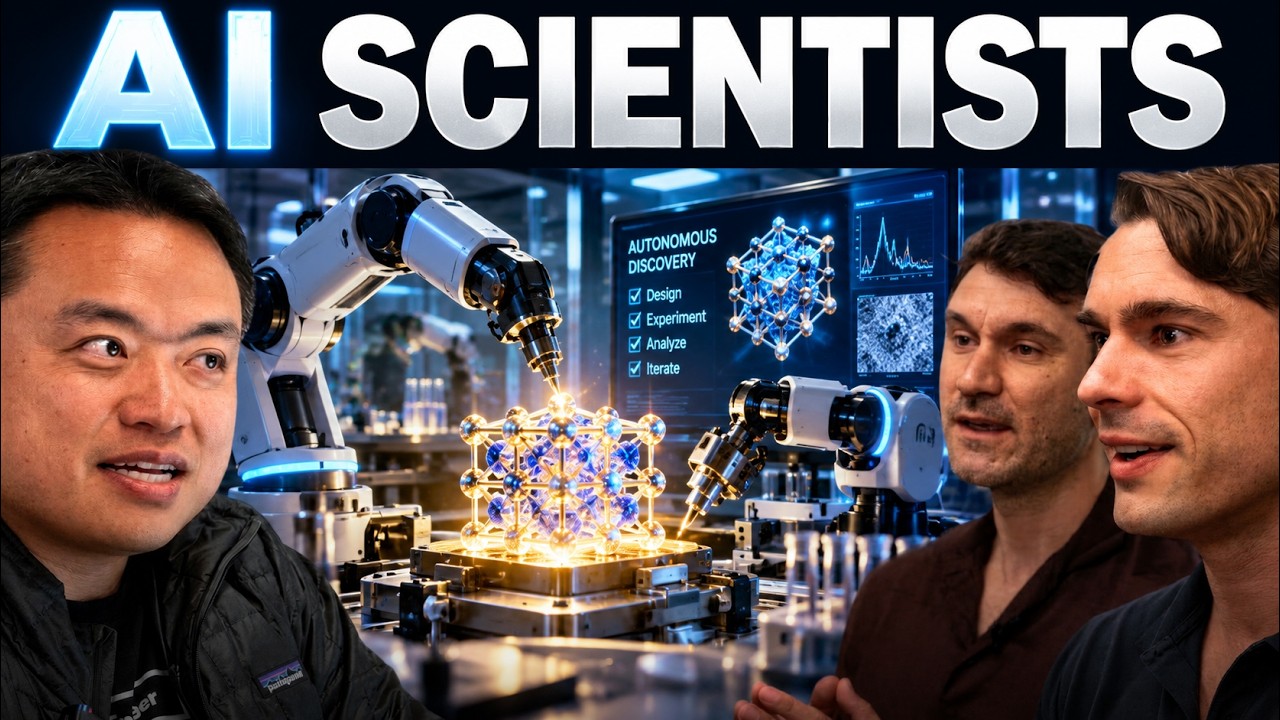
Periodic Labs outlines its vision for 'synthesis superintelligence,' arguing that the next frontier of AI will come from letting models experiment with the physical world, rather than simply training on digital data. The core thesis is that scientific discovery requires reasoning under uncertainty, noise, and missing information—a challenge fundamentally different from optimization in math or coding. The lab builds an end-to-end loop integrating AI systems, high-throughput physical experimentation, advanced characterization (like XRD), and computational tools (like DFT) to accelerate materials discovery.
Key takeaways
-
Science vs. Machine Learning: The Role of Uncertainty
3:40
Unlike ML, which excels at what it has been trained on, scientific discovery is defined by what hasn't been trained on. The physical world introduces noise, stochastic labeling, and measurement uncertainties (e.g., temperature variations in a furnace), requiring AI systems to employ different reasoning strategies than those used in purely digital environments.
-
The Synthesis Superintelligence Loop
12:00
The discovery process is a loop: 1) Determining stable materials (Synthesis), 2) Developing processes to create them (Synthesis Conditions), and 3) Characterizing the resulting material (Characterization). The AI must manage this entire flow, moving beyond simple 'kick off an experiment' models.
-
Scaling and Automation: The '140 IQ' Lab
23:00
To overcome physical bottlenecks, the lab is building AI systems directly onto machinery (e.g., SEM) to achieve '140 IQ'—meaning the equipment has full context regarding the experiment's intent, allowing for intelligent data capture and maximizing data utility.
-
Data Lineage and Negative Results
28:20
The most valuable data is not the positive result, but the full lineage of the scientific process, including negative results and failed experiments. This allows the construction of sophisticated RL environments that train on the *process* of science, not just the final output.
Technical details
-
Density Functional Theory (DFT)
1000s
DFT is a powerful simulation method for materials, derived from the Hohenberg–Kohn theorem. It estimates properties like formation enthalpy, which helps predict material stability by determining if a material's energy is lower than other known materials. It is used to complement experimental data, especially for initial screening.
-
X-ray Diffraction (XRD)
800s
XRD is a primary characterization tool. By shooting X-rays at a material, a diffraction pattern is generated, which acts as a 'fingerprint' of the crystal structure. AI systems are being developed to analyze these patterns to identify the phases present, even when the results are complex or mixed.
-
Reinforcement Learning (RL) Environments
800s
RL is applied to materials discovery by constructing environments that reward the identification of present phases and penalize spurious or chemically implausible phases. This allows the AI to learn from the entire experimental process, not just the final outcome.
-
Multi-modality Characterization
1100s
To reduce ambiguity, the system integrates multiple data types (modalities) beyond just XRD, including electrical and magnetic properties, and electron microscopy. This holistic approach is crucial for accurate decision-making under uncertainty.
Mentioned resources
- Periodic Labs
Channel & topics
Watch on YouTube · Back to latest
This independent, AI-assisted summary is provided for commentary and informational purposes. It may contain errors or omit important context. Please watch the original video for the creator's complete presentation. Video, thumbnail, and related copyrights belong to their respective owners.