Topic

Agent Evaluation

All digests tagged Agent Evaluation

Catch Agent Regressions Before You Ship: Evals for Managed Deep Agents thumbnail

· 8:57

Catch Agent Regressions Before You Ship: Evals for Managed Deep Agents

This session details how to implement robust evaluation (evals) for Managed Deep Agents to prevent performance regressions as the agent's capabilities grow. The process involves using Harbor, which ensures each evaluation runs in a fresh container. Evals are structured into an environment (data/state), a job (instruction), and a check (verifier). The workflow is scaffolded using `mda evals init`, which can be automated by handing the task to a coding agent (e.g., Claude Code). Results and traces are managed and monitored in LangSmith, allowing for continuous evaluation and integration into nightly CI pipelines.

Key takeaways

  1. Purpose of Evals

    Evals serve two primary goals: catching regressions (ensuring changes don't break existing features) and 'hill climbing' (actively improving agent capabilities). The focus is on defining and catching regressions.

  2. Harbor's Role in Evaluation

    Harbor is bundled into Managed Deep Agents and is crucial because it builds an image around the agent, ensuring every eval runs in a fresh container. It also manages test execution to prevent environment pollution.

  3. Anatomy of an Eval 2:15

    An evaluation consists of three parts: the environment (the starting data/state), the job (the instruction, defined in a markdown file), and the check (the verifier that determines if the job was completed adequately).

  4. Automating Eval Scaffolding 2:36

    The command `mda evals init` scaffolds the necessary files (e.g., `task.md`, `Dockerfile`, tests). Using the `-i` flag allows the work to be handed off to a coding agent, which generates the initial eval suite.

  5. Production Monitoring

    Evals can be managed in production by running them nightly within a CI system. Results are logged into LangSmith, allowing developers to continuously track agent performance and stability.
Watch on YouTube Full article

Everything Is a Rollout — Alex Shaw + Ryan Marten, Terminal-Bench, Harbor, Laude Institute thumbnail

· 21:11

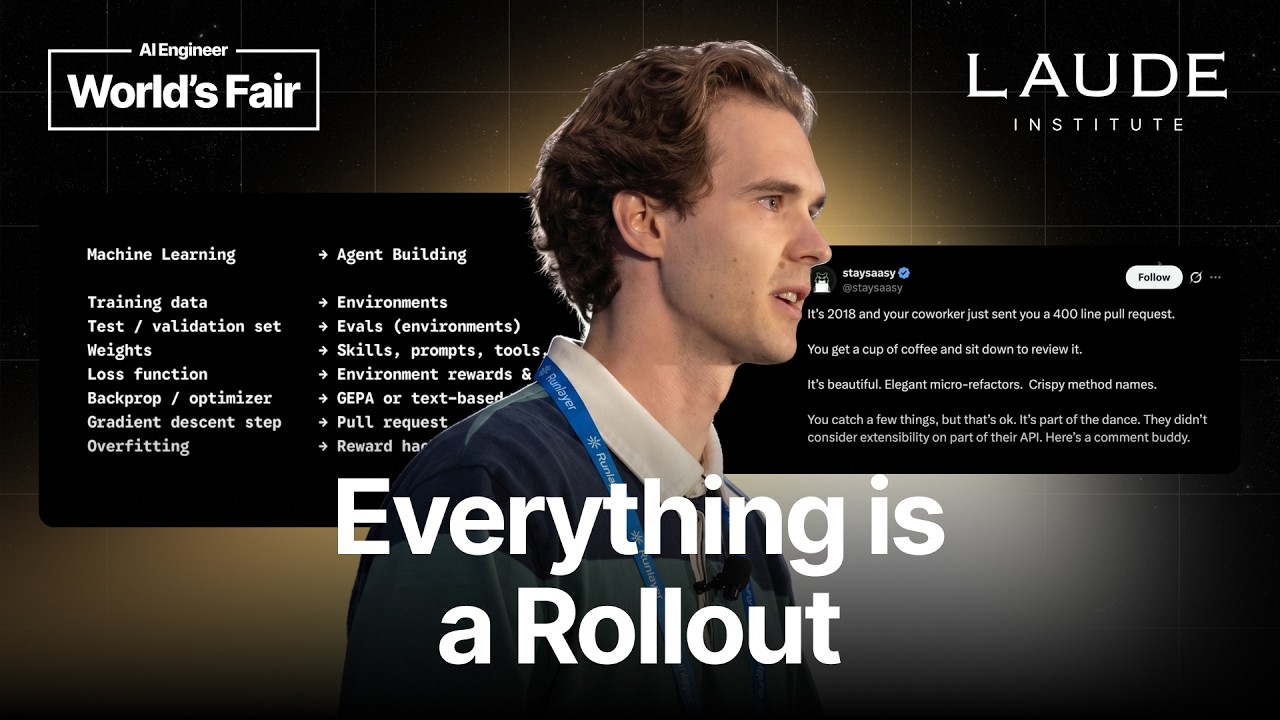
Everything Is a Rollout — Alex Shaw + Ryan Marten, Terminal-Bench, Harbor, Laude Institute

Alex Shaw introduces Harbor, a framework designed for evaluating and optimizing AI agents. The talk argues that agent development should be viewed through the lens of machine learning rather than traditional software engineering. This requires treating agent performance as a 'blackbox artifact' and managing it via empirical evaluation—a process formalized by 'rollouts.' Harbor provides the necessary infrastructure (sandboxes, standardized environments) to execute these complex evaluations in parallel.

Key takeaways

  1. Agent Development vs. Software Engineering 5:15

    Unlike traditional software engineering where behavior is predictable before execution, agentic coding and AI agents are best treated as blackbox artifacts whose performance requires empirical evaluation (e.g., 'Generated code is best treated as a blackbox artifact').

  2. The Role of Rollouts in Agent Evaluation 10:30

    Agent evaluation relies on 'rollouts' within sandboxed environments. This process involves passing the sandbox to the agent, collecting a trajectory, and then passing it to a verifier which produces rewards. Harbor standardizes this universal process.

  3. Harbor as an Interoperable Standard 12:20

    Harbor is presented as a common language and open-source framework for specifying agentic environments, allowing interoperability across different agents, models (e.g., GPT 5.5), and sandboxes to maximize data velocity.

  4. Diverse Evaluation Use Cases 17:30

    Evaluation can be highly specialized, including assessing how well agents build products (e.g., RampBench), how they use a product's headless mode, or automating internal processes.

Watch on YouTube Full article