The Highest Loop — swyx
Summary
The talk explores the concept of 'loop stacking' and the progression of AI development, arguing that modern AI engineering requires understanding the current operational 'loop' level. The speaker posits that the core skill is defining whether to scale up a loop for increased productivity or scale down for improved reliability and bug fixing. The highest level of innovation, or 'highest loop,' is defined as human collaboration to determine the next major technological loop.
Key takeaways
-
The Progression of AI Development
0:15
AI has advanced from basic tokens to chat, then to using tools, and is now focused on complex automations and 'loop stacking' (0:00-0:15).
-
Mastering the Operational Loop
0:55
A core skill for AI engineers is defining the working loop level: going up a loop for scaling inference/productivity, or going down a loop for reliability and bug fixing (0:30-0:55).
-
The Highest Loop
5:40
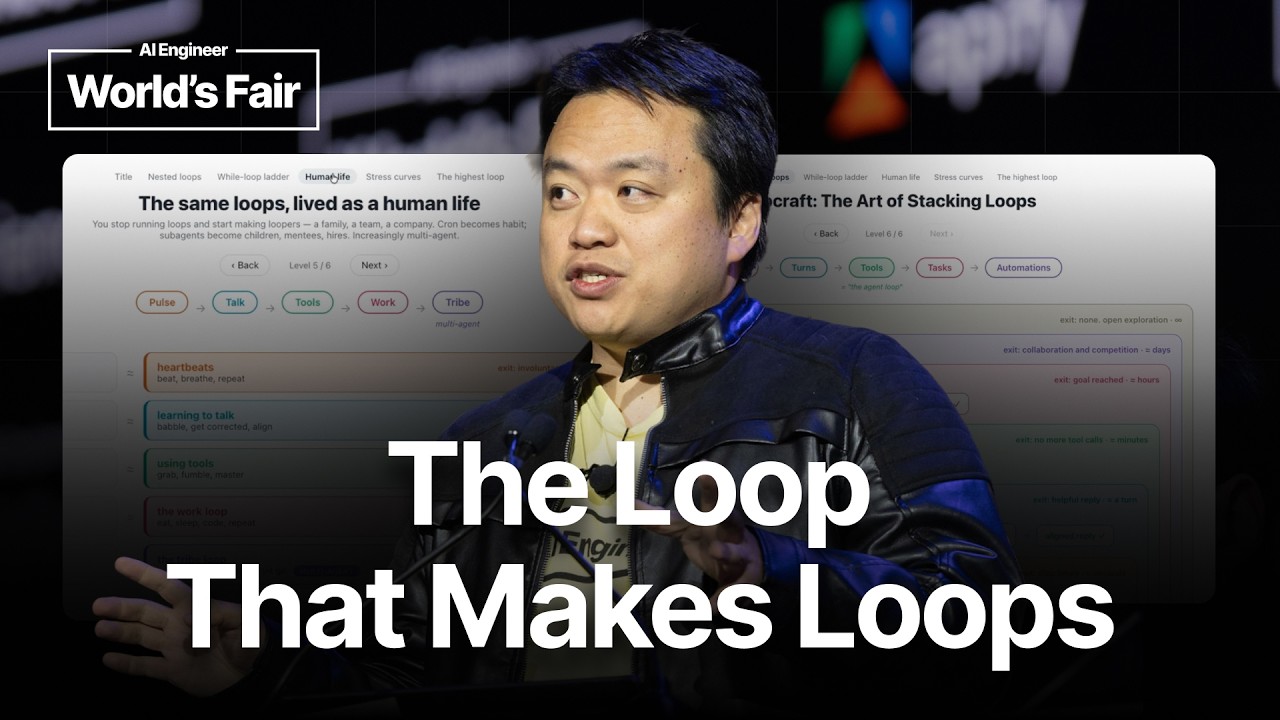
The highest loop is where humans gather to figure out the next major loop—the loop that makes loops. This is the purpose of the AI Engineer World’s Fair (3:20-3:40).
Technical details
-
AI Generalization and Diffusion
245s
AI agents are generalizing across domains, moving beyond pure coding into vertical tracks such as AI in healthcare, AI in finance, and AI in GTM (2:30-2:45).
-
Automation and Looping
15s
The current focus in AI is on automations, 'cron jobs,' and 'loop stacking,' which is considered a core skill (0:00-0:15).
-
The Human Loop Analogy
200s
The human life cycle is analogized as a series of loops: heartbeat (proof of life) $\rightarrow$ talking $\rightarrow$ using tools $\rightarrow$ working $\rightarrow$ working in teams $\rightarrow$ collective intelligence (1:40-2:00).
Mentioned resources
- Loopcraft
Channel & topics
Watch on YouTube · Back to latest
This independent, AI-assisted summary is provided for commentary and informational purposes. It may contain errors or omit important context. Please watch the original video for the creator's complete presentation. Video, thumbnail, and related copyrights belong to their respective owners.