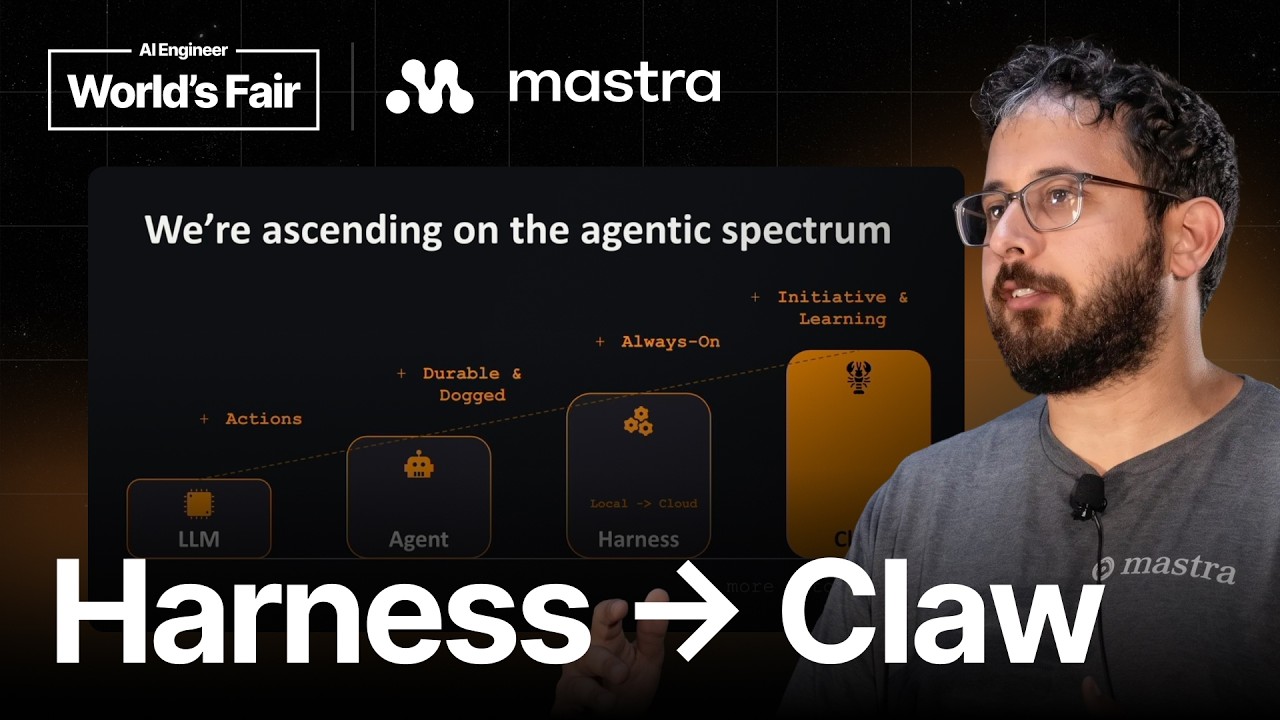
Sandboxing, Agent Harnesses, and Agent Teamwork
Summary
The discussion explores the evolution of AI agents from simple task execution to sophisticated SRE (Site Reliability Engineering) capabilities. The core argument is that true value lies not in faster triage (Mean Time To Resolve - MTTR), but in building an agent that learns and compounds operational memory across an organization's entire stack. Key architectural shifts include moving beyond rigid, deterministic tools toward non-deterministic problem solving, requiring advanced techniques like sandboxing, environment simulation, and establishing governance structures for multi-agent teams.
Key takeaways
-
The Value Shift: Learning over Triage
20:05
AI agents' primary value is shifting from simply reducing MTTR to building an agent that learns from every investigation. The goal is creating a compounding operational memory, allowing the system to improve its decision-making process and predict failure modes rather than just reacting to alerts.
-
Harnesses Define Agent Capability
3:25
The 'harness' is defined as everything between the user and the LLM—including prompts, skills, file systems, and tools. The challenge is balancing necessary guardrails (to prevent agents from doing wrong things) with enough freedom to allow for complex, non-deterministic problem solving.
-
The Need for Cross-Environment Testing
23:55
Because every company's infrastructure (e.g., Gojek vs. Uber) is unique, agents cannot simply be trained on general knowledge. Durable development requires simulating and testing agent performance across diverse, idiosyncratic production environments.
-
Future State: Agent Teams and Governance
1:03:22
The next frontier involves multi-agent systems (e.g., a Coding Agent working with an SRE Agent). These teams require defined governance structures, similar to a RACI matrix, ensuring agents know their roles and how to share context without losing isolation.
Technical details
-
Agent Architecture & Harnesses
205s
The 'harness' encompasses all components exposed to the agent, including prompts and skills. Tools like Claude CodeX are cited as high-level abstractions that facilitate complex interactions.
-
Sandboxing and Security
2705s
As agents gain capability (e.g., moving from rigid custom tools to running Python/Bash), sandboxing becomes critical. The goal is achieving 'as much non-determinism inside the box, but with a really strong box' to prevent malicious or incorrect actions.
-
Operational Memory & Context Graphs
3205s
The most valuable data is not raw logs, but structured knowledge of past decisions and failure modes. Techniques like 'context graphs' are needed to preserve and query the decision-making process (SOPs) in a human-readable format.
-
Agent Teams & Workflow
3802s
The concept of specialized, interacting agents is emerging. The SRE agent and the Coding Agent must work together, sharing resources while maintaining proper isolation (e.g., using a 'planning' mechanism).
Mentioned resources
- Cleric
- LangChain (Viv)
Channel & topics
Watch on YouTube · Back to latest
This independent, AI-assisted summary is provided for commentary and informational purposes. It may contain errors or omit important context. Please watch the original video for the creator's complete presentation. Video, thumbnail, and related copyrights belong to their respective owners.