Road to GTC Berlin: Europe’s AI Builders in the Spotlight
Summary
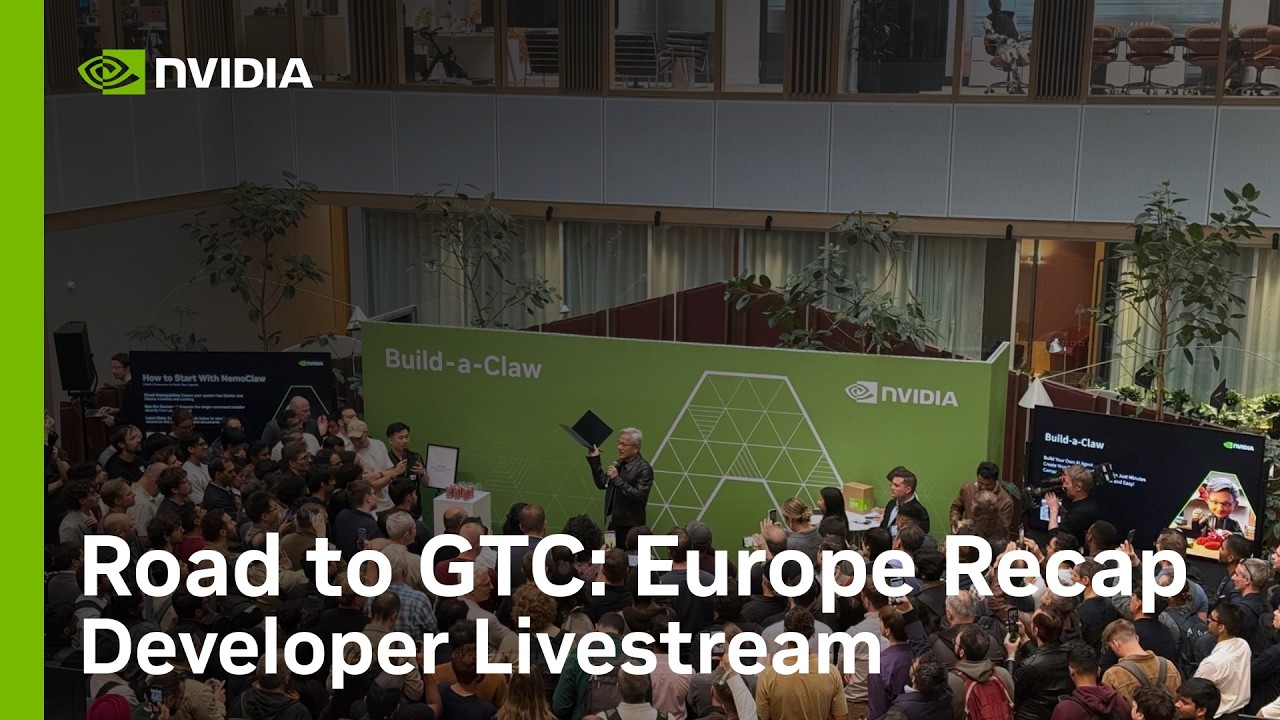
This video summarizes the 'Road to GTC Berlin' build series across Europe, highlighting key developer themes in AI, particularly agent development, open models, and physical AI. Speakers demonstrated advanced use cases ranging from healthcare workflow automation and patent law analysis to advanced robotics and computer vision. A major recurring theme is the need for agent safety, security, and the deployment of sovereign, local AI solutions (on-prem/edge) to ensure reliability in mission-critical environments.
Key takeaways
-
Agent Safety and Security
39:00
A top concern across all cities is making agents safe and secure. Solutions include using OpenShell (containerization) and implementing frameworks like Nemo Guardrail to sandbox agents, ensuring they cannot execute unauthorized actions even if they possess the capability (e.g., preventing an agent from purchasing items via an API call when only reading is allowed).
-
Sovereign and Edge AI Deployment
33:20
For safety-critical fields (like healthcare), relying on external cloud models is risky due to fluctuating pricing and stability. The trend is toward sovereign AI, enabling local, on-prem deployment using hardware like the NVIDIA DGX Spark or RTX Spark to maintain full control and data privacy.
-
Multimodal and Computer Vision Agents
40:00
Advanced agents are moving beyond simple code or API calls. Demonstrations showed agents using multimodal capabilities to 'see' a screen (GUI) and interact with applications (e.g., CAD software, ERP systems) as if a human were operating the computer, enabling complex, natural language-driven workflows.
-
Physical AI and Robotics
16:40
Robotics applications are advancing rapidly, moving from simple tasks to complex, agentic workflows. Examples include training robots for bin picking using imitation learning and reinforcement learning, and developing voice-driven AI assistants for hospital staff to keep their hands free for patient care.
Technical details
-
Agent Architecture & Safety
2340s
The concept of building agents involves more than just using services (like ChatGPT). Key components include defining agent ingredients, using containerization (OpenShell), and implementing guardrails (Nemo Guardrail framework) to restrict agent actions.
-
Local/Edge AI Hardware
2340s
Devices featured for local AI prototyping include the NVIDIA DGX Spark, RTX Spark, and the Jetson family, allowing developers to run models on-site, ensuring data sovereignty and reliable operation.
-
Large Language Models (LLMs) & Open Models
2340s
The focus is on open-weight models (e.g., Gemma, Neatron 3.5) that can be deployed locally. Techniques include using embedding models (NVIDIA embedding model) and vector databases to process and compare vast amounts of data, such as comparing historical texts (Britannica) to modern Wikipedia.
-
Robotics Learning Paradigms
1000s
Robots are being trained using advanced methods like imitation learning and reinforcement learning (RL). For instance, moving a robot arm for pick-and-place tasks was shown to improve significantly when RL was applied to the policy stack.
Mentioned resources
- NVIDIA DGX Spark / RTX Spark
- Nemo Claw
- OpenShell
- Neatron 3.5
- Knowledge Across Time
Channel & topics
Watch on YouTube · Back to latest
This independent, AI-assisted summary is provided for commentary and informational purposes. It may contain errors or omit important context. Please watch the original video for the creator's complete presentation. Video, thumbnail, and related copyrights belong to their respective owners.