Orchestras, Not Factories: How the Fastest Builders Work — Charlie Holtz, Conductor
Summary
Charlie Holtz, co-founder of Conductor, outlines principles for achieving peak building efficiency, arguing that the future of development lies in 'orchestras' of human and AI effort, rather than 'factories' of pure automation. Key strategies include staying near technological frontiers, avoiding over-optimization for non-default workflows, establishing 'slop-free zones' for critical code, centralizing all organizational data ('feeding the beast'), and giving agents free-range, cloud-based sandboxes for exploration and collaboration.
Key takeaways
-
Stay Near the Frontier
3:20
Always experiment with the latest tools (e.g., ultra code, slash go) to generate new ideas. Staying current is crucial because workflows move too fast for traditional information trickle-down methods. (2:00)
-
Don't Try to Beat the Market
3:25
When deciding on workflow optimization, ask if the workflow is the default. If it is, wait for major platforms (Anthropic, OpenAI, etc.) to integrate it, rather than spending time on niche optimizations. (3:25)
-
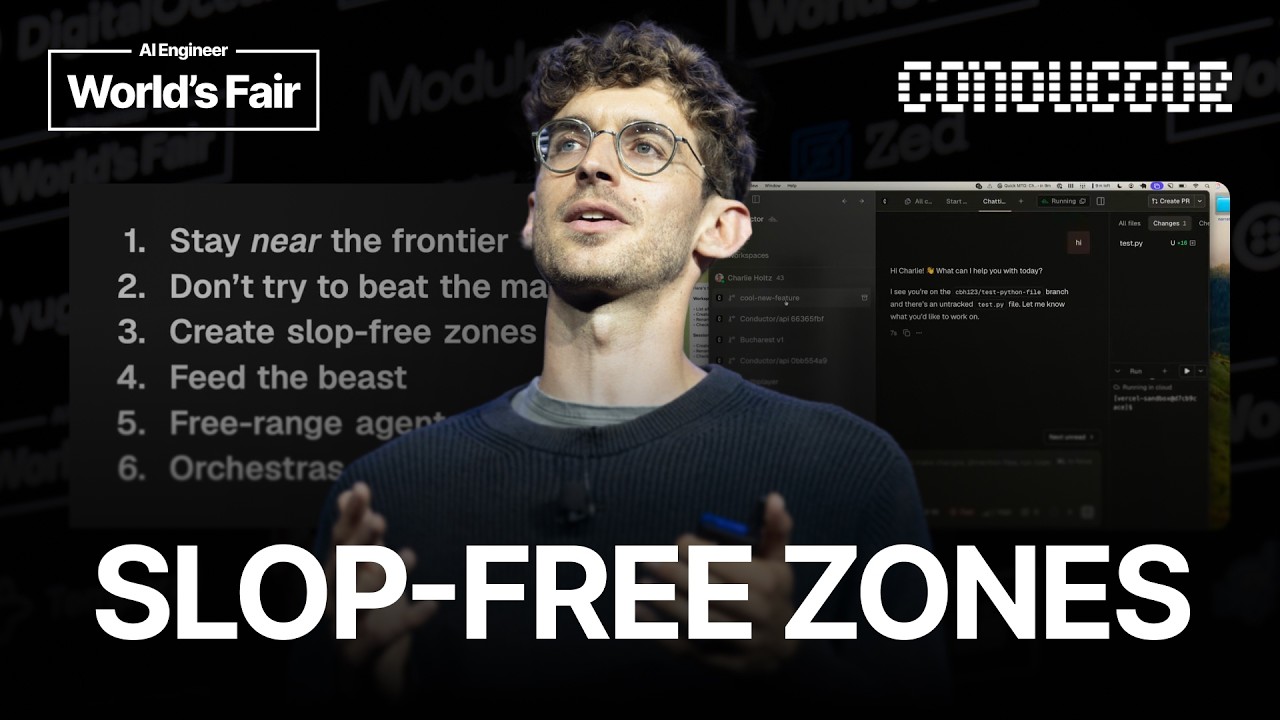
Create Slop-Free Zones
5:25
Identify critical parts of the codebase (e.g., migrations files, documentation, skills) that require strict human review and care, preventing the codebase from becoming unstable. (5:25)
-
Feed the Beast
7:25
Centralize all organizational information—including Slack messages, bug reports (Discord), and meeting recordings—into a single database so agents have maximum context for effectiveness. (7:25)
-
Free-Range Agents
8:40
Provide agents with cloud sandboxes where they can run and explore without being confined to a local laptop, enabling sustained work and collaboration. (8:40)
-
Orchestras, Not Factories
14:40
The future of development should feel human and crafted, like conducting an orchestra, where humans and agents collaborate, rather than managing an assembly line or 'feature factory.' (14:40)
Technical details
-
Conductor
65s
A desktop application designed to manage and orchestrate multiple coding agents (Cloud Codes, Code Accesses) from a single interface. (1:05)
-
Agent Architecture
520s
Agents benefit from cloud sandboxes, allowing them to continue running and working even when the user closes their laptop. (8:40)
-
Data Integration
445s
The 'Conductor Internal Agent' (CIA) acts as a centralized database, ingesting data from sources like Slack and Discord to provide comprehensive context for agents. (7:25)
-
Code Safety
325s
Designating 'slop-free zones' is critical; for example, CI requires human review for any changes to the migrations file. (5:25)
Mentioned resources
Channel & topics
Watch on YouTube · Back to latest
This independent, AI-assisted summary is provided for commentary and informational purposes. It may contain errors or omit important context. Please watch the original video for the creator's complete presentation. Video, thumbnail, and related copyrights belong to their respective owners.