Dashboards Are Dead — Sarah Simionescu, Composio
Summary
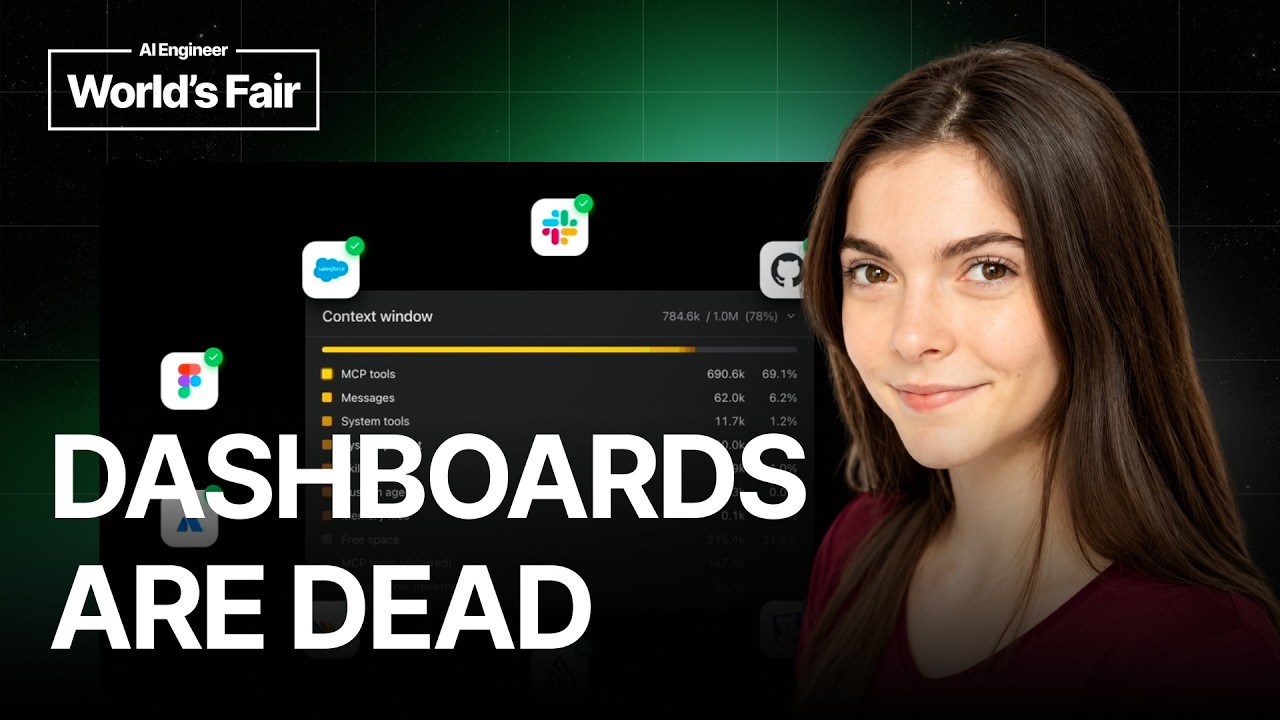
The talk argues that traditional dashboards and even early AI query systems are obsolete because they fail to handle complex, cross-application workflows. The speaker proposes that the future of product development must cater to AI agents, not human users. She details the limitations of the existing Mattermost Connectivity Protocol (MCP) and introduces a new interface designed to allow agents to seamlessly execute complex tasks across multiple, disparate applications (e.g., Slack, DataDog, PostHog, Metabase) by providing a unified search and execution plan.
Key takeaways
-
The Dashboard is Dead
0:12
Every dashboard and obscure query language (e.g., DataDog syntax, JQL, Slack search modifiers) is fundamentally a translation layer, meaning the user never wanted the dashboard; they wanted the answer. (0:12)
-
Limitations of MCP
5:31
While the MCP protocol allows agents to connect to services, it is insufficient because agents lack memory, context overload occurs when connecting many tools, and every application remains isolated, requiring manual orchestration. (3:31)
-
The Agent-First Solution
A new interface is required to translate messy, sparsely documented APIs into a cohesive, unified experience for agents. This allows agents to generate a full execution plan (e.g., fetching Slack messages, searching Sentry, and querying DataDog) without requiring pre-built workflows or skills. (6:45)
Technical details
-
Query Languages and Data Access
127s
Historically, multiple tools (DataDog, Jira, Slack) each required unique query languages, making every dashboard a translation device between the user and the data. (1:27)
-
MCP Protocol (Mattermost Connectivity Protocol)
237s
MCP is an open standard for connecting AI systems to data sources, allowing agents (like Claude) to generate and execute queries. However, it requires the service to manage communication, leading to issues like context window overflow when connecting many tools. (2:37)
-
Composio Search and Execution Plan
The proposed solution involves a central search mechanism that not only identifies the correct tools but also generates a detailed execution plan (e.g., identifying the need for a Slack channel ID before querying messages). (6:45)
-
Cross-App Data Analysis
The system can perform complex, multi-source analyses (e.g., linking user IDs from PostHog to query data in Metabase) without loading full result sets into the agent's context window, using tools like Composio Remote Workbench. (7:20)
Mentioned resources
- Composio
- DataDog
- PostHog
- Metabase
- MCP Protocol
Channel & topics
Watch on YouTube · Back to latest
This independent, AI-assisted summary is provided for commentary and informational purposes. It may contain errors or omit important context. Please watch the original video for the creator's complete presentation. Video, thumbnail, and related copyrights belong to their respective owners.