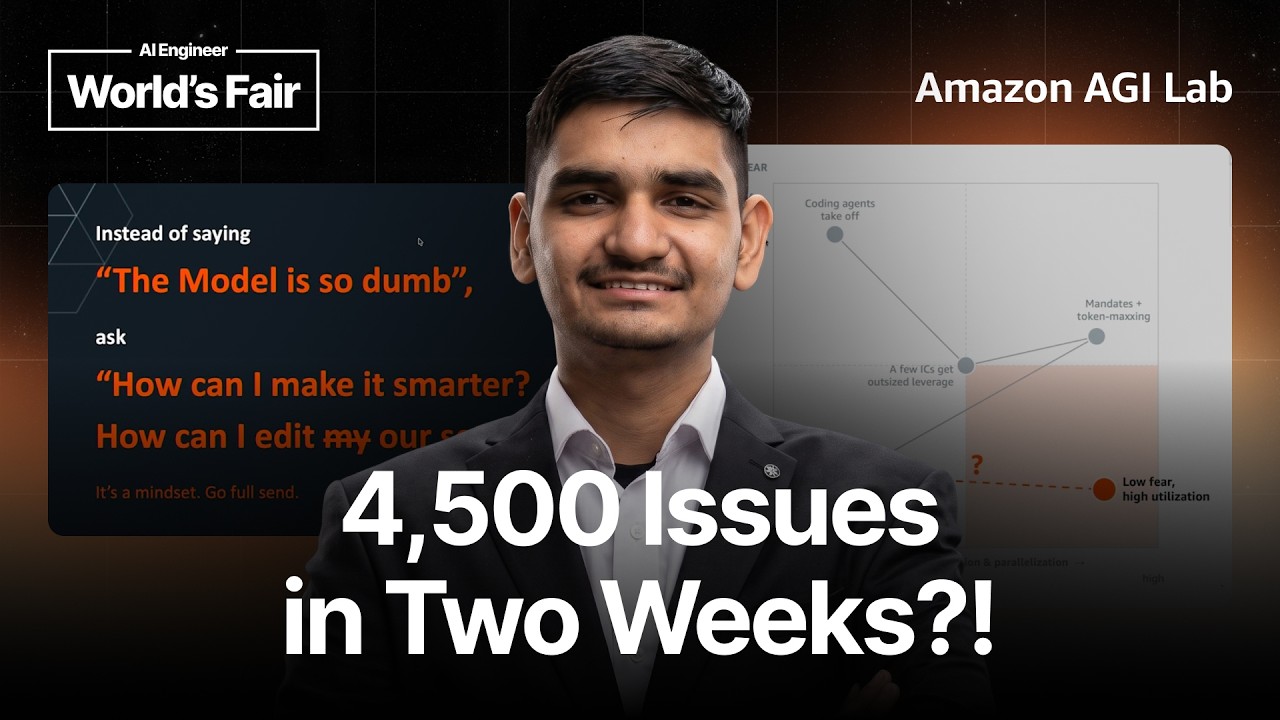
Agents, codebases, and teams — Aditya Khandelwal, Amazon AGI Lab
The adoption of AI agents in software development is presented as primarily a leadership and organizational challenge, not merely an individual contributor (IC) problem. Successful implementation requires systemic changes—specifically 'harness engineering'—to manage codebase complexity and ensure reliable agent performance across teams. Key strategies include implementing progressive disclosure, establishing high-value skills like 'ship it,' and creating self-healing CI/CD pipelines to mitigate inevitable AI 'slop.'
Key takeaways
-
Agent Adoption is a Leadership Problem
9:52
The speaker argues that making engineers work well with agents requires organizational buy-in (leadership action) rather than individual effort. Relying on ICs to restructure the codebase alone will fail, leading to uneven productivity and increased review burden for those who are not early adopters.
-
Symptoms of a Poor Setup
7:18
Warning signs that an agent setup is failing include: engineers 'babysitting' agents, the system silently burning context (e.g., blowing through 500k context units), or requiring constant manual intervention for simple tasks.
-
Harness Engineering Principles
11:49
Effective agent integration requires three principles: Smart prompt injection (treating the codebase as a single unit to inject context), closing the loop (creating self-healing pipelines to detect and remove 'slop'), and continuous iteration, treating the process like an ongoing organizational improvement effort.
-
Progressive Disclosure Best Practices
16:57
To manage context overload, implement strict boundaries. For example, a hard limit of approximately 100 lines is suggested for files like `skill.md` to ensure the agent receives only necessary context in its initial prompt.