Agent Memory Is Solved. Agent Learning Isn't. — Karthik Ranganathan, Yugabyte
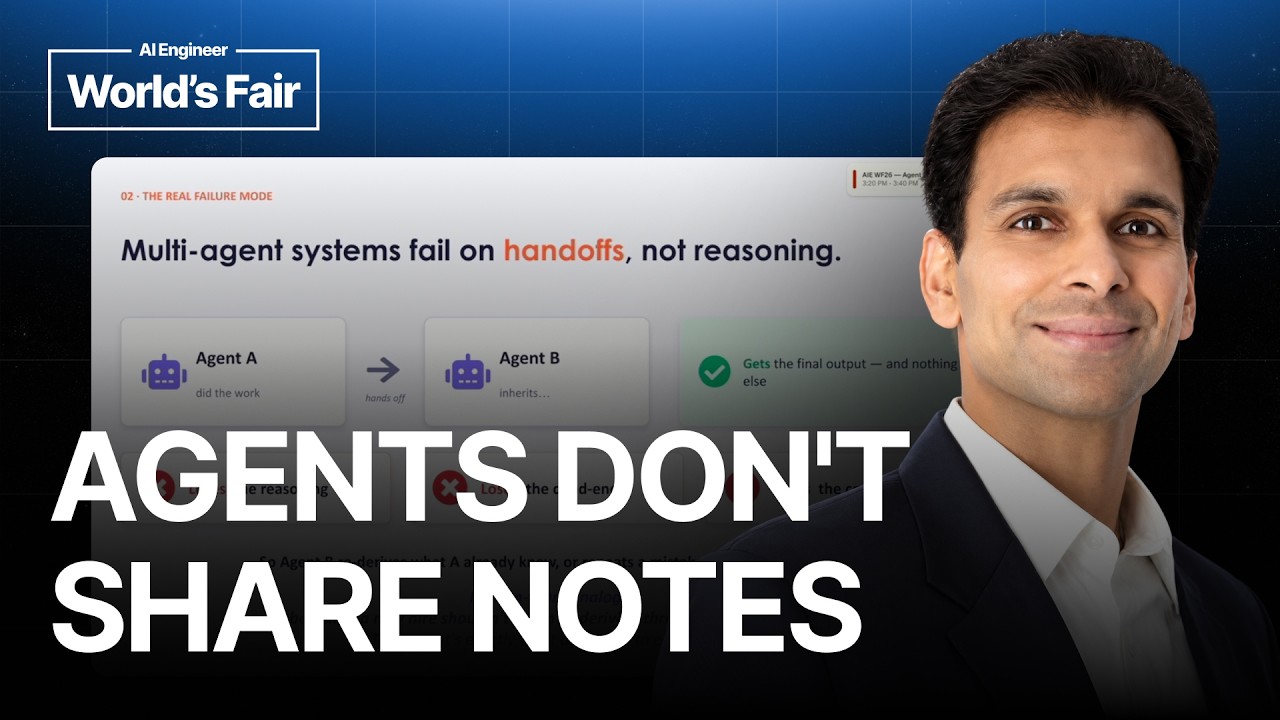
The talk addresses the critical distinction between per-agent memory (which is considered solved) and shared, collective learning across multiple agents (which remains an unsolved problem). The core challenge is that when an agent passes work to another, it loses the reasoning, dead ends, and full context, forcing the receiving agent to re-derive information and burn tokens. Yugabyte introduces Meko, an agent-native persistence layer designed to solve this by enabling agents to promote private memories into a governed, shared data pack, thus creating durable, traceable, and reusable collective knowledge.
Key takeaways
-
Agent Memory vs. Agent Learning
Agent memory is solved (per-agent context extraction and reuse). However, true learning happens when a group of agents collaborate, requiring infrastructure that supports shared, governed context, which is currently lacking.
-
The Lost Context Problem
3:57
When Agent A hands off work to Agent B, it typically only passes the output (e.g., an MD file) but loses the reasoning, dead ends, and full context. This forces Agent B to re-derive the information, wasting tokens and resources.
-
Misconceptions in AI Memory
5:57
The speaker debunks five common misconceptions: more memory does not equal learning; shared state is not shared knowledge; running RAG on everything is not equal to quality learning; fine-tuning is not scalable for persistent lessons; and bigger context windows are often an expensive failure.
-
Meko's Solution: Shared, Governed Context
12:07
Meko is an agent-native persistence layer that allows agents to push private context into a shared space (a data pack). This context can be promoted, ensuring it is governed, traceable to its source, and available to multiple agents or humans.