Topic

LLM Evaluation (Evals)

All digests tagged LLM Evaluation (Evals)

How to Design a Data Agent People Can Verify thumbnail

· 6:47

How to Design a Data Agent People Can Verify

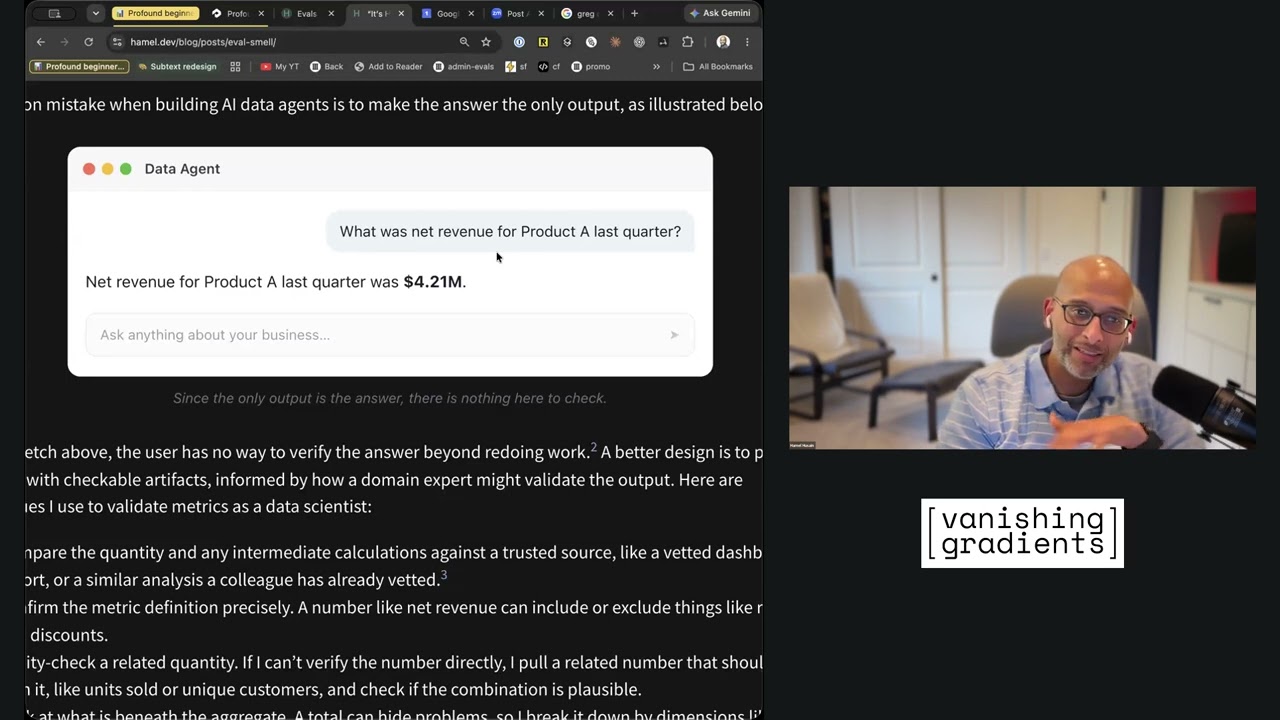
The video argues that current internal 'data agents' (AI chatbots that query databases to answer business questions) represent a significant design flaw if they only provide a final answer without showing their work. To build trustworthy AI products, the design must prioritize verifiability, allowing domain experts to trace the data's provenance, review the underlying logic (e.g., SQL queries, definitions, intermediate calculations), and confirm the result's accuracy. This shift requires adopting design patterns similar to literate programming and notebooks.

Key takeaways

  1. The Flaw in Current Data Agents 2:05

    Simply receiving an answer (e.g., 'net revenue is X') from a data agent is insufficient because the user cannot verify its correctness. The lack of transparency makes the output untrustworthy.

  2. The Need for Provenance and Traceability 2:30

    A proper data agent must show the 'working'—the path taken to reach the number. This includes the underlying SQL query, the definitions used (e.g., what constitutes 'net revenue'), the filters applied, and the specific calendar period used.

  3. Designing for Evaluation (Evals) 3:50

    The product design should mimic a data scientist's thought process, utilizing notebooks or semantic layers to display intermediate calculations and the source of data. This makes the product inherently easier to evaluate and debug.

  4. Benefits of Verifiable Design 4:40

    Designing for verifiability not only builds user confidence but also provides rich data signals, making it easier to automatically classify errors and collect better feedback for model improvement.

Watch on YouTube Full article

How Evals and Prompts Shape Agent Behavior — Preetika Bhateja & Daniel Bump, YouTube Ads thumbnail

· 19:29

How Evals and Prompts Shape Agent Behavior — Preetika Bhateja & Daniel Bump, YouTube Ads

Building reliable AI agents requires a comprehensive evaluation loop that extends far beyond prompt engineering. The process involves optimizing foundational tools, establishing rigorous evaluation workflows (Evals), and iteratively refining behavior using feedback signals rather than simple scorecards. Key strategies include starting with small-scale, intuition-based evaluations to identify failure patterns early, analyzing agent trace logs for reasoning failures, and focusing on systemic patterns of error rather than isolated instances.

Key takeaways

  1. Agent Reliability Loop

    Agent behavior is a function of its capabilities, guardrails, and the evaluation process. The system relies on an iterative loop: Prompts $\rightarrow$ Evals $\rightarrow$ Iteration $\rightarrow$ Feedback.

  2. Foundational Optimization

    Before large-scale agent evals, optimize the core set of LLM-friendly tools. Consider implementing an independent critique agent with a remediation loop to fill gaps in base tool limitations.

  3. Starting Small (Vibing) 3:35

    Instead of immediately building comprehensive, scalable evals, start with an intuition-based approach ('vibing'). This allows for quick iteration and radical architectural changes without being hindered by strict scalability requirements.

  4. Deep Failure Analysis 7:50

    To understand failures, analyze agent trace logs to see the reasoning behind a conclusion (e.g., why an agent removed a disclaimer despite explicit instructions). This is more valuable than simple pass/fail metrics.

  5. Scaling Evals and Consensus 10:10

    When involving human raters (scale raiders), provide clear rubrics, detailed examples, and train the team on expected outcomes. For complex systems, collect explanations from raters rather than just a binary pass/fail rating.

  6. Focusing on Patterns 15:30

    When diagnosing model performance degradation (regressions), focus on identifying systemic patterns of failure across the entire golden set, rather than hyper-fixingating on single, isolated examples.

Watch on YouTube Full article