What Is PewDiePie Building? | For Beginners
This video provides a technical deep dive into the architecture of modern AI agents, using PewDiePie's project, Odysseus, as a primary example. It explains how agent harnesses function by wrapping an LLM, managing context (system prompts, tool definitions, memory, and transcripts), and coordinating tool calls. Furthermore, it details the process of running and fine-tuning small, local models (e.g., Qwen 3.5 9B) using frameworks like llama.cpp and Hugging Face to ensure data privacy and offline capability.
Key takeaways
-
Understanding the AI Agent Harness
7:07
An agent is essentially a software loop that wraps an LLM. It takes user input, sends it with comprehensive context (system prompt, tool definitions, memory, and full transcript) to the LLM, and executes any required tool calls before generating a final answer. (4:27)
-
Local Model Deployment
10:30
Running a model locally means the LLM itself operates on the user's hardware (e.g., within a Docker container), ensuring data never leaves the machine. This contrasts with cloud APIs, which send data to an external inference provider. (10:30)
-
Fine-Tuning for Tool Reliability
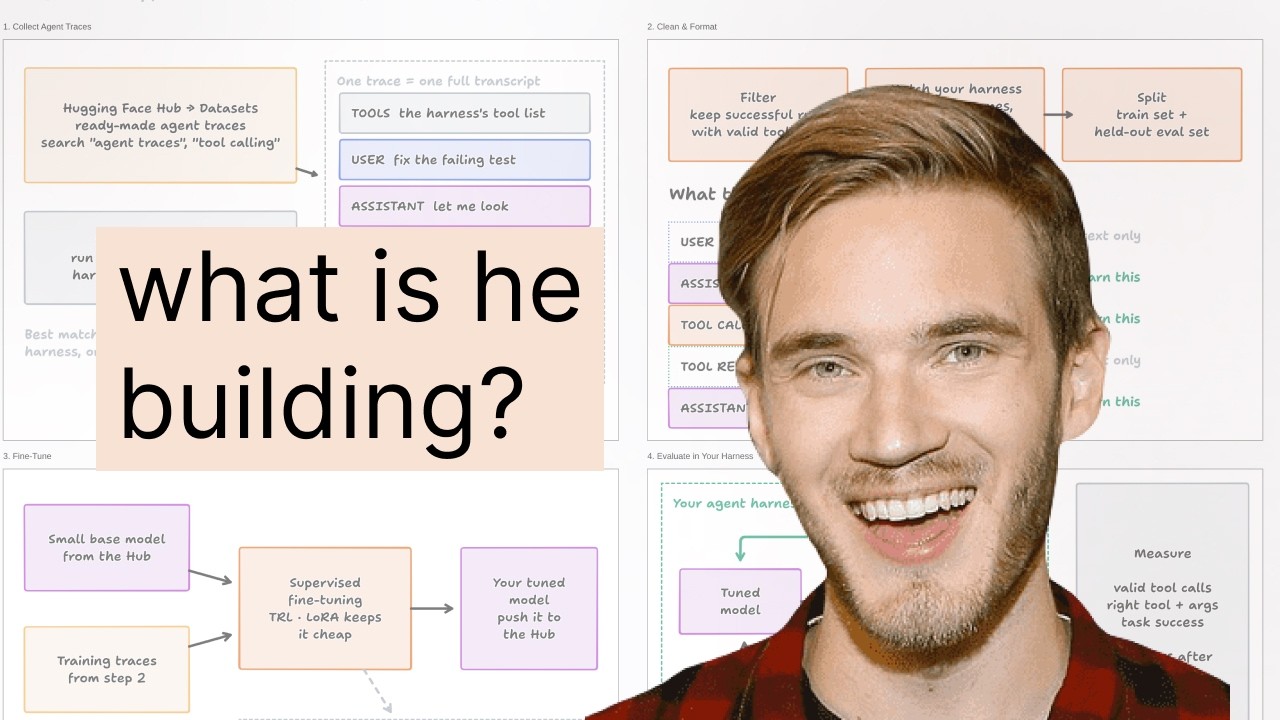
To make a smaller local model (e.g., Qwen 3.5 9B) reliably use specific tools within a custom agent harness, the model must be fine-tuned using high-quality 'agent traces'—historical conversations where the agent successfully executed tool calls. (16:51)