How Many Credentials Should Your AI Agent Have? Zero. — Jim Clark, Docker
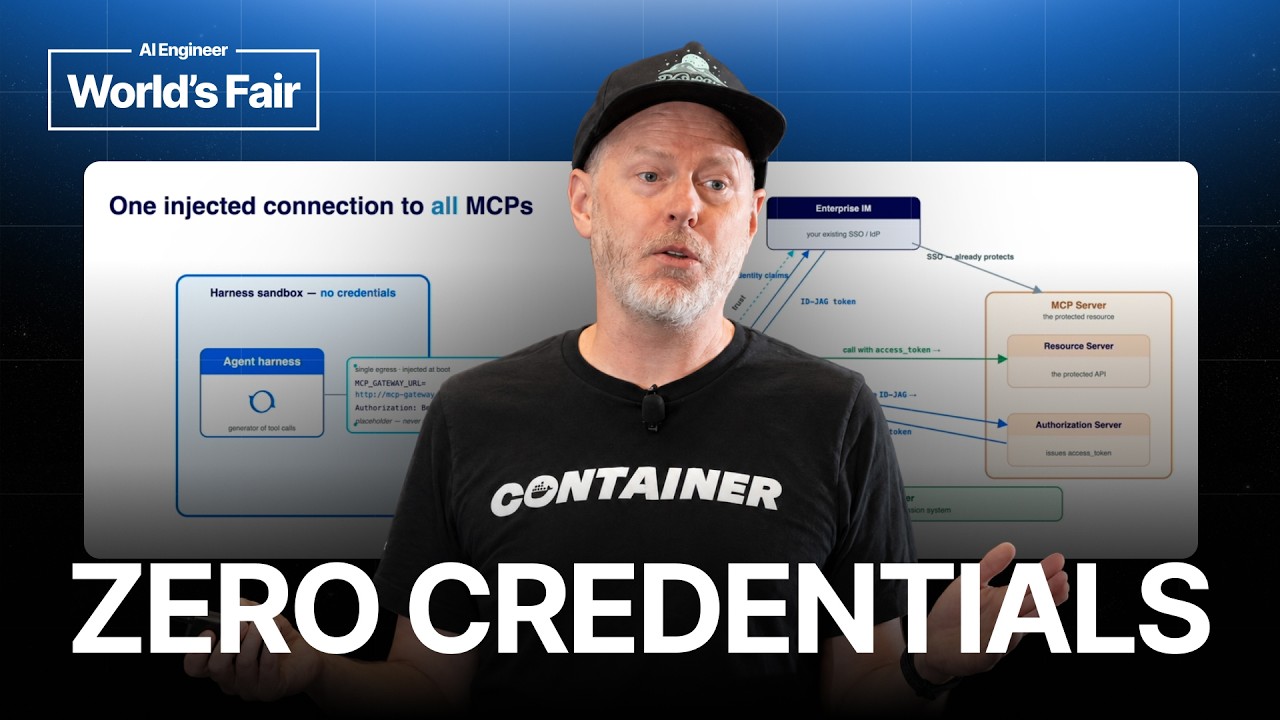
As AI agents become capable of running unsupervised and for extended periods, managing their potential impact (the 'blast radius') is critical. The solution proposed is to implement granular sandboxing, where agents operate within highly restricted environments defined by their specific task intent. This architecture utilizes MCP Gateways as single control points to manage all incoming context, tools, and resources, ensuring that agents never have unnecessary credentials. The integration of Cross App Access (XAA) further enhances safety by leveraging existing corporate SSO infrastructure for identity claims.
Key takeaways
-
Safety through Restriction, Not Supervision
AI safety is achieved by limiting the tools and context available to the agent, rather than relying solely on human supervision. The goal is to model the sandbox boundaries after the precise intent of the task.
-
The Role of Sandboxes and MCP Gateways
1:40
A sandbox is a restricted execution environment for an agent. MCP Gateways serve as a single control point, funneling all Micro-Control Point (MCP) traffic to manage which tools, resources, and prompts are accessible to the sandbox.
-
Zero Credentials Principle
2:00
The most critical security maxim is that a sandbox should contain zero credentials. This drastically reduces the potential blast radius if the agent performs an incorrect action.
-
Cross App Access (XAA) for Identity
2:03
XAA allows agents to utilize existing corporate Single Sign-On (SSO) systems (like Okta) to define agent identity claims and authorization grants, centralizing administration without requiring new consent screens.