Topic

Build Engineering Workflows

All digests tagged Build Engineering Workflows

I Deleted 5 Things From This File Before ChatGPT Saw It. It Still Found The Problem. thumbnail

· 13:40

I Deleted 5 Things From This File Before ChatGPT Saw It. It Still Found The Problem.

The video addresses the critical challenge of using powerful AI models on highly sensitive internal documents without violating data privacy. The speaker argues that traditional advice ('don't upload') is insufficient because useful work requires context. A proposed solution involves a workflow—demonstrated by the tool Airlock—that strips unnecessary Personally Identifiable Information (PII) and confidential details, then rebuilds a clean, sanitized copy of the file. This ensures the model receives only the minimum necessary context required to complete a specific task, keeping the original sensitive data local.

Key takeaways

  1. AI requires minimal, targeted context

    Instead of uploading entire files, define the job first and determine the absolute minimum information needed for the AI to perform the task. The model needs an operating plan, not PII like home addresses or API keys.

  2. Redaction is insufficient; rebuilding is necessary 6:43

    Simply blacking out sensitive data (redacting) can leave behind metadata and structural issues in file containers (like Word comments/track changes). The safer approach is to rebuild the approved material into a separate, clean document.

  3. Define protected terms for context 2:05

    Tools must allow users to define 'protected terms' (e.g., internal product codes) that are confidential but may not look like standard PII, giving the AI necessary contextual understanding.
Watch on YouTube Full article

Tmux + Fable = Cut 35% less token thumbnail

· 16:01

Tmux + Fable = Cut 35% less token

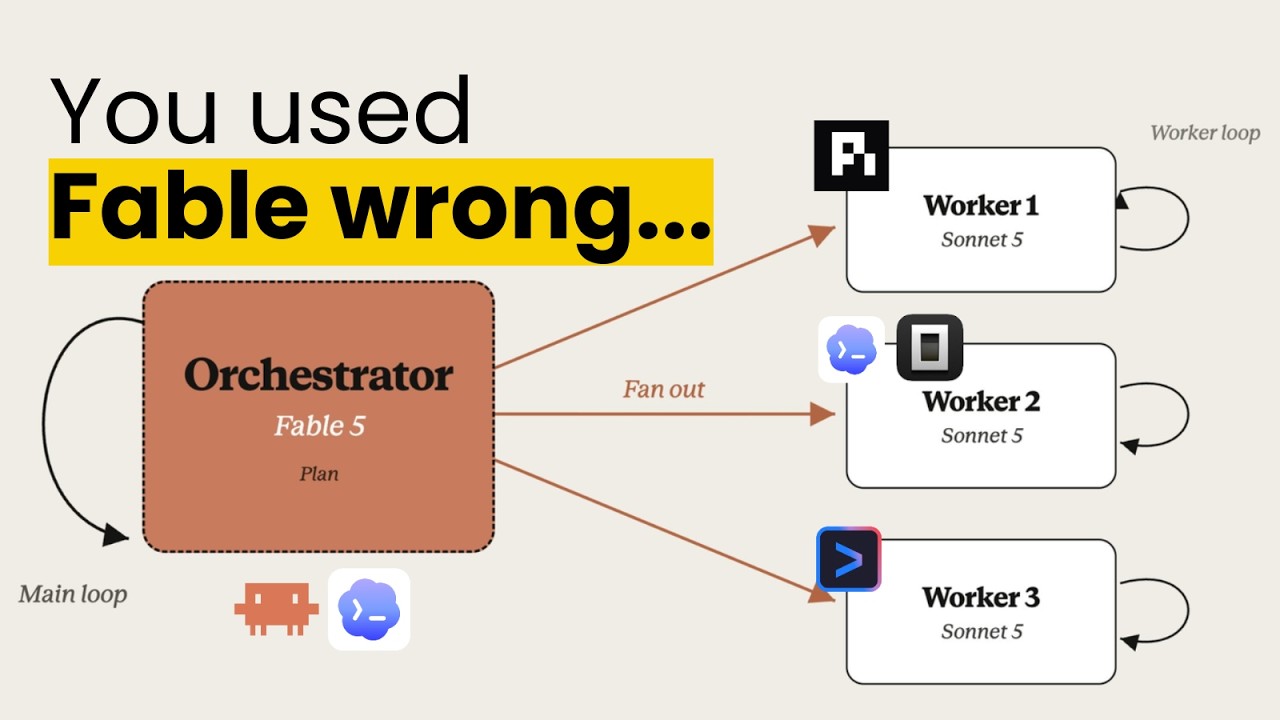
The video details advanced strategies for optimizing AI coding agent workflows, focusing primarily on reducing token consumption and maintaining context persistence. The core recommendation is shifting from using powerful but expensive frontier models (like Fable 5) as the primary executor to utilizing them only as advisors or planners, while delegating hands-on work to smaller, cost-effective models (like Sonnet 5). Techniques covered include implementing persistent 'sidekick' sessions via Cloud Code Agent Teams and leveraging terminal multiplexers like Tmux for universal agent orchestration.

Key takeaways

  1. Optimize Model Roles for Cost Efficiency 2:01

    It is recommended to use a powerful model (e.g., Fable 5) as the advisor/planner, but delegate execution to smaller models (e.g., Sonnet 5). This approach is more cost-efficient than using the expensive model as the main executor because the advisor role benefits from cached context rather than reading full conversation history.

  2. Leverage Persistent Agent Sessions (Sidekicks) 5:20

    Traditional sub-agents lose context upon completion, leading to wasted tokens when making edits. Using persistent sessions (like Cloud Code's Agent Teams) ensures the main agent can send follow-up messages that inherit all past context cheaply via cached tokens.

  3. Universal Agent Orchestration with Tmux 12:26

    Tmux, a terminal multiplexer, allows users to run and manage multiple independent coding agents (e.g., Grok, Pi Agent) in parallel sessions within a single terminal. This provides a low-level way to achieve agent team functionality across different AI tools.

  4. Advanced Orchestration Tools

    While Cloud Code offers built-in delegation rules via `cloud.md`, dedicated platforms like Orca provide an integrated, packaged experience with out-of-the-box orchestration skills and better visibility into multiple running sessions.

Watch on YouTube Full article