Topic

Agentic Workflows

All digests tagged Agentic Workflows

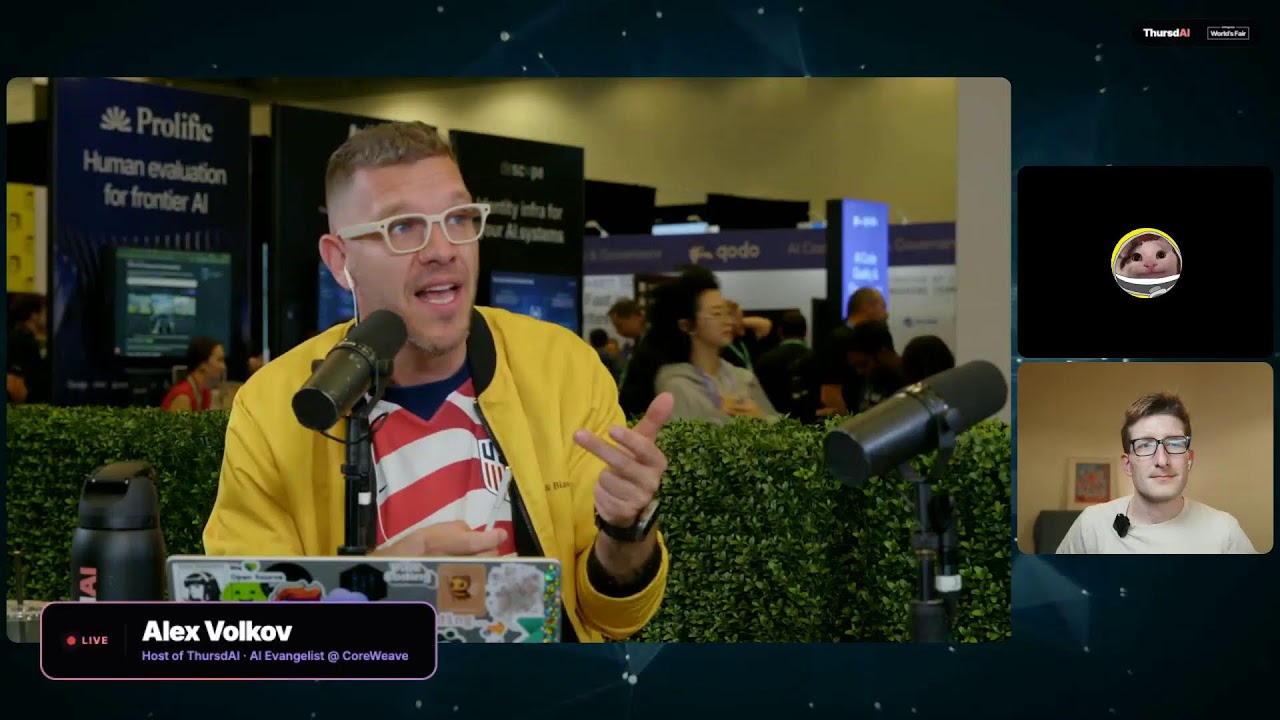
📅 ThursdAI - LIVE from AI Engineer Worlds Fair - OpenAI, DeepMind, EXO, Sakana & more friends thumbnail

· 2:53:57

📅 ThursdAI - LIVE from AI Engineer Worlds Fair - OpenAI, DeepMind, EXO, Sakana & more friends

This live panel discussion from the AI Engineer World's Fair focuses on the critical shift toward local and open-source AI models. Speakers debated the current state of frontier models (like OpenAI's GPT-5.6) versus decentralized, sovereign AI solutions running on consumer hardware. Key technical topics included model routing (Fugu), agentic workflows using tools like Weights & Biases' Coreweave Ara, and the necessity of local inference to ensure data sovereignty and prevent vendor lock-in.

Key takeaways

  1. The resurgence of Fable 22:40

    Fable is back, marking a significant moment for open models. The discussion highlighted that this trend emphasizes the need for decentralized AI solutions over reliance on single cloud providers.

  2. Local AI and Sovereignty 35:50

    Running large language models (LLMs) locally is presented as crucial for guaranteeing data sovereignty, preventing vendor lock-in, and ensuring continuous operation regardless of cloud provider restrictions.

  3. Model Routing and Orchestration 45:00

    The concept of model routers (like Fugu) was presented as a superior method for achieving high performance, allowing users to dynamically select the best model for specific tasks rather than relying on a single monolithic LLM.

  4. The Agentic Era and Tooling 1:03:20

    Tools like Weights & Biases' Coreweave Ara are emerging to automate the entire AI research loop (auto-research), moving beyond simple chatbots into full agentic co-pilots for ML engineers.

Watch on YouTube Full article

Building retrieval harness for enterprise agents thumbnail

· 1:09:03

Building retrieval harness for enterprise agents

This technical walkthrough details the architecture of an enterprise agentic retrieval harness, moving beyond traditional Retrieval Augmented Generation (RAG) systems. The core argument is that effective data access requires giving agents a comprehensive set of tools—including local file system traversal (GP), semantic search, keyword search, and multimodal analysis—rather than relying on a single indexing method. Key focus areas include managing complex document parsing, ensuring multi-tenancy via custom metadata, and optimizing vector storage for scale and cost.

Key takeaways

  1. Harness over RAG 2:00

    The most capable approach is not to select a single retrieval method (e.g., pure semantic search or pure GP access) but to build an agentic harness that allows the agent to decide how to combine multiple tools for data exploration and verification.

  2. The Role of File Primitives 4:20

    For document-driven workflows, critical primitives include: (1) Retrieval (hybrid search), (2) Directory listing/hierarchy traversal, (3) Grep for exact text matching, (4) Chunk-by-chunk analysis, and (5) Multimodal processing via localized screenshots.

  3. Enterprise Scaling Challenges 6:45

    Scaling to multi-tenant or million-file situations requires specialized indexing pipelines that manage data freshness, security, and permissioning. Using custom metadata attached during the parsing process is crucial for filtering access at the vector storage layer.

Watch on YouTube Full article