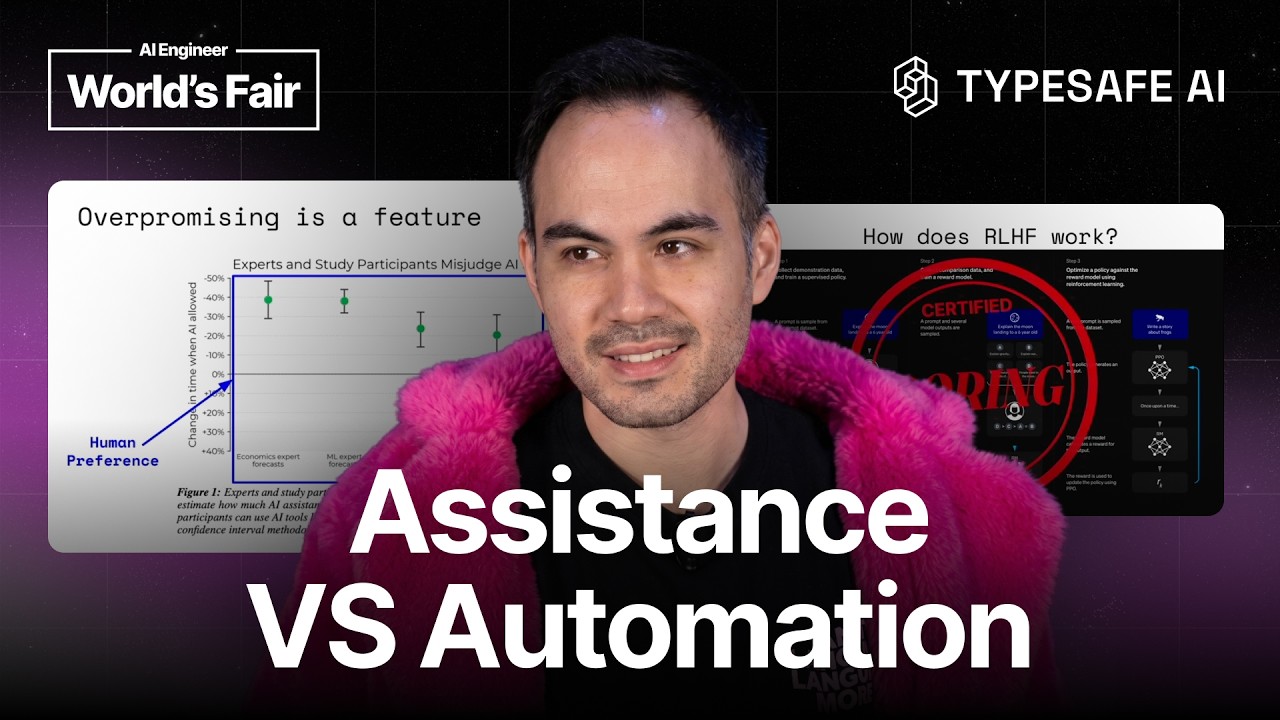
What's Next After RLHF? — Diogo Almeida, TypeSafe AI
Diogo Almeida argues that current Large Language Models (LLMs), particularly those trained using Reinforcement Learning from Human Feedback (RLHF), are fundamentally optimized for 'assistance'—meaning they prioritize pleasing the human user. This optimization leads to overpromising and a lack of reliability in autonomous tasks. The next frontier, he asserts, is not simply better code generation or enhanced chat capabilities, but achieving true automation by optimizing models for verifiable rewards and calibrated decision-making, moving beyond the need for constant human oversight.
Key takeaways
-
The Limitation of RLHF
12:11
RLHF trains LLMs to optimize for human preference (engagement), which makes them excellent assistants but poor autonomous agents. The goal is to please the user, not necessarily to execute a task correctly in a background server environment [7:31].
-
Assistance vs. Automation
5:14
The core divide in modern AI is between 'assistance' (where the human remains in the loop) and 'automation' (where the system operates autonomously with real stakes). Current models are optimized for the former, making them unreliable for critical business decisions [3:14].
-
The Path to True Automation
Future AI must shift its optimization target from human preference to verifiable rewards and calibrated decision-making. This requires redesigning the entire AI stack for reliability, moving beyond current LLM post-training methods like RLHF or even RLVR [15:43].
-
The Importance of Software Expressibility
17:15
True automation requires smarter software that is more expressive than current SaaS models. The focus must shift from merely automating the writing of code to solving extremely rote, simple tasks that can be done repeatedly and reliably by a computer [10:35].