Your Agent Is a Lethal Trifecta (And What to Do About It) — Kim Maida, Keycard
Summary
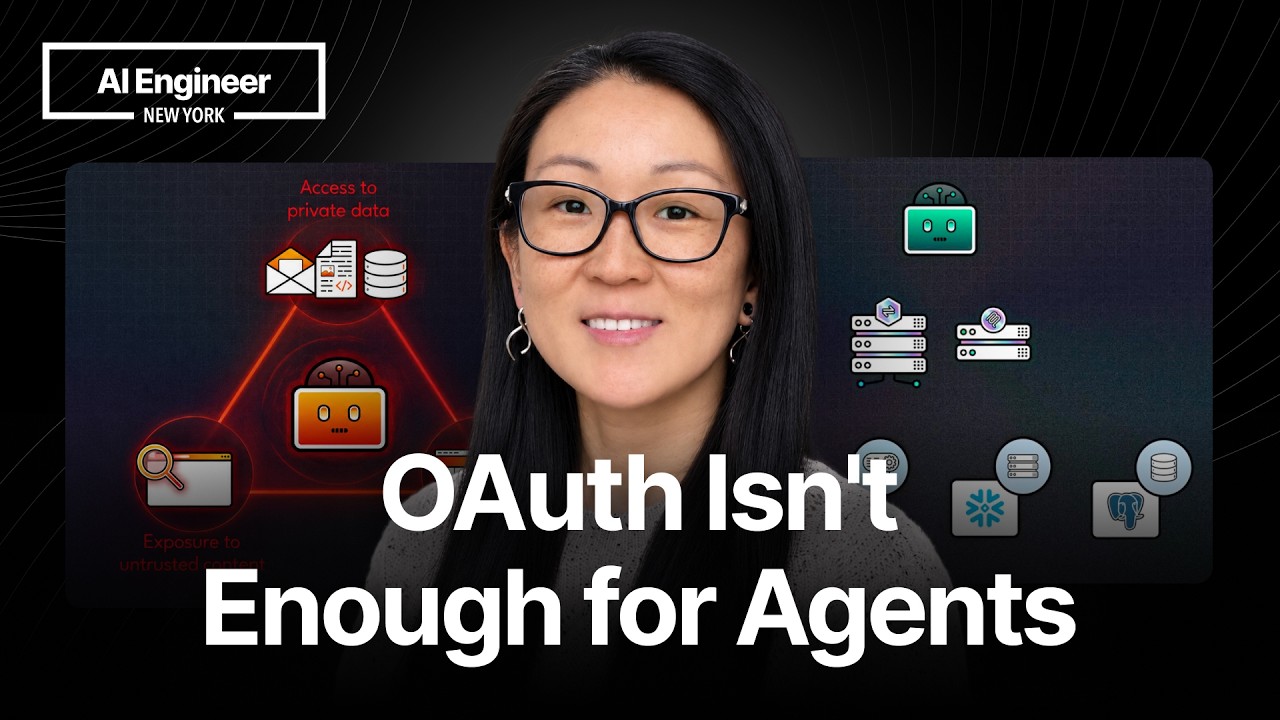
The video addresses the security risks posed by overprivileged AI agents, which combine access to private data, exposure to untrusted content, and external communication capabilities—the 'lethal trifecta.' The solution presented moves beyond traditional access control methods (like OAuth or sandboxes) by implementing delegated authorization using OAuth token exchange. This process ensures that agents receive short-lived, task-scoped credentials, making identity, policy, and access decisions visible throughout the entire request chain.
Key takeaways
-
The Lethal Trifecta
6:56
AI agents are dangerous because they combine access to private data (e.g., customer data warehouse, billing database), exposure to untrusted content (e.g., user-submitted tickets), and external communication capabilities (e.g., third-party APIs). Overprivileged agents can execute catastrophic actions (e.g., dropping a production database, scaling services) even with human supervision. (4:16, 2:32)
-
Delegated Authorization via Token Exchange
14:03
To mitigate risk, the system must use OAuth token exchange, which extends OAuth 2.0. This process ensures that the user's identity is carried through the agent execution path, allowing the Security Token Service (STS) to evaluate policy and issue credentials scoped only to the specific, requested task. (8:43, 12:18)
-
Intent-Based Authorization (IBA)
23:31
IBA is a proposed standard (not finalized) that checks the user's intent or 'mission' before the agent acts. The STS evaluates the proposed mission (goal, allowed actions, limits) against policy, ensuring the agent cannot perform actions outside the defined scope, even if the underlying API key has broad permissions. (14:11)
Technical details
-
Overprivileged Agent Risks
232s
An agent with standing API keys and admin credentials can perform unauthorized actions, such as dropping a production database or scaling services from four to 40 pods, incurring significant costs ($420/hour). (2:32)
-
OAuth Token Exchange Flow
1218s
The secure flow requires the user to log in, granting consent (scopes) to the agent. The STS then issues a subject token, which is passed to the agent's MCP server. The STS validates the request against governance policy, issuing ephemeral, task-scoped access tokens for both the MCP server and the downstream resource. (12:18, 16:05)
-
Policy Enforcement Points
1218s
Access control must be enforced at multiple points: the Authorization Server (initial scope narrowing), the STS (policy evaluation), and the MCP gateway (token validation). The STS must issue tokens that are ephemeral and cannot be stored by the MCP server. (12:18, 16:05)
Mentioned resources
- Incidex API
- Customer Data Warehouse
- Cloud Hosting API
- Snowflake Key
Channel & topics
Watch on YouTube · Back to latest
This independent, AI-assisted summary is provided for commentary and informational purposes. It may contain errors or omit important context. Please watch the original video for the creator's complete presentation. Video, thumbnail, and related copyrights belong to their respective owners.