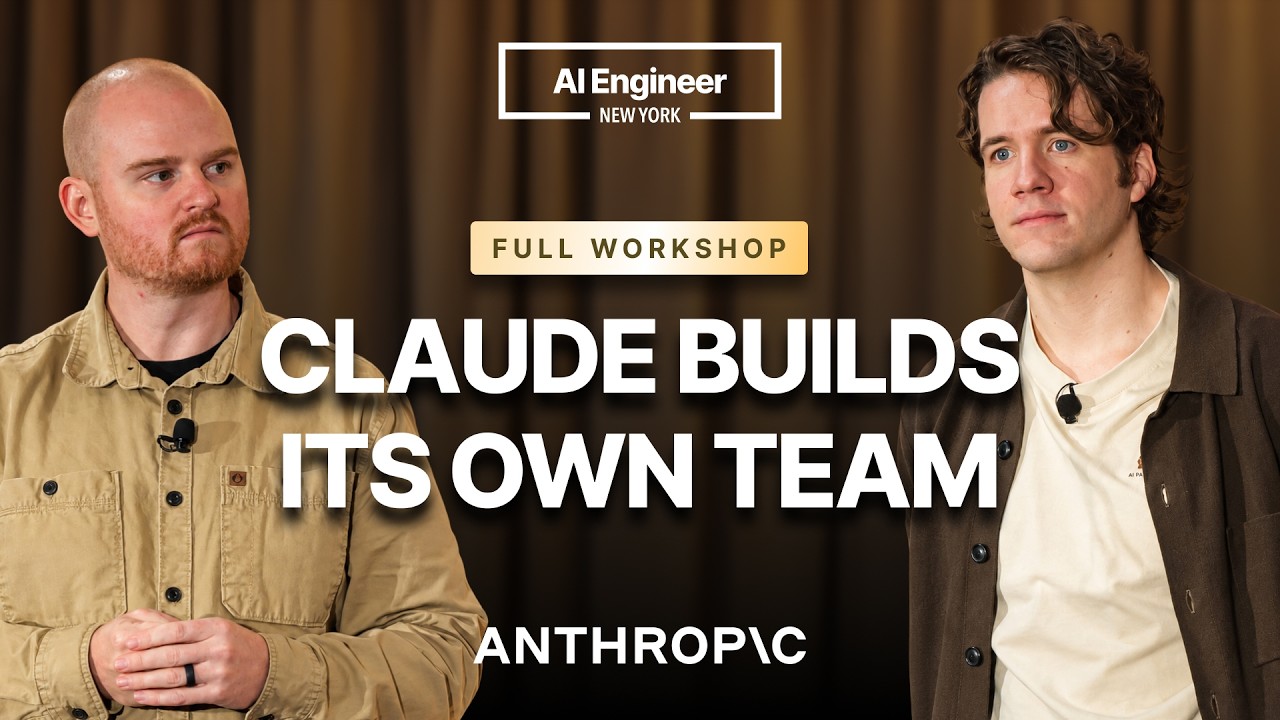
Why One AI Agent Isn’t Enough (And How to Run 1,000) - CJ Avilla & Harrison Stall, Anthropic
Summary
The session addresses the scaling limitations of single AI agents, drawing parallels to historical computing challenges (e.g., OS/360, Unix) where massive coordination was required. Anthropic introduces 'Flows' within `Claude Managed Agents` as the solution: a multi-agent orchestration engine that allows a single goal to be broken down and executed by up to 1,000 collaborating agents. This system enables complex, verifiable, and scalable AI workflows, providing crucial controls for safety, budgeting, and state management.
Key takeaways
-
Scaling Beyond Single Agents
12:15
Single agents struggle with ambitious tasks due to 'laziness, self-preference bias, and goal drift' (1:12:15). Flows solve this by enabling dynamic workflows that fan out tasks across multiple, isolated sub-agents, allowing for arbitrarily complex, nested operations.
-
The Power of Flows
11:15
Flows allow the lead agent to automatically plan and orchestrate a multi-agent topology without manual interconnection management. This is achieved via an API surface, enabling integration into external systems like CI/CD pipelines (1:07:15).
-
Advanced Safety and Control
13:45
For production use, the platform emphasizes safety through explicit controls: setting token budgets, using credential vaults to prevent plaintext secrets from touching the sandbox, enabling 'Auto Mode' for tool calls, and providing a durable event stream for real-time monitoring (1:27:50).
Technical details
-
Multi-Agent Orchestration (Flows)
675s
Flows are the next iteration of multi-agent orchestration, allowing Claude to fully orchestrate its own multi-agent topology via the API. The system uses a lead agent to generate a plan, which then automatically fans out tasks to specialized sub-agents in isolated contexts (e.g., a scan agent followed by a review agent) (1:07:15).
-
API Integration and Workflow Management
750s
The system is designed as an API surface, allowing developers to integrate workflows into external applications or CI systems (1:12:15). Key features include: 1) Running workflows on schedules (webhooks); 2) Passing in preconfigured sub-agents; and 3) Using the `Multi-agent` argument to initiate a flow (1:31:45).
-
Security and Isolation
885s
Safety is maintained by separating the 'brain' (inference/state) from the 'hands' (action/tools). Credentials are managed via dedicated vaults, ensuring secrets never touch the sandbox. Furthermore, the environment can be restricted to specific domains, and tool access can be controlled on a per-tool basis (1:21:15).
-
Optimization and Iteration
930s
Developers can optimize resource allocation by setting compute budgets for specific phases (e.g., allocating more compute to the 'review phase' vs. the 'scan phase'). The `hill climb` skill can be used to iteratively improve prompts and workflow logic (1:35:00).
Mentioned resources
- Flows
- Claude Managed Agents
- Bug Hunter
- Explainer Studio
- Claude Code
- Credential Vaults
Channel & topics
Watch on YouTube · Back to latest
This independent, AI-assisted summary is provided for commentary and informational purposes. It may contain errors or omit important context. Please watch the original video for the creator's complete presentation. Video, thumbnail, and related copyrights belong to their respective owners.