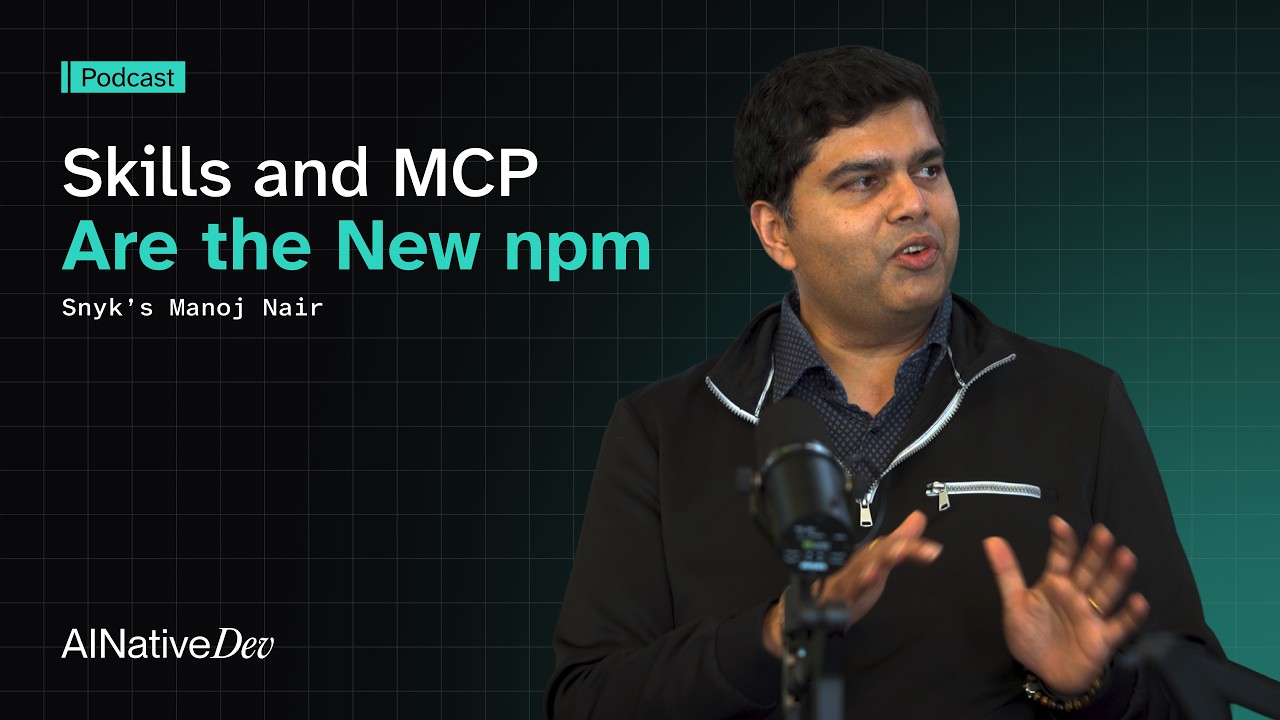
Snyk's Manoj Nair: Skills and MCP Are the New npm
Summary
The adoption of AI coding agents is rapidly transforming the software development lifecycle, moving beyond simple co-piloting to fully autonomous 'software factory' capabilities. While this acceleration promises massive productivity gains, it introduces significant security challenges. Experts emphasize that securing the process (the factory) is now as critical as securing the product itself. Key risks include insecure agent output, the supply chain vulnerability of new components (like Skills and MCP servers), and unpredictable agent behavior. Overcoming these hurdles requires implementing advanced controls such as sandboxing, granular identity management, and shifting organizational risk acceptance to enable automated remediation and merging.
Key takeaways
-
The Shift to Agentic Development
12:51
The industry is moving from 'using AI' (Co-pilot era) to 'building with agents' (agentic development), where agents perform complex tasks autonomously, potentially running without constant human oversight [00:11:18].
-
The Three Core Agentic Risks
11:18
The primary security concerns are threefold: insecure code output, the vulnerability of the new supply chain (e.g., Skills and MCP servers being the 'new npm'), and unpredictable agent behavior (e.g., an agent deleting a production database) [00:11:18].
-
Security Must Secure the Factory
17:56
Security efforts must evolve from merely securing the final product to securing the entire 'software factory'—the process, the agents, and the workflows themselves [00:27:56].
-
The Need for Organizational Risk Acceptance
23:14
Accelerating agent adoption requires a top-down cultural shift where organizations are willing to accept a calculated level of operational risk in exchange for fixing massive amounts of technical debt and improving speed [00:22:54].
Technical details
-
Agentic Supply Chain Risk
678s
The supply chain risk has expanded beyond traditional dependencies. New components like Skills and MCP servers are viewed as the 'new NPM,' requiring security context and validation for every component used by an agent [00:11:18].
-
Securing the Agent Loop
848s
Best practices for running agents include using secure sandboxes (e.g., Docker), enforcing separate agent identities, and implementing dynamic/ephemeral authorization to limit the agent's blast radius [00:27:56].
-
Automated Remediation
1556s
Specialized remediation agents can address technical debt and backlogs by using security context and global context (e.g., analyzing millions of repos) to suggest safe upgrade paths and fix vulnerabilities in a batch mode, achieving high success rates (e.g., 93% marked success rate) [00:33:00].
-
Future Agent Controls
2338s
The next frontier in security requires solving for agent *intent* and *behavior* on the fly, rather than just blocking known threats. This involves understanding the business logic and the true purpose of the agent's request to grant precise, temporary permissions [00:40:18].
Mentioned resources
- Snyk
- Skills and MCP servers
- Tessl
Channel & topics
Watch on YouTube · Back to latest
This independent, AI-assisted summary is provided for commentary and informational purposes. It may contain errors or omit important context. Please watch the original video for the creator's complete presentation. Video, thumbnail, and related copyrights belong to their respective owners.