Inside Arca's Long-Horizon Agents That Run the Business - Aman Singh, Arca
Summary
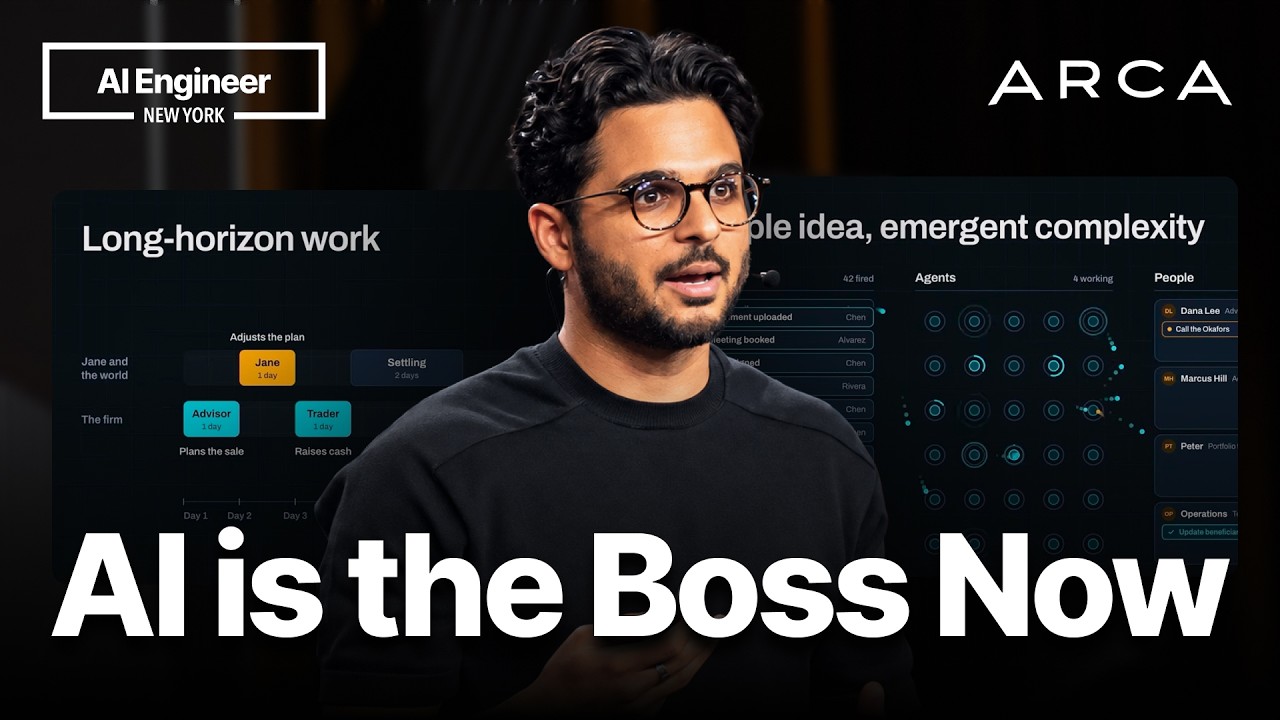
Arca, an AI-native financial services firm, utilizes 'long-horizon agents' that are designed not merely to assist, but to own and execute complex client goals end-to-end. The system manages highly stop-start, multi-day workflows (e.g., raising cash for a tax bill) by integrating five core primitives: a signal system for external awareness, operational context, a harness for tools/guardrails, persistent memory for state tracking, and shared spaces for human collaboration. This architecture shifts the workflow dynamic so that agents prompt people, allowing the firm to proactively steer the business by driving outcomes.
Key takeaways
-
AI-Native Definition
Arca defines 'AI native' as agents running the business and executing decisions that shape outcomes, rather than simply assisting through a co-pilot interface. The work in financial services is characterized as long-horizon and stop-start, spanning multiple days and involving numerous hand-offs.
-
Agent Ownership of Outcome
Agents are given the capability to own a client goal end-to-end, managing the entire lifecycle from initial signal (e.g., a tax bill notification) through execution, even when human intervention is required.
-
Proactive Business Steering
The system enables proactive business goals (e.g., preparing tax situations every January) to be integrated into the agents' goals, allowing the firm to drive outcomes before clients even prompt the service.
Technical details
-
Long-Horizon Workflow Primitives
0s
The system relies on five key components to manage complex, multi-day work: 1) A signal system (monitoring emails, calls, custodian events, market movements); 2) Operational context (guiding action based on the signal); 3) A harness (providing tools and guardrails for execution); 4) Persistent memory (maintaining state over long periods); and 5) Shared spaces (where agents build plans and pull in necessary human expertise).
-
Signal Processing and State Management
417s
The system treats all interactions—including human actions like rescheduling a calendar event or marking a task complete—as signals. These signals wake up background agents, which continuously evaluate the world state to progress work and communicate changes (e.g., updating a required cash amount from $100,000 to $80,000).
-
System Complexity and Improvement
The core engineering challenge is managing emergent complexity from hundreds of concurrent signals. Arca addresses this by standardizing work processes within the firm and collecting rich reasoning from human users, which serves as crucial data for system evaluation (evals).
Mentioned resources
Channel & topics
Watch on YouTube · Back to latest
This independent, AI-assisted summary is provided for commentary and informational purposes. It may contain errors or omit important context. Please watch the original video for the creator's complete presentation. Video, thumbnail, and related copyrights belong to their respective owners.