I Ranked Every AI Eval Concept From Worst to Best
Summary
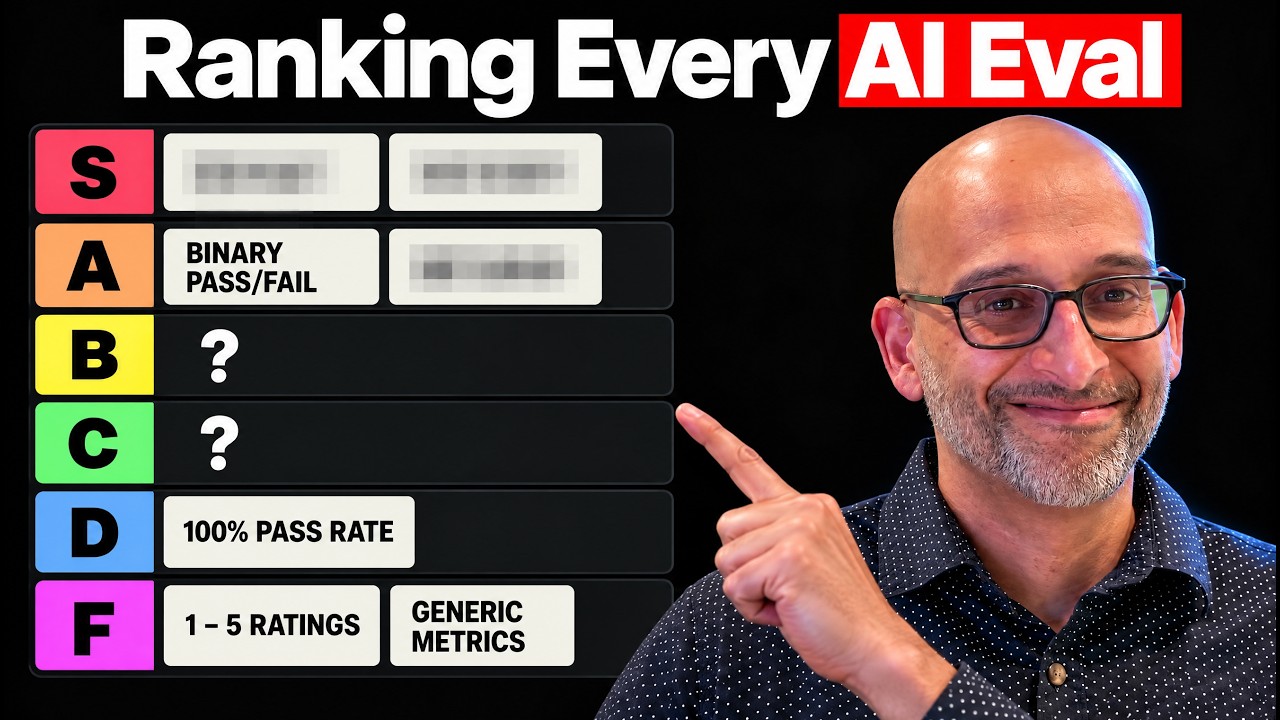
This video provides a comprehensive ranking of 28 common AI evaluation (eval) practices, grading them from S-tier (best) to F-tier (worst). The central thesis is that effective evaluation must be data-driven: teams should look at their actual product data first to determine which evals are necessary. The speaker strongly advises against using generic metrics, off-the-shelf tools, or relying on top-down brainstorming, emphasizing instead the use of custom annotation tools and domain expertise.
Key takeaways
-
Prioritize Data Analysis Over Brainstorming
The most valuable activity is looking at the data itself. Writing evals before analyzing real-world failures (a top-down approach) is inefficient. Error analysis (S-tier) is crucial for identifying what is actually broken in the application.
-
Domain Expertise is Non-Negotiable
Domain experts (e.g., a lawyer for a legal AI) must write the prompts and annotate the data, not developers. This prevents a separation of concerns and ensures the evaluation criteria are accurate.
-
Favor Code-Based and Binary Checks
11:57
Code-based checks are the cheapest and most effective form of evaluation. Furthermore, using binary pass/fail metrics is preferred over subjective art scales (like 1 to 5) because binary outcomes cut through noise and clarify decision-making.
-
Validate LLM Judges with Human Labels
To trust an LLM judge, it must be validated against human labels. This process is essential because generic or off-the-shelf prompts rarely make sense for a specific product.
Technical details
-
S-Tier Practices (Recommended)
0s
Implement error analysis (0:51) and build custom annotation tools (2:03) to remove friction when reviewing traces. Use code-based checks (7:17) as they are the cheapest form of evaluation. Finally, validate LLM judges against human labels (10:54) and ensure domain experts write the prompts (11:59).
-
F-Tier Practices (Avoid)
0s
Avoid generic metrics (e.g., helpfulness score) (0:27), off-the-shelf LLM judges (3:25), or using public benchmarks (5:24) as substitutes for product-specific evals. These are often generic and fail to correlate with product-specific failures.
-
Annotation and Prompting
0s
The speaker advises appointing a 'benevolent dictator' (8:24) for data annotation to minimize cost and complexity. When designing the application, focus on 'Designing for verification' (8:24) by showing intermediate outputs, not just the final answer.
Mentioned resources
Channel & topics
Watch on YouTube · Back to latest
This independent, AI-assisted summary is provided for commentary and informational purposes. It may contain errors or omit important context. Please watch the original video for the creator's complete presentation. Video, thumbnail, and related copyrights belong to their respective owners.