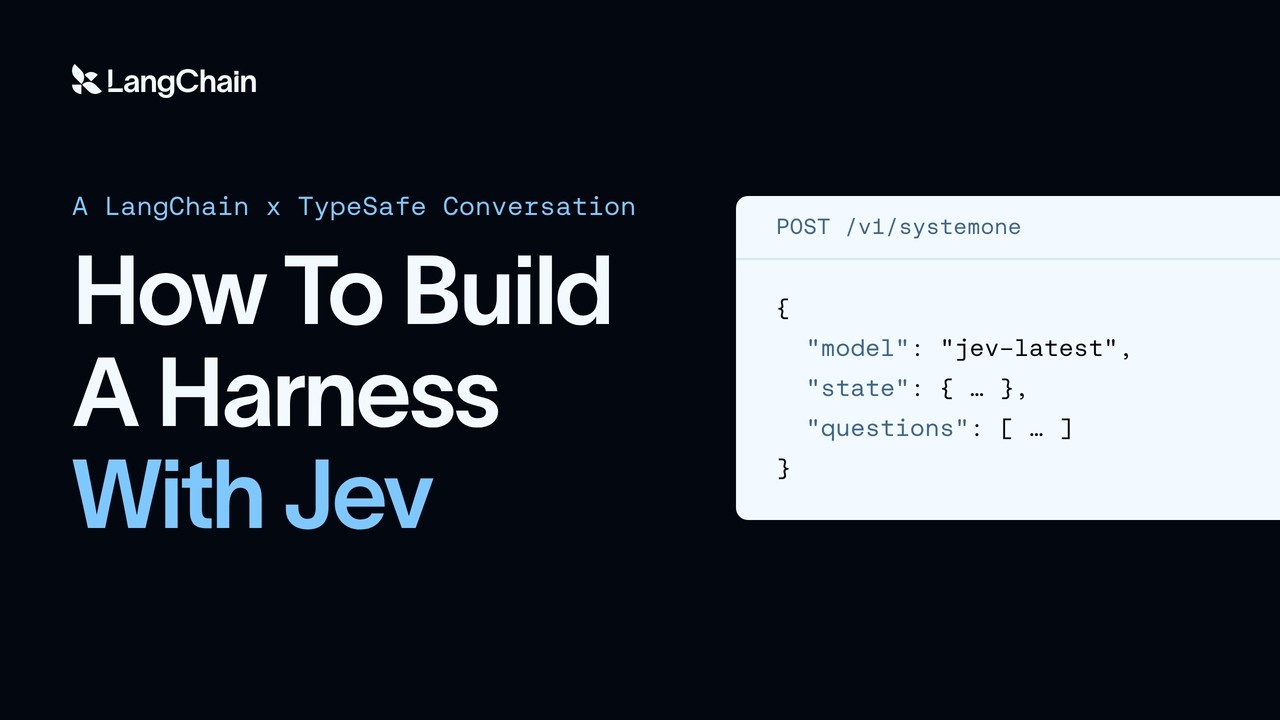
How To Build A Harness With Jev | A LangChain x TypeSafe Conversation
Summary
This conversation introduces Jev, a novel System 1 model from TypeSafe AI, designed for fast, low-latency, and cost-effective decision-making. Unlike traditional LLMs, Jev does not generate text; instead, it makes structured decisions based on well-scoped questions and type-safe schemas. For build engineers, the primary focus is integrating Jev into agent harnesses (using frameworks like LangChain) to enhance reliability, manage risk (e.g., safety classification), and optimize resource usage (e.g., model routing) within the agent development lifecycle.
Key takeaways
-
Jev is a System 1 Model, not a Generative LLM
5:23
Jev is fundamentally different from LLMs; it does not generate text or images. It is designed to make fast, intuitive decisions from specific, well-scoped questions using type-safe schemas. This aligns with System 1 thinking (quick determinations), contrasting with System 2 thinking (multi-step reasoning, often associated with LLMs and code).
-
Three Core Question Types for Structured Decisions
20:13
Jev supports three decision types: **Choice** (selecting one option from a list, analogous to a classifier); **Score** (rating a state on a single, semantically defined axis, e.g., 0 to 2 for frustration); and **Noul** (a simple True/False or binary check). Questions must be broken down to the point they cannot be broken down further.
-
Integrating Jev into Agent Middleware
32:37
Jev can be integrated into agent harnesses as middleware to solve critical problems: **Safety Classification** (e.g., determining if a tool call is destructive and requires explicit intent) and **Model Routing** (selecting the optimal model—fast vs. in-depth—for a given task). This is significantly cheaper and faster than using heavy LLMs for every decision point.
-
Context Engineering and Observability Best Practices
When using Jev, it is crucial to minimize the state input to only what is strictly necessary for the determination. Furthermore, building auditability into the system and utilizing platforms like LangSmith for observability and evaluation (Evals) is highly recommended.
Technical details
-
System 1 vs. System 2 Thinking
520s
System 1 thinking (Jev) is fast, intuitive, and based on quick determinations. System 2 thinking (LLMs/Code) involves multi-step reasoning, connecting dots, and composing outputs.
-
Jev Input and Output
1213s
Jev takes a 'state' as input and an array of questions. It outputs a structured decision (e.g., a choice, a score, or a boolean) rather than generating prose.
-
Model Jaggedness and Context Limits
The model's performance can degrade with large state inputs. The guideline is to provide only the information strictly necessary for the determination. The context length is 32K tokens for the state plus the largest question, with a 64K cap for the state plus all questions.
Mentioned resources
Channel & topics
Watch on YouTube · Back to latest
This independent, AI-assisted summary is provided for commentary and informational purposes. It may contain errors or omit important context. Please watch the original video for the creator's complete presentation. Video, thumbnail, and related copyrights belong to their respective owners.