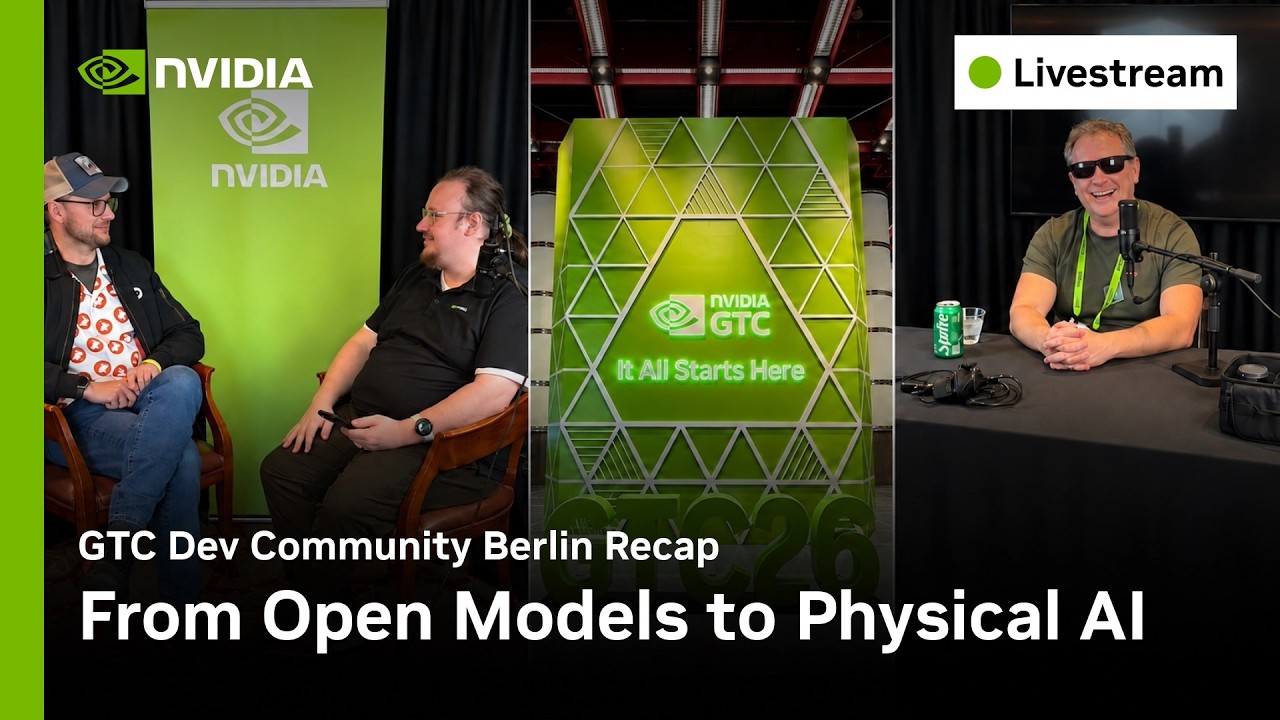
GTC Dev Community Berlin Recap: From Open Models to Physical AI
Summary
This recap of GTC Berlin explores the convergence of open models, generative AI, and physical AI, detailing how developers can move from desktop experimentation to industrial-scale robotic and factory automation. Key focus areas include the development of multi-modal models (e.g., Flux 3) for video and robotics, the implementation of agentic platforms (11 Agents) for complex workflows, and the use of Digital Twins (NVIDIA Omniverse) to simulate and optimize industrial processes, significantly reducing time and engineering effort in manufacturing.
Key takeaways
-
Physical AI and Robotics are the Next Frontier
10:00
The industry is moving beyond safe, secure AI from the base layer to direct application in robotics. Companies are demonstrating free-form robotic arms and using models to enable robots to become the 'brain' of the system, making physical AI a core focus.
-
Industrial AI via Digital Twins
2:55:00
Digital twins, powered by NVIDIA Omniverse and Cosmos, allow manufacturers to simulate complex processes (like PCB inspection or supply chain changes) in a virtual environment before physical implementation. This approach can reduce engineering effort by 85% and NPI time by 40%.
-
Agentic AI and Voice Modalities
13:00
The development of agentic orchestration platforms (e.g., 11 Agents) is accelerating, with a strong emphasis on voice AI. These platforms integrate speech-to-text, text-to-speech, and turn-taking models to create highly natural, conversational, and functional agents.
-
Open Weights and Local Compute
5:00
The trend favors open models and local AI deployment. Technologies like RTX Spark and open-weight models (e.g., 7B parameter models) allow powerful AI to run on local hardware, increasing accessibility and reducing reliance on centralized cloud infrastructure.
Technical details
-
Generative Video/Multi-Modality
8500s
Black Forest Labs released Flux 3, a model trained jointly on image, video, audio, and robotics modalities. It enables near real-time video generation and editing, allowing for complex physical simulations (e.g., generating videos of a person eating spaghetti in 12 seconds, down from minutes).
-
Digital Twin Simulation
10500s
The use of NVIDIA Omniverse and Cosmos allows for the creation of digital representations of physical factories. This enables simulating complex processes, such as validating product variations or predicting supply chain impacts, without physical prototypes.
-
Agentic Orchestration
780s
Agent platforms (like 11 Agents) operate in three layers: the voice engine (STT/TTS/Turn-taking), agent orchestration (system prompt, knowledge base, model), and integrations (connecting to external APIs/CRMs).
-
Local/Edge Compute
300s
The availability of specialized hardware like RTX Spark and the focus on open-weight models (e.g., 7B parameters) makes powerful AI accessible for local deployment, even on consumer-grade laptops.
Mentioned resources
- RTX Spark
- Flux 3
- NVIDIA Omniverse
- 11 Agents
- Hugging Face
Channel & topics
Watch on YouTube · Back to latest
This independent, AI-assisted summary is provided for commentary and informational purposes. It may contain errors or omit important context. Please watch the original video for the creator's complete presentation. Video, thumbnail, and related copyrights belong to their respective owners.