Exploits Now Beat Patches: Open Source Security in the AI Era - Patrick Smyth, Chainguard
Summary
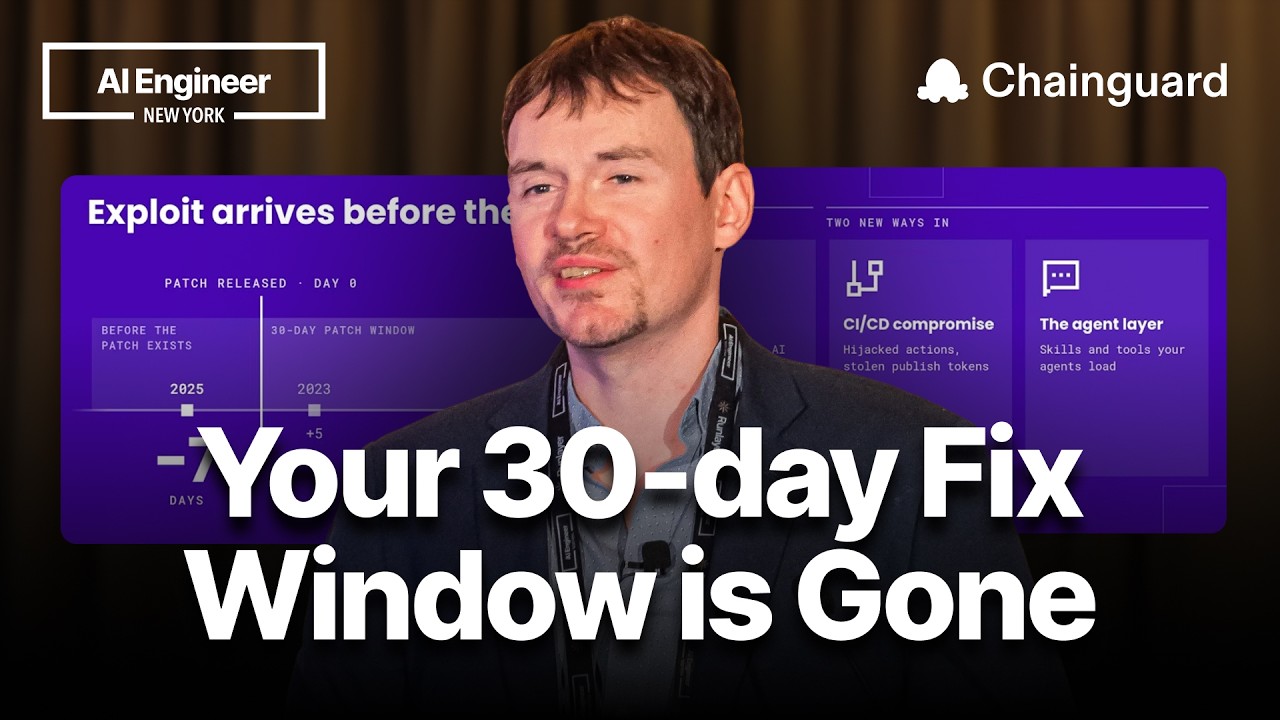
The modern software supply chain faces unprecedented risk due to AI-assisted attacks and sophisticated supply chain malware. The speaker argues that the threat landscape has shifted such that exploits now, on average, land before patches are available. Build engineers must move beyond traditional 30-day remediation windows and adopt a multi-layered defense strategy focusing on artifact signing (SLSA/Sigstore), hardening build environments (CI/CD, developer laptops), and utilizing minimal, source-built base images to mitigate both known CVEs and emerging zero-day vulnerabilities.
Key takeaways
-
Exploits Beat Patches
3:53
Data suggests that, on average, the exploit for a vulnerability hits before the patch is released, rendering traditional remediation timelines ineffective. (2:33)
-
The Attack Surface Has Expanded
18:39
Attackers are no longer limited to production code; they are targeting 'side doors' like CI/CD pipelines, developer workstations, and emerging agentic layers. (11:19)
-
The Need for Provenance and Signing
To establish zero-trust pipelines, it is critical to sign every artifact created and consumed using standards like SLSA and Sigstore. (17:01)
-
The Eternal September of Security
20:20
The security environment is constantly shifting from a high-trust to a low-trust state, requiring continuous vigilance and adopting 'minimal' approaches to reduce the attack surface. (12:20)
Technical details
-
Supply Chain Malware
299s
Recent attacks include Shai Hulud (a worm originating in the JavaScript ecosystem), Trivy, and Axios, demonstrating how attackers chain together dependencies to compromise multiple targets. (4:59)
-
Vulnerability Remediation
1119s
While scanning tools (e.g., Grype, Trivy) identify known CVEs, the focus must shift to mitigating zero-days and unknown vulnerabilities, which are increasingly leveraged by frontier AI models. (11:19)
-
Hardening Build Environments
Solutions include using minimal, source-built distributions (like Wolfi) and implementing hardened CI/CD actions (Chainguard Actions) to secure the build process itself. (13:56)
-
Artifact Signing and Provenance
SLSA and Sigstore are recommended for cryptographically signing artifacts and attaching provenance, ensuring integrity throughout the development lifecycle. (17:01)
Mentioned resources
- Chainguard
- Sigstore
- SLSA
- Wolfi
Channel & topics
Watch on YouTube · Back to latest
This independent, AI-assisted summary is provided for commentary and informational purposes. It may contain errors or omit important context. Please watch the original video for the creator's complete presentation. Video, thumbnail, and related copyrights belong to their respective owners.