Agents Built an OS Kernel That Runs Doom — Kevin Hou, Google DeepMind
Summary
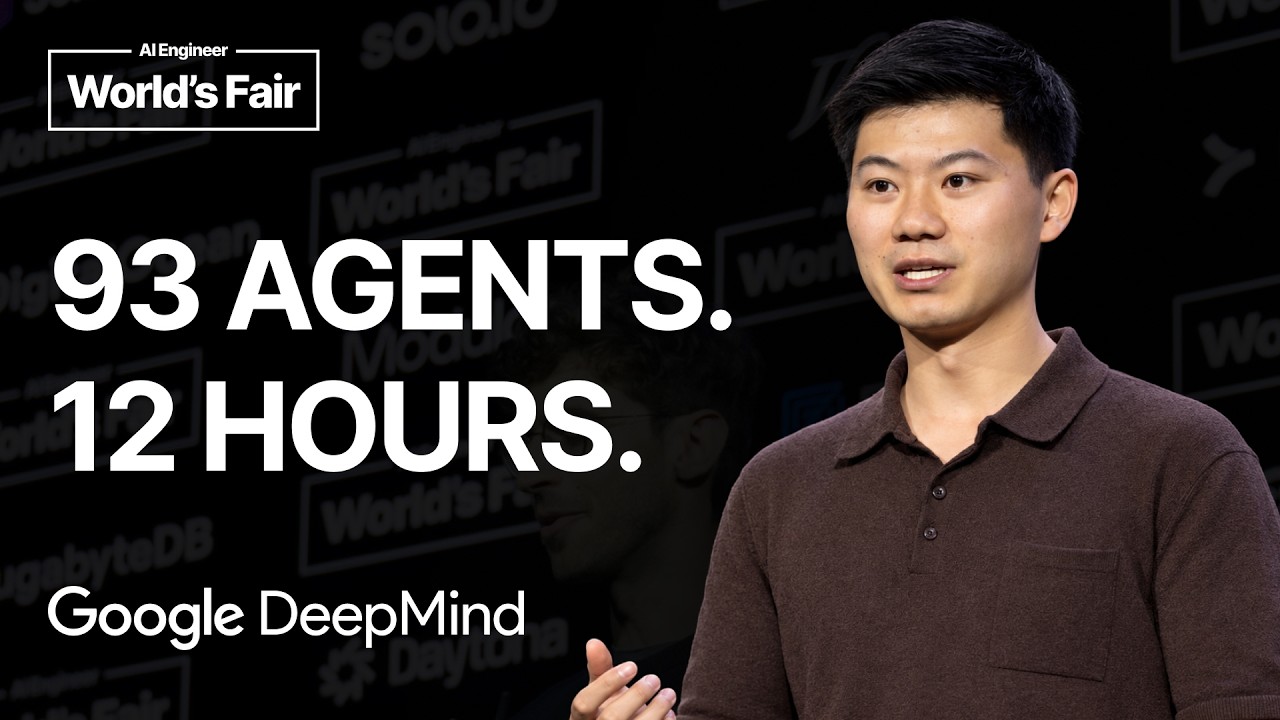
Kevin Hou details the evolution of agentic coding tools, introducing Antigravity 2.0, Google's agent coding product. The core principle is 'scaling with intelligence,' meaning product primitives must evolve as LLMs improve. The future (2026 era) is defined by 'agent teams' or 'swarms,' which are powered by three new primitives: dynamic subagents, sidecars, and generative UI. These tools allow for complex, parallelized tasks, demonstrated by building an entire OS kernel that runs Doom using 93 subagents in 12 hours.
Key takeaways
-
The Agentic Evolution
5:20
Coding tools have progressed from deterministic autocomplete (2022) to agent-based systems (2024) and parallel agent managers (2025). The next phase (2026) is focused on agent teams/swarms, which decouple the IDE from the agent manager for greater flexibility.
-
The Three Core Primitives
10:25
The future of agent teams relies on: 1) Dynamic Subagents (specialized, parallel roles); 2) Sidecars (a new plugin protocol for listening to external triggers like webhooks or cron jobs); and 3) Generative UI (rendering interactive UIs on the fly, bypassing fixed templates).
-
Demonstrated Capability
18:10
Antigravity successfully built a complete OS kernel from scratch and ran Doom. This feat required 93 subagents over 12 hours, utilized 2 billion tokens, and cost under $1,000.
Technical details
-
Antigravity 2.0 Architecture
180s
The product was updated by decoupling the IDE from the agent manager, allowing the agent manager to function as a standalone 'mission control' application.
-
Dynamic Subagents
795s
Subagents are dynamically generated and configured by a main orchestrating agent. They can operate in parallel, take on specialized roles (e.g., front-end, QA), and even select different models from the main agent's model.
-
Sidecars Protocol
Sidecars are a new plugin primitive enabling the model to listen to the outside world. This allows agents to set up triggers based on external events such as SMS messages, webhooks, or GitHub PRs.
-
Generative UI
This primitive allows the system to render interactive UIs (e.g., Kanban boards, graphs, data filters) on the fly, rather than relying on fixed HTML or templates, improving user interaction and data visualization.
-
Model Capabilities
840s
The system leverages Gemini 3.5 Flash, which is noted for being fast, cheaper, and highly capable of leading and managing teams of agents.
Mentioned resources
- Google Antigravity
- Gemini 3.5 Flash
Channel & topics
Watch on YouTube · Back to latest
This independent, AI-assisted summary is provided for commentary and informational purposes. It may contain errors or omit important context. Please watch the original video for the creator's complete presentation. Video, thumbnail, and related copyrights belong to their respective owners.