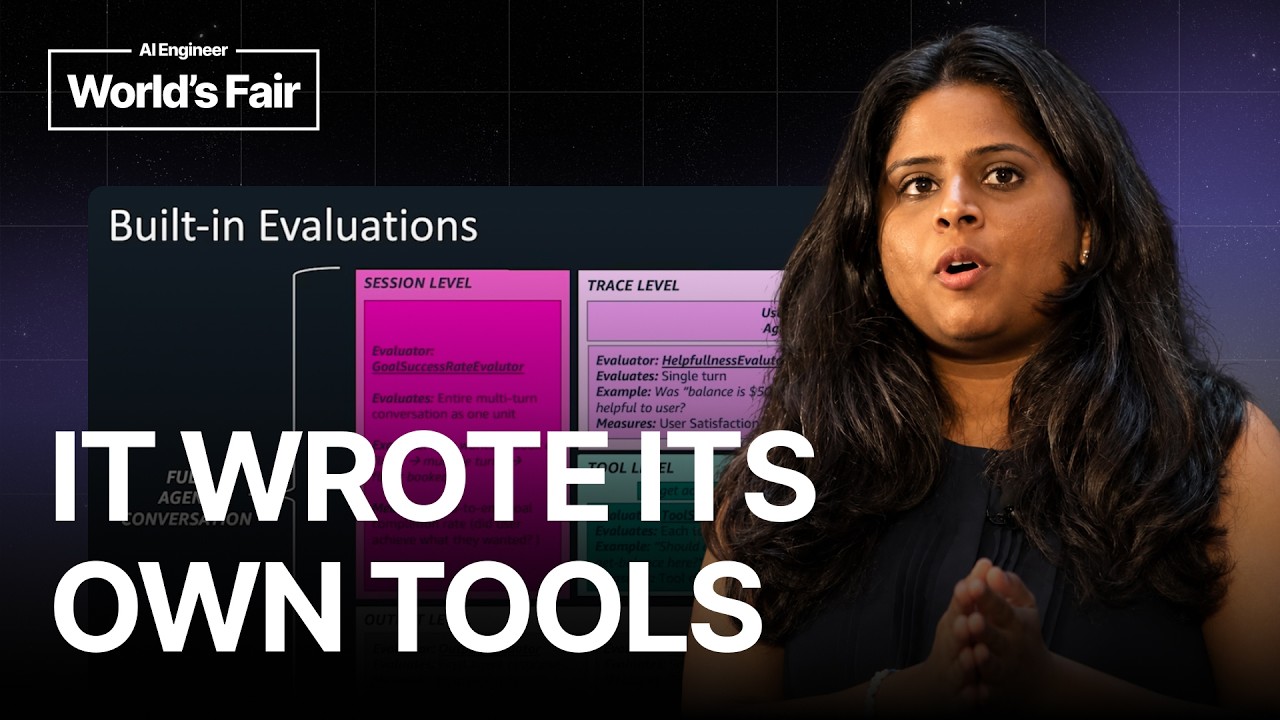
Agents That Write Their Own Tools at Runtime — Sandhya Subramani, AWS
This talk introduces meta-tooling, a capability where AI agents can write, load, and use their own tools and even create sub-agents at runtime, without needing to be explicitly programmed for every function. Using the open-source Strands Agents SDK, the speaker demonstrates how an agent can dynamically create tools (like a math calculator or character counter) and handle complex tasks, such as planning a multi-stage itinerary. For production use, the talk emphasizes the necessity of robust guardrails, including sandboxed execution, constrained permissions, and comprehensive evaluation (evals) to ensure reliability and prevent undue damage.
Key takeaways
-
Meta-Tooling Core Components
10:44
Implementing meta-tooling requires three core tools: `editor`, `shell`, and `load_tool`, guided by a system prompt that defines what constitutes a 'good tool.'
-
Self-Modifying Agents
19:13
Agents can write tools and even create sub-agents (e.g., a travel planner creating 'flight agent,' 'activities agent,' and 'itinerary agent') to solve complex problems.
-
Agentic Patterns
18:23
Advanced multi-agent systems can utilize patterns like Swarm (parallel sub-agents), Graph, Handoff, and Workflow to coordinate tasks.
-
Production Guardrails
To trust self-modifying agents, implement guardrails including sandboxed execution, constrained permissions, and thorough evaluation (evals) across goal success, tool choice, and inter-agent flow.