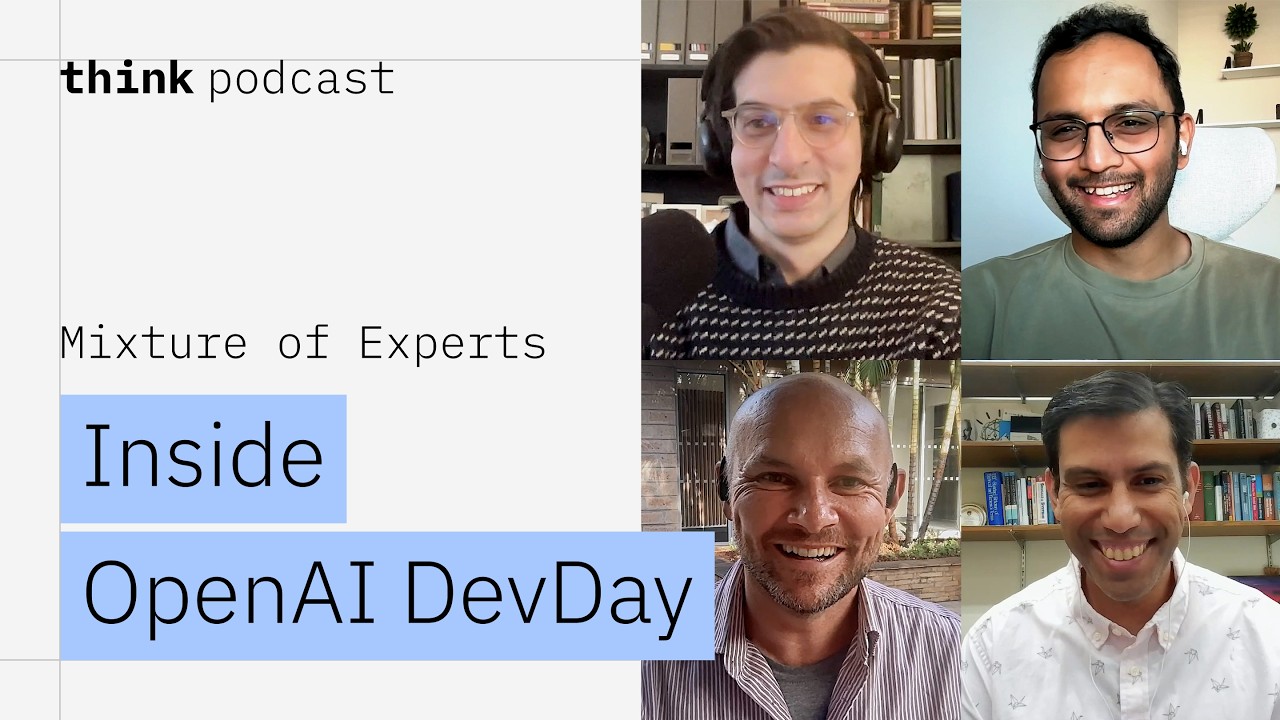
OpenAI's always-on agents, 700+ math manuscripts & HackerRank's AI interviewer
This episode explores the rapid advancements in AI across several domains, including persistent AI agents, generative mathematics, and automated job interviewing. Key discussions covered OpenAI's 'Dots' agent, which aims to automate complex, multi-step tasks; the release of 722 AI-generated math manuscripts, raising questions about the future of mathematical discovery; and HackerRank's Chakra, an AI-powered coding interviewer. Technically, the segment concluded with an explainer on Mixture of Experts (MoE) models and the critical distinction between 'open weights' and 'open source' AI models.
Key takeaways
-
Persistent AI Agents (Dots)
2:28
OpenAI introduced 'Dots,' an agent designed to be 'always-on' and capable of managing tasks persistently. The core technical challenge remains determining how much work can be delegated and forgotten about without requiring constant human permission or clarification (00:58).
-
AI in Mathematics
9:08
OpenAI released 722 AI-generated math manuscripts covering 372 families of results (9:08). This prompts a debate on whether AI is merely solving historical problems or if it can generate entirely new mathematical questions, which is considered a major frontier (9:08).
-
AI Interviewing and Bias
17:43
HackerRank's Chakra uses AI to run coding interviews, assessing candidates' skills. While this expands opportunities by allowing high volume screening, concerns remain regarding potential bias and the ability to evaluate a candidate's performance when they are allowed to use AI during the test (16:03).
-
Mixture of Experts (MoE) Architecture
22:13
MoE models, exemplified by Reflection AI's Beam, improve efficiency by carving the model into specialized 'expert' regions. During inference, only the necessary experts are activated, significantly speeding up processing compared to activating every parameter in the model (24:18).